Friday, November 4, 2011

Ten Statements About....A STIR OF ECHOES (1999)

Usually, I'd be happy to have Ileana Douglas put me under
her spell.  In this film however....uh, no.
"Does it hurt to be dead?"

1) This starts with one of the most compelling openings I've ever seen. The whole situation with Zachery David Cope's Jake talking directly to the camera about his day...and our slow realization that he's talking to what we'll learn is Samantha...works on two levels. First off, it makes us part of that 'little club' that Kathryn Erbe's Maggie refers to later in the film that Jake and Kevin Bacon's Tom forms as the film progresses. Secondly, it puts us in Samantha's shoes, preparing us for the first person POV when we start piecing together her very awful fate.

2) Koepp recognizes something very important when it comes to putting together a good film--namely, that care has to be taken to make all levels of production consistent, including casting. The great thing about Erbe, Bacon, and many of the other actors in this film is that none of them are movie star handsome, not even Bacon whose face has gained a blue collar character with age. These are people who look like they could have lived in the 'six square blocks' that Tom supposedly grew up on. Even Erbe and her screen sister Ileana Douglas may both be hot, but they're 'around the neighborhood' hot, not 'red carpet' hot.

3) One of the great signs of a great script is how seeds get planted to the film's climax very early on, yet we don't notice them until we look back on the movie. Koepp's script is so tight clues are planted as to what happened, the motivation for it, and the character arc Tom is about to go through within the first five minutes, long before the weird shit starts getting set in motion.

4) I've mentioned that Ileana Douglas is hot, right? What's interesting to me is how Koepp is able to invest her with elements of the comic relief without her character being made to look foolish. And Douglas is such an excellent actress that she's able to sell scenes such as her dividing up the potential single men at a party or struggling with a marijuana high while trying to put Tom back under hypnosis to reverse what happened to him without it ever coming off as broad.

5) That being said, the most fascinating and complex character is Frank, played by Kevin Dunn. Throughout the first act, it is Frank who plants many of the seeds that will point to Samantha's fate...and yet, he turns out to be far from the villain we assume he's going to be, and his motivations become understandable, if not sympathetic. It's a surprisingly good performance from someone who is, at his core, a comedian.

Ever wonder what Chase woke up to every morning that
season or two of HOUSE, Kevin?  You're about to find out...
6) Another great element of the film? While Samantha may get a little grumpy, as when she tries to spur Jake into moving forward by showing him horror films against his will (honest!), she's never out and out murderous. The worst thing she does is manipulate things so that Maggie badly bumps her head. And speaking of Samantha....

7) Can you believe she was played by Jennifer Morrison?

Yes, that Jennifer Morrison. And she's very good playing a ghost, mainly because her mope-face comes off as understandable when you're playing a dead spirit as opposed to a gifted medical doctor or the bounty hunting daughter of Snow White....

8) I love the fact that this film is, at its core, a murder mystery...yet Koepp doesn't let us know it's a murder mystery until we're already very, very commited to following Tom's character arc to its conclusion.

9) I bet there are some people who would find the inclusion of Eddie Bo Smith's Neil The Cop, given his role is tiny to the point of almost non-existent. And yet...Koepp needed to include that information in the film so we could understand what Tom is going through, but Douglas' Lisa doesn't have the spiritual toolbox to convey that to him. Thus his presence is necessary, even if it meant reducing Smith to Exposition Man.

"Waaaait a minute...is that the revival of my career..?"
But then, I also like how Smith represents a third aspect of the 'wider world' that Tom is accused of being afraid of, and what eventually prompts him to step into it.

10) Even though this was shot on location, I appreciate the fact that Koepp sticks to the idea that Tom has lived a very sheltered life that is confined to this one neighborhood...and the very few times the film ventures out of that neighborhood, Chicago looks alien and more than a bit scary. The setting is vital to the film, but Koepp refuses to force the Chicago-ness down our throat because it's not about a city but a couple of blocks within it.

Overall...forget M. Night Shamalyan and his shoutier, showier entry that came out the same year--this is the definitive ghost story for the turn of the millennium, a film that is grounded in reality and character, not style and atmosphere. Hell, I don't even fast forward through the end credits just so I can savor the highly appropriate song that plays under them, Poe's 'Hello.'

If you ignore this movie any more, I will find you. And you're not going to like it.

Tuesday, November 1, 2011

Ten Statements About....VERONICA MARS SEASON TWO, EPISODE ONE 'Normal Is The Watchword' (2005)...Plus some words on how we got here...

The biggest surprise about Veronica's lovelife is that it doesn't
include Duncan or Logan...no, wait....
"This is Neptune. Nothing happens accidentally."
To the surprise of everybody--including series creator Rob Thomas--Veronica Mars was renewed. At the time, it was the lowest-rated drama series to ever be picked up for a second season, and the only new show on UPN's 2004 schedule to be on its 2005 schedule. Part of the reasoning was because the show had garnered some celebrity fans. In an article in Entertainment Weekly, Stephen King of all people praised the show as being 'Nancy Drew meets Philip Marlowe.' Kevin Smith posted on his blog called it the best show on television, and Joss Whedon actually expressed envy over how well-crafted the season finale was. This resulted in both Smith and Whedon taking small parts in Season Two.

But I have to think somebody at Viacom, which owned both UPN and CBS, took a shine to the show. During the summer, key episodes of the first season were presented on CBS during prime-time on Friday. And a new advertising push spurred on by these celebrity endorsements preceded the show's return in late September of 2005. It's obvious that there was a desire for this show to succeed.

Which leads us to....

1) Well, it's the second year and even though Thomas and company decide to try to fool us into thinking we're back in the 'done-in-one-mini-mysteries' structure at first, it doesn't mean that things haven't been shifted around. And it's clever how Thomas is able to hold off some of the major revelations--especially the ones about the way the Veronica-Duncan-Logan-Meg rectangle has shifted--until late in the episode.

2) Now knowing he has another full season, Thomas chooses to make a few changes--primarily ratcheting up the '09er/PCHer tension through one of the loose ends in last season's finale. It allows for him to comment on then-current concerns, like the introduction of metal detectors in inner-city schools, without venturing out of Neptune proper.

3) We also get a couple of new additions to the cast. Along with Ryan Hansen and Kyle Gallner's Casablancas brothers being fully promoted to regulars (and we'll see the genius of that as we go along) and the addition of Charisma Carpenter, fresh from Angel, as Kendall Casablancas, Dick and Cassidy' stepmom, we get Steve Guttenberg's Woody Goodman. Of course, the brillance of introducing Guttenberg up front as a recurring character is that we're automatically assuming he's this season's Aaron Ecchols, a bad guy who will somehow be involved in the overarc. As we'll learn....yes and no.

There are ways to introduce Whedonverse actresses to
bolster ratings, and there are ways....
4) On the other hand...the presence of Goodman also introduces a puzzling new aspect to Neptune--namely that it's a large enough market for it to support an MLB team, The Sharks. This is really peculiar given how close Neptune has been established as being to San Diego, and how Keith Mars was depicted as a Padres fan (there was even a subplot in one episode last season that had Veronica saving up to send her dad to Padres Fantasy Camp). This element really adds nothing to the season's overarc, and it simply muddies the continuity between the two.

5) Okay, I lied...the Sharks angle does give Thomas an excuse to introduce the Cooks, Jeffrey D. Sam's Terrance and his daughter, Tessa Thompson's Jackie. I suspect that Jackie was introduced to give Wallace a concrete love interest this season, but as we'll learn. this character is so badly written that we'll wish the Cooks weren't bolted onto this season's overarc so awkwardly. but then....

6) As we'll see, the series doesn't quite know what to do with Wallace this season. While he's a major portion of this episode, once more acting as Watson to Veronica's Holmes, his role gets reduced quite rapidly to the point where he literally drops out of sight for the middle portion of the season. It's a criminal underuse of Percy Daggs.

7) I have to admit...when we get the story about how Veronica and Duncan got back together, I love that we never find out what was written inside the birthday fortune cookie. Thomas is confident enough in the audience that has followed this show to this moment to know they will come up with the right answer to that question.

8) I appreciate that Thomas doesn't let Veronica and Weevil stay buddy-buddy like they were in Season One...but that the relationship and the respect hasn't degraded to the point where they're not there for each other. Yes, the words in their scene get heated (and sets up one of the sub-plot threads for this season), but in the end it is Weevil who offers Veronica a ride--not because he has to, but because he recognizes that she is one person he can count on.

Believe it or not, what precedes this shot is the biggest
suprise of this episode....
9) Of course, mention should be made of the sudden, blink-and-you-miss-it uncredited cameo by Amanda Seyfried as Lily, running out of the corner of Veronica's eye to lead her to Weevil. It's an indicator that the magic realism aspect of the series is not quite going away just yet...

10) And here's where Thomas pulls the rug out from under us...after all the indication that this season's mystery was going to involve the murder of a PCHer apparently at Logan's hand, we get the actual start of this season's overarc--the crash of the school bus and the death of all within. And it becomes apparent from the one quick, horrific shot of the path the bus took to its watery grave that what Thomas has in mind is a lot more grandiose than what he's been letting us in on.

Overall...if we ignore how some of these plot threads sour, this is an excellent start to the second season, climaxing in that one moment of magnificent misdirection that makes it clear that things are going to get darker...maybe even darker than they were last season.

Monday, October 31, 2011

Ten Statements About....PET SEMATARY (1989)

Denise Crosby...scarier live or undead?  Discuss....
"I'll bite, Judd. What's the bottom of the truth?"
"Well, sometimes dead is better. The person you put up there ain't the person who comes back."

1) I don't care how nice she acts, Denise Crosby always looks sinister...which I guess is appropriate for this film, huh?

2) Boy, does Dale Midkiff's Louis come off as a douche, even when he's trying to be nice. I suspect that's not so much the character but the way Midkiff affects this very level, flat monotone when acting that makes it seem like that.

3) Thank goodness for Fred Gwynne's Judd. While he is as understated as both Crosby and Midkiff, Gwynne does give the film a certain texture and life when he is onscreen. And the thing I find the most fascinating is how you never know Judd's true motivations--whether he introduces Louis to the MicMac burial grounds out of genuine concern for his new friend...or something darker.

"You need to commit sui--no, wait...that was the other movie."
4) I wonder if King had intentionally created Brad Greenquist's Victor to reflect the role Griffin Dunne had in An American Werewolf In London...because I can see the parallels very clearly.

5) While I don't think Crosby sells the speech that accompanies it very well, Rachel's revelation about her sister's death is probably the most harrowing sequence of the film. Not only because it's one of the rare times we see emotion in both Crosby and Midkiff, but because the make-up effect used to depict Zelda literally makes her into something strange and alien and yes, nightmarish.

6) I find it interesting how, even with its R rating, director Mary Lambert uses great restraint when dealing with Gage's death. The way the brief glimpses of the aftermath of the acccident give way to a succession of snapshots from Gage's life and the tasteful way the funeral scene is handled (if I remember the book correctly, Gage's body actually falls out of the casket during the scuffle between Louis and his father) makes us feel for the life that was lost and not dwell on the horror of his death...for that's still to come.

7) The scene between Judd and Louis after Gage's death, where Judd reveals why 'Dead is Better,' and conveys his own fears that he might have put things in motion that led to Gage's death, illustrates more than anything how different Midkiff and Gwynne are as actors. There seems to be genuine feeling in Judd's voice as he tries to dissuade Louis that leads logically to his breaking down in the end, whereas Louis retains that same even keel, that same baseline that doesn't waver. Maybe Midkiff felt he was trying to convey how Louis was dead inside emotionally, but since he doesn't waver from that same note throughout the film, we get no sense of the change in the character's outlook.

8) I like how, during the sequence where Rachel decides she needs to come back to check on Louis, Lambert does several compositions where that creepy portrait of Zelda--with a black cat that resembles Church at her feet--towers over her, as if to remind us of how in this film's world, screwing with death and the dying has its consequences.

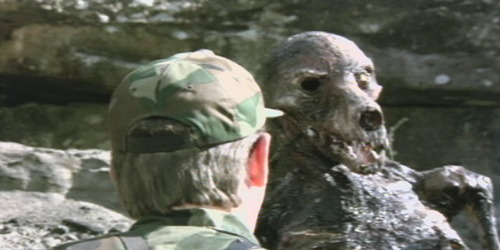
Apparently, Gage likes to play rough...terminally so...
9) That succession of scenes at the beginning of Act Three--Rachel's nightmare about Zelda, the optical effects trying to scare Louis into turning back, the fading and reappearing Victor--really seem weirdly out of place given how low key the film has been up until this point. It isn't even a sign of things ramping up, as we're back to more subtle scares sans special effects once Gage comes back.

10) The thing that makes Back-From-The-Dead Gage so truly terrifying is that yes, he's a malevolent entity, but still with the mindset of a young child who doesn't comprehend life and death yet, someone who probably truly believes that slicing up old men and former Star Trek: The Next Generation actresses consitutes playtime...which makes his admonishment of 'No fair,' when Louis gains the upper hand a degree of unease.

Overall...although it does suffer quite a bit from dating with time and a pair of central performances that needed a bit more life and nuance, this is still a more or less restrained adaptation of a King novel...and still may stand as one of the better ones.

Saturday, October 29, 2011

Ten Statements About....PRINCE OF DARKNESS (1987)

"Let's do The Time Warp Agaaaaaaaiiin!"
"I've got a message for you, and you're not going to like it."

1) You gotta give credit where credit is due--I think Carpenter's choice of Victor Wong as his Professor Quatermass manque was brilliant, as it helps obscure the fact that what he's doing is an unofficial Quatermass movie. I think most people would have expected Donald Pleasance to play the academic with the knowledge that could shatter the world....

(Of course, if you don't want to tip your hand, you shouldn't write the film under the pen name of 'Martin Quatermass'...but we'll get to that towards the end of this entry)

2) It's not his pornstache that makes Jameson Parker's Brian a character we're inclined to dislike--it's his distant line readings and his stalkerly behavior toward Lisa Blount's Catherine. After experiencing such plucky and larger-than-life heroes in Carpenter's cv as Jack Burton and Snake Plissken, Parker's underplaying of his character grates. But then....

As a results of the horrible events of this film, Jameson
Parker suddenly realizes he's saddled with the worst pornstache
eeeeever.
3) Catherine is such an odd character herself, very mercurial and far too analytical. She's just as off-putting as Brian....which leads me to conclude that this is one of those movies where the main characters are voids.
(But we'll get to that towards the end of this entry)

4) I don't think it's intentional, but the fact that the demonic forces seem to be primarily homeless people and women makes the politics of this film seem rather icky. All the jokes about male chauvinism and the scene where two of the men beat up and defenstrate a possessed female colleague don't help dispel that impression, either.

5) And speaking of those homeless people/zombie types (lead by Alice Cooper)...I really wonder if they were necessary. They smack a little of Carpenter's perchance for second guessing himself, an element he added after the fact to allow us more kills and icky maggot shots.

The true mission of our heroes is to protect the
world's ugliest lava lamp...
6) Yes it sometimes comes off as forced, but I actually appreciate Dennis Dun's Walter quite a bit. His exasperation at being literally forced into a closet and desperate attempts at levity--more to calm himself than to get a reaction out of the female possessed waiting outside--manages to amuse me.

7) It's not the gooey make-up that makes the ultimate version of Susan Blanchard's Kelly's possession work--it's the strange, twitchy body language she develops that makes her seem like a particularly spastic, excitable child.

8) I will admit that some of the psuedo-science makes an odd sort of sense, especially the fact that the liquid nature of the creature allows for it to take over other organisms easily as it's absorbed into the body. But a lot of it seems made up at the spur of the moment, especially the whole mirror thing that occupies the last fifteen minutes of the film.

9) The sad thing about the ending, which teases that Brian has gone through a similar transformation to the one Kelly went through, thus allowing him to break into this mirror dimension to retrieve Catherine, is that the combination of the lack of chemistry between Parker and Blount and the curious nature of their relationship serves to deprive us of any sense that Brian is capable of trying this, or that he's motivated enough to try it.

10) While Carpenter doesn't indulge in the clip shows Brian DePalma inflicts on the public in the name of high art, the 'winking references' in this film are thoroughly over the top. Besides the Martin Quatermass stunt, Carpenter names characters after writers John Wyndham and Dennis Etchinson; has Brian make reference to transferring from Kneale University, named after the creator of Quatermass; names another character after B-Movie actress Susan Cabot; and even names Donald Pleasance's priest Loomis, a reference to his character in the Halloween series. It ends up being more distracting than surprising.

Overall...I keep getting the impression this is a film I should like, but I've watched it several times and I never get over the fact that it lacks coherence and ends up being a bunch of crazy crap that seems to happen with a slew of scientific argle bargle designed to conceal that fact.

Wednesday, October 26, 2011

Ten Statements About....ROSEMARY'S BABY (1968)

One of the greatest reaction shots in movie history...
"He has his father's eyes."
"What do you mean? Guy's eyes are normal!"
 
1) This film is right smack dab in the middle of Polanski's suspense/horror period--and much like similar films like Repulsion, What? and The Tenant, Polanski starts building the sense of unease with tiny, near-subliminal touches during Guy and Rosemary's initial visit to the Bramford. After all the strange glimpses of workmen seemingly working on nothing, the cracks in the hall and the likesuch, I'm surprised they're willing to take it...especially after Maurice Evans' Hutch gives them that gruesome catalog of stuff that happened within. But then, you all know what my friend Derrick says about white people and haunted/evil houses...

(and incidentally, after this and The House On Haunted Hill, I'm convinced that if Elisha Cook is showing you a house...run.)

2) You know, I always knew that Farrow would give good paranoid with the best of them...but I never realized how well she did the before of Rosemary, how she was able to convey how engaging the character is at the beginning of the ordeal. This just emphasizes how truly far she falls once everything goes off the rails--an emphasis given sharper relief by the hints we see in her dreams that there was always something of a desire to keep everything in order in her from an early age.

You know, if you meet a couple over the body of their
just-suicided boarder...they're prolly not good best
friend material.
3) I love how Rosemary and the Casevets are, at their core, doing the same thing when they interact with Guy--namely, reflecting back his own desires and thoughts, feeding him a continual line of what they think he needs to hear. It makes the deal Guy makes--or that Rosemary thinks he makes--all the more plausible.

4) The genius of the dream sequence is how Polanski spends so much time with stuff that is obviously a dream--the whole thing with the ship and Hutch and the like--that when we get to the stuff that might not be, like creepy naked old folks preparing Rosemary for her date with The Devil, we don't question it. Hell, even when a wide-eyed Farrow tells us flat out that this is not a dream, we don't accept it as fact.

5) I really like how the only person who behaves in a creepy and suspicious manner is Guy--which is why I think John Cassavetes was perfect in the role. I think that if they had cast someone more, well, movie star handsome we wouldn't buy him being so squirrely...which means that Guy wouldn't serve to throw suspicion off of the true monsters of this film.

6) I know there has to be some form of make-up involved...but My God, does Farrow sell her physical changes through her body language and even the way the timbre of her voice subtlely alters every time she improves or worsens.

7) Reason why this film could never be remade #1: the fact that, crazy dream sequence nonwithstanding, we never see anything overtly supernatural happening. This keeps open something that Polanski wanted open (and something that seems to have been an obsession with him during this period)...that it's all in Rosemary's head, and this conspiracy of witches is something she creates to justify her condition. If it was remade, you know we'd have lots of scary shit going on and CGI spooks a'bounding. And speaking of which...

The worst thing about these satanists is how...
reasonable they are.
8) Reason why this film could never be remade #2: Every one of the members of the conspiracy in it behaves so damn normally. This creates an ambiguity that modern Hollywood would just not let stand.

9) Because this film is so claustrophobic, confined for the lion's share to just that one apartment building, it actually serves to make the few outside shots seem alien and strange, even the ones of landmarks we recognize.

10) What makes the final sequence so unnerving is how Polanski gives us a variety of reactions to Rosemary discovering Adrian's existence. The fact that Roman and Minnie treats her with such reverence and respect allows us to come to our own decision about what our heroine ultimately decides...and no matter what she does decide, it's not good.

Overall...a masterful, excellent film that can be looked upon either a paranoid thriller or a creepy, subtle horror story that is made even more amazing by the uniformly great performances from everyone--especially Farrow.

Tuesday, October 25, 2011

Ten Statements About....THE HOWLING III: THE MARSUPIALS (1987)

I know European women are supposed to be hairy, but
DAAAAAMMMMN!
"What you need is a smoking gun."
"What I need is a werewolf holding a smoking gun."

1) As if it wasn't apparent from such previous entries on his cv as the woman-raping human cicada epic The Beast Within or the super-hero musical parody The Return of Captain Invincible (which features Christopher Lee singing and dancing his way through a bartending chart), Phillipe Mora is not a person who plays by the rules...and Lord, does this film bear this out. Who else would look at this franchise and think, 'this would be perfect for my marsupial spy/romance/satire'....

2) That being said...the opening of the film, which features anthropological footage of a group of aborigines posing before a female werewolf they had just tortured and killed, the black and white slowly fading into full color, is truly disquietingly surreal.

3) While I will admit that female lead Imogen Annesley is very sexy, I was more intrigued by the performance of Dagmar Blahova as the Russian lycanthrope Olga. It's not because she is attractive--she isn't--or that her dialogue is convincingly delivered--it isn't. It's because she has such a weird physicality that she brings to her role, especially when she's in the transitionary state between human and animal, that you can't take your eyes off her. The way she snaps her teeth and contorts her face is far more convincing than the low budget werewolf masks that other people are saddled with.

Boy, some of these at-home pregnancies
go horribly wrong....
4) Boy, if you're going to base your werewolves on a specific species, I can't think of any animal more nightmarish that the Tasmanian Wolf. The way, judging from the film footage shown in the movie, that animal was able to open its toothy mouth so impossibly wide is insane....

5) There is such a demented sense of kitchen-sink-edness to this film, as if somebody is whispering in Mora's ear, 'How about we try this?' This is a film where it seems like the orientation changes every ten minutes, which oddly enough gives it an insane sort of energy that drives it forward. However....

6) The film grinds to a total halt roughly the moment we find out that Max Fairchild's Tylo has called down this legendary werewolf spirit to destroy the military contingent sent out to annihilate the remaining werewolves. The fifteen minutes before the end becomes a meandering, sputtering group of disconnected scenes that shows that no one had an idea how to end this movie. You could easily lop off the last ten minutes and not miss anything significant.

7) And on a related note--it rings false that some twenty years passes in that fifteen minutes, and the fact that the low budget demanded a major plot development is reduced to a big gout of expository dialogue only makes that final act a real soporific.

"Yeah, well...I went native, opened an organic bakery,
joined a commune...the usual...how about you, Bill?"
8) Let's be honest here--the special effects are pretty much uniformly awful. The little marsupial baby in particular is wince-worthy. Luckily, the film is so lunatic in its plotting, fearlessly dropping stupid idea after stupid idea into the pot that you can overlook much of the lame animatronics and rubbery masks.

9) I rather like how this film gleefully has its aboriginal guide character back away very suddenly from the expedition when it realizes this werewolf spirit is on the hunt, advising people how slowly they're going to get et if they don't turn tail and run.

10) I can understand the reasoning behind why a key scene with Barry Otto's Beckmeyer interviewing Thylo suddenly switches from film to videotape, but the abruptness of the changeover and the length at which the video portions go on blunts the impact.

Overall...yes, it's a dumb, dumb movie I cannot possibly defend on many levels. But the severely demented nature of the plotting creates an energy and sense of fun that draws me in every time. If only they truncated that last section...

Friday, October 21, 2011

Ten Statements About....STRANGE INVADERS (1983)

You may think it sounds silly, but trust me...you don't want
Arthur Newman coming to get you....
"Shouldn't have brought the dog in the first place."

1) Even though it is a stand-alone story, this second collaboration between director Michael Laughlin and writer Bill Condon apparently is intended to be a thematic and tonal sequel to their previous Strange Behavior, down to having the teen stars of the previous film, Dan Shor and Dey Young, in scenes that bookend the film.

2) Boy, Paul Le Mat's Charlie Bigelow is a goofy looking hero, even if he's got a certain quirky charm that fits with the film's tone.

3) I really have to wonder if Nancy Allen was cast as the female lead primarily due to her slight resemblance to Diana Scarwid, who plays Bigelow's ex-wife. It would certainly explain why Allen's reporter Betty Walker and Bigelow get so cozy so quickly...

4) There's a strange fairy tale feel to the first act and part of the second...and it's not just because the denizens of Centreville seem to be eireely frozen in 1958. It's small but obvious touches like the fact that the plane Charlie takes home to New York is devoid of any passengers save for him, or the presence of a small, whitish-blonde boy in the cavernous office of Charlie's mentor at Columbia for no reason. It helps create a sense of unreality that allows us to buy into the recreation of classic drive-in sci-fi we're immersed into in the second half of the film.

Is it just me, or do these alien look like they suffer from
perpetual migraines?
5) However...the second Charlie, Betty and Louise Fletcher's Mrs. Benjamin arrive in Centerville to investigate the disappearance of Charlie's wife, the film seriously loses its focus. We never quite get a handle on these aliens and why they've been hanging around Earth for the last quarter century, or why they're going home, or why they've gone all in with their 50's personas even when they know the culture has changed, or why they've been transforming people into these weird blue balls of electricity, or any of the fifteen other questions the first half of the film raises.

6) While the creatures are pretty cool--they're highly reminiscent of the Lectroids from Buckaroo Banzai only mired in goo and muck--they come off the most effectively while in disguise. Kenneth Tobey, who plays de facto alien leader Arthur Newman, and Fiona Lewis, who plays the world's most aggressive Avon Lady, come off the best due to the way their line readings sound...off somehow.

7) And while there is nothing nearly as squirm inducing as the injury to the eye gag in Strange Behavior, the way the aliens convert their human victims into Blue Glowy Balls is pretty effective, as they seem to literally dehydrate and shrivel away into nothingness.


"Ooooooh....glowie...."

8) I got the impression that the aliens were going to turn out to be some form of insect, especially given how much is made of Charlie's profession as an etymologist. But we never find anything out, and made me wonder how Charlie was able to mate with one of them and produce a daughter.

9) Given the somewhat impressive mothership in the opening and closing sequence, the interior of the spaceship is a little warehouse-rific, innit?

10) I like Wallace Shawn and June Lockhart and Mark Goddard as much as the next person...but their presence here adds nothing. It smacks of the oft-rumored meddling that Orion Pictures made in the film's production.

Overall...not as effectively bizarre as Strange Behavior by any means, and with that frustrating drop in coherence at the halfway mark, the film still has a degree of charm. It certainly makes me wonder what would have happened if Laughlin and Condon had continued their collaboration with their planned third film, The Adventures of Philip Strange.