Showing posts with label Robert Holmes. Show all posts

Wednesday, August 29, 2012

Ten Statements About....DOCTOR WHO STORY NINETY-EIGHT: THE RIBOS OPERATION (1978)

Much like Sarah Jane, this Scottish brunette is not just a
pretty face...
"You want me to volunteer, is that it? And if I don't?"
"Nothing."
"You mean nothing'll happen to me?"

"Nothing. Ever."


1) And here we are at 'The Key To Time,' the 16th Season. And, as with most of the serials for this season, this is a story where moments of brilliance float in the middle of great seas of dullness. We're at the point where Williams seems to treat the show solely as a kid's show, coupled with his constant dancing about in an effort to keep Tom Baker engaged in the show--an action that will lead to one of the worst seasons of the classic series. Luckily, this is not that season.

2) The biggest new development is the introduction of the companion Romana, played by the stunning Scottish actress Mary Tamm. And even though Tamm proved to be...limited as an actress, she does manage to give Baker someone to work off of in a new way. Romana, because she is a Time Lady, is able to be confrontational with this Doctor about his shortcomings and lack of education, creating an interesting 'practical knowledge vs. learned knowledge' tension that isn't played off of enough.

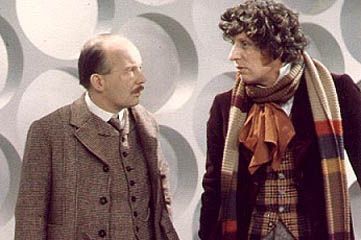
3) The actual set-up for this season, written by Anthony Read and Graham Williams, features the Baker Doctor literally humbled in the presence of Cyril Lucking's White Guardian. It's really very well done, both as a change of pace and as a piece of exposition. We get to see Baker trying to exert himself in resisting the Guardian's wishes, but the very subtle threat (see the quote above) seems to put him back in line. Lucking plays the character well, and the scene is expertly done.
As Tom Baker's tenure went longer and longer, he began to
forget things...like turning off the lights in the refrigerator...

4) ...and then we're plunged into the story itself and it's...well, it's not very good. There's a definite sense that writer Robert Holmes really wanted to write a pilot for a show about a pair of intergalactic con-men and forced it into a Who serial. That whiff of back-door pilot never leaves the series even when it's focusing on The Doctor and Romana.

5) That being said, the con-men are responsible for one truly brilliant moment. When Nigel Plaskett's Unstoff reveals to Timothy Bateson's shunned and broken Binro that yes, his theories about the stars are absolutely true is what this show should be about--a great little nugget of wonder in the middle of this sad, plodding little serial.

6) I know there may be people who love Paul Seed's rather, ummm, vigorous performance as the Graff Vinda K, but I'm not one of them. He's so over-the-top, and seems to be proclaiming every line as if he just ate a particularly bitter lime. Plus--he does that weird Holmes trick (we'll see it again in The Caves of The Androzoni) of addressing the camera directly for one of the cliffhangers!

7) Even though they really don't do much with the setting, I do appreciate how the visual designers chose to give the setting a very Russian feel. It's the sort of thing we don't see often in science fictional settings, and it does give the serial a somewhat unique feel.

8) This may be the first serial where The Doctor--who, not three seasons ago, actively refused to kill The Daleks, the greatest source of evil in the galaxy--actively kills someone. I'm not sure if the reason I find this so distasteful is that it's the beginning of a long slippery slope that will end with Peter Davison waving a gun about and Sylvester McCoy, ummm, blowing up Skaro. It's a sign of some very, very bad things to come.

9) ....and then there's the Shrivenzale. This is an example of a creature that maybe--maybe--if it was kept in the shadows might've been effective, but every time we see it straight on looks ridiculous. I particularly like the one shot at the top of episode two where we see the Shrivenzale scrabbling to gain purchase against the stone floor to eat some Romana butt....and we see the rubber claws literally bending back in on itself. Thankfully we see only a little bit of these dopey monsters, but since they're the only real monstrous thing in this story their crapitude sticks out.
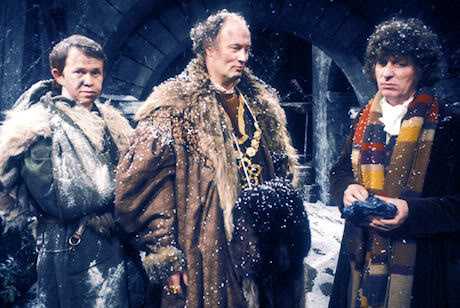
"Hello, we're the backdoor pilot people...can you spare a serial
to let us tell the audience our premise?

10) I think when you come down to it, the thing that bugs me the most about this story is how dismissive Holmes is of large chunks of the story he's created. He's obvious way more interested in Garron and Unstoffe than in anything else that's going on that the parts that don't directly involve those two (like, let's say, stuff involving The Seeker and her psychic abilities) are written in a grey, plodding way. Maybe this is because of Williams' interference and forcing the Key To Time framework on it, but it's very, very minor Holmes....and in this case, minor Holmes is not good Holmes.

Overall...there are some good moments in this story, particularly involving the set up for The Key To Time. But ultimately, this is a weird and bland tale that reads like a backdoor pilot that justifiably wasn't picked up.

Thursday, June 14, 2012

Ten Statements About....DOCTOR WHO STORY EIGHTY-TWO: THE PYRAMIDS OF MARS (1975)

"I will not laugh...I will NOT laugh...I will NOT laugh..."
"I am the servant of Sutekh. He needs no other. Now I bring Sutekh's gift of death to all humans."


1) Cards on the table time--this is one of my all-time favorite Who stories overall, and easily the high point (with maybe only Robots of Death and The Talons of Weng-Chiang rivaling it) of what I consider to be the high point of the Classic series. This is a tightly written, clever, and scary little adventure that wastes very little in telling its tale.

2) And admittedly, one of the major reasons why I love this story so much is the strength of its villains. Sutekh is an amazing, monstrous character, a character so malevolent that you actually worry that The Doctor might lose, given such vivid life by Gabriel Wolff...and he doesn't fully appear until the last episode! But until he does, Bernard Archard's Scarman ably handles the bad guy duty as Sutekh's pawn, giving us two exceptional opponents for the Doctor and Sarah to come up against.

3) This is the penultimate serial in that tightly linked series of stories (it finally pays off when The Doctor and Sarah return to 1980 Earth in The Android Invasion.), and the way they link this serial to the previous one is fairly clever in that it serves to fill in more backstory about the show's mythology.

4) Another thing that's clever? The script by Robert Holmes and Lewis Griefer under the name 'Stephen Harris' manages to introduce links to previous serials (the dress Sarah wears--quite fetchingly, I might add--is referenced as belonging to Troughton era companion Victoria; she refers to one of the puzzles in the titular pyramid as being similar to one in the city of Exxilon from one of her Pertwee stories) in a subtle and non-obtrusive way. These act as 'easter eggs' for long time viewers without in any way alienating the newer viewers. It might be one of the reasons the Hinchcliffe era had some of the biggest ratings in the show's history, and one of the reasons this era was chosen to be syndicated internationally in the 80's.
And the scary thing is that this guy burning the Egyptian
is only the second most frightening villain in this serial!

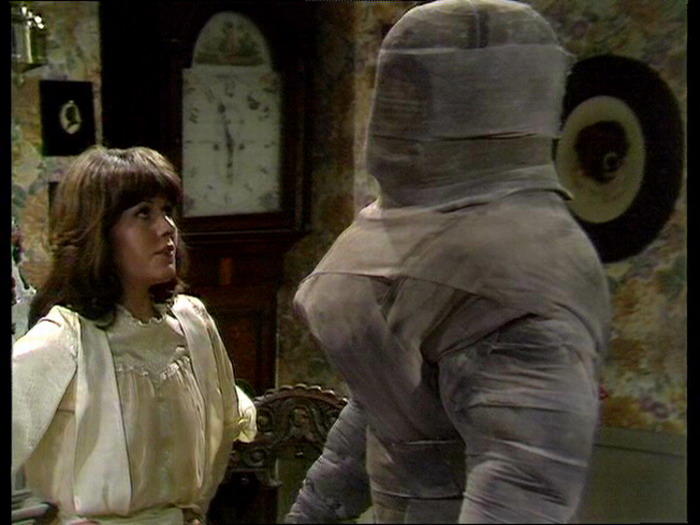
5) Are the mummies kind of silly-looking? Yes, especially when they kill a poacher by squeezing him between their cleavage. Is the reason behind their being there still effective and cool? Damn straight.

6) It continues to amaze me how effortlessly Elisabeth Sladen and Tom Baker seem to work as a unit together. Their chemistry is so easy that they work like clockwork--Hell, their chemistry is even more apparent now that Ian Marter is gone, with a give and take that's just stunning. It doesn't surprise me to learn that some of this serial's interplay between the two was improvised on set. What's the most amazing is how, unlike with other companions, you never lose sight of the deep friendship these two have, even when they're yelling at each other. In her way, Sarah defines the Baker Doctor more than any other companion, much in the way Jamie defines the Troughton Doctor, Jo defines the Pertwee one and--as we'll see later--Ace defines the McCoy one.

7) Even though I don't like how he goes out--and even that serves a significant purpose in the serial, by giving us the reaction of someone not used to dealing with such horror on a daily basis--I really like Michaek Sheard's Laurnece Scarman. In particular, I really like how he's obviously a very, very smart man whose weakness is his love for his brother. The joy he has not only in showing off his radio telescope and discussing it with the Doctor, but in comprehending the Tardis so quickly makes him a fun and memorable character.
You can keep Leela and her Janis Thorns and Ace and her
bombs...I'll take Sarah with a rifle any day...

8) While the Baker propensity for comedy--this is the propensity that gets out of control under Graham Williams--is starting to make Sarah the butt of some jokes, whether intentional or unintentional, she is still far from the 'wailing frail' most Rose-sucking fans of the modern serial write her off as. Once again, she is trusted to help the Doctor enact his plans, primarily through shooting the gelignite and destroying the Osirian War Rocket. Even in the last episode, where Sarah does do some panicking, it's short (and she trusts the Doctor enough to calm down when he asks her to). There's a major difference between showing fear and being ineffectual in the face of that fear....

9) You know, I didn't realize this until I started watching these serials back to back, but one of the signatures of the Hinchcliffe era is great confrontations between The Doctor and his opponents. And the exchange between Sutekh and The Doctor that begins the fourth episode is so powerful, so engaging and deeply layered, that it remained in my head during all those years when Who was unavailable here in the New York market. It doesn't surprise me that Wolff (along with Michael Wisher) so defined villainy in the series that he was frequently used in the Big Finish audios and became the voice of The Great Beast in the 'Impossible Planet/Satan Pit two parter of the new series.
"What do you mean that after this conversation I'm
going to become amewling puss?"

10) I know much of the puzzles in the Pyramid of Osiris are kinda childish and relatively simple, but I dug the whole Indiana Jones-ish aspect of the Doctor working his way through the place....so much so that I never noticed the fact that that part of the fourth episode is just treading on water until they can spring the real solution on us.

Overall...a tight, exciting, flavorful little story that pretty much defines the Hinchliffe/Holmes era. There is very, very little to detract from its high entertainment value. Absolutely essential viewing for people who want to study the Classic era of Who!

Sunday, May 6, 2012

Ten Statements About....DOCTOR WHO STORY SEVENTY: THE TIME WARRIOR (1973/74)

"Hello...I'm the Greatest Companion You Will EVER Have."
"A straight line may be the shortest distance between two points, but it is by no means the most interesting."

1) Ahhhhhh, Sarah Jane Smith. If anyone wants proof of why Elisabeth Sladen is the gold standard of Who Companions, you have just to see this serial. Just as Tom Baker steps in and owns the part of the Doctor instantly a few serials hence, Sladen makes sure we know what Sarah Jane is all about from her first appearance at the scientist's summit. And throughout the serial, Sarah Jane is proactive, taking the point when dealing with Irogron. She's the perfect Doctor Who companion because she can take a major role in stories while complimenting the Doctor, not overshadowing him.

2) I know stories indicate that Jon Pertwee didn't get along with Sladen, but you never see it here. On the contrary, The Doctor seems to have a gleeful admiration for her and entrusts more and more to her as the story progresses. It's as if in Sarah Jane you get both the Ian and the Barbara, the Jamie and the Zoe, the ass-kicker and the smart chick all rolled into one package.

"My name is Linx.  I am 34, and my interests are military
adventurism, torture and conquest.  I am looking for..."
3) And then there's The Sontarans. You can keep your Daleks, your Cybermen, your Ice Warriors...I'll take these guys. Supposedly writer/creator Robert Holmes wrote out an exceptionally long treatise on these aliens, and it certainly shows in this serial. Over the course of four parts we learn loads about the Sontarans--and I love how these guys have an actual cultural outlook and personality. Linx is a monster, but one that has a code of honor and even a rudimentary sense of humor. Yes, they become diminished in future appearances (slightly--very slightly--returned to some form of dignity by Russell T. Davies., although I could do without the short jokes), but for now they're the most brutally formidable of the Who monsters.

Plus...it gives The Doctor an alien race that's strong, but not so super-strong (like the Cybermen) that they can engage him in hand to hand.

4) One of the clever touches to Holmes' script is how Linx honors his promise of giving Irongron 'magical' weapons--but is satisfied with just giving them rifles and a single primitive robot, as if he's willing to do what he says, but never so far that his allies could become a liability to him. It shows how intelligent an enemy Linx is....

5) ...and, to the script's credit, The Doctor responds in kind. This isn't the Doctor of other eras who gleefully cheat by using high tech to squash his foes dwelling in the past; he uses methods more or less consistent with that time and a knowledge of guerilla tactics. Just as with Linx, this speaks volumes of this Doctor's view on the sanctity of time and cultural development.

6) Another cool touch is how Donald Pelmear's Professor Rubeish is set up to be comic relief....but is revealed to be a valued ally who uses his own weaknesses to his advantage, and--like Sarah Jane--takes action against his situation. It doesn't surprise me that The Doctor ends up trusting Rubeish to help enact his final plan.
You know the story...two aliens, one woman...trouble.

7) I also appreciate that while there is a gag about Linx claiming Earth for the Sontaran Empire (a plot thread that is picked up with the Sontaran's next appearance in next season's The Sontaran Experiment), this whole serial is motivated by a very simple, very selfish intent--namely, that Linx wants to return to the war with the Rutans. Everything derives from this one need on Linx's part. It's refreshing to see this kind of story in amongst all the 'we're taking over this planet NOW' tales that Doctor Who all too often deals with.

8) Here's the one thing that bothers me about the Sontarans, though...the whole thing about the 'probic vent' in the back always rang wrong. I understand the reason for the vent (it forces Sontarans to face their enemies in battle and never turn their back on them), but it seems a somewhat arbitrary concept...and given that the Sontarans presently are practicing an in vitro form of reproduction, I can't figure out why they didn't breed out this weakness when so many of their opponents sneak up on them and smack 'em on the vent.

9) I find it interesting that Holmes chose to have Alan Rowe's Edward of Essex just accept The Doctor and Sarah Jane at face value, just ascribing their weird clothes and speech to their being sorcerers. It nimbly sidesteps what could have been a time consuming duplication of the 'who are these beings?' thing that we've been through already once with Irongron.

10) I am not entirely sure--other, more learned fans will correct me, I'm sure--but this may be the first serial done under Barry Letts that does not feature stunts by Havoc! It does kinda show, especially with the painful long-shotting of many of the fight scenes to conceal that this isn't Pertwee doing all the chopping and kicking.

Overall...an excellent introduction to an excellent companion, featuring a solid new villain and sober, clever script writing. And on top of that, it apparently is the first serial to namecheck Gallifrey. Downright required viewing.