Showing posts with label Tom Baker. Show all posts

Wednesday, July 10, 2013

Ten Statements About....DOCTOR WHO STORY ONE HUNDRED AND SIXTEEN: LOGOPOLIS (1980)

Now that he's established, this Master gets to
being truly, seriously scary....
“Logopolis is not the universe."
“But it is. Logopolis is the keystone. If you destroy Logopolis, you unravel the whole causal nexus.”

1) There is no doubt, right from the first part of this serial, that Janet Fielding’s Tegan Jovanka is going dominate the companion screen time....and given the abrasiveness and bossiness of the character (it’s not for nothing that at one point during her tenure she’s referred to as ‘a mouth on legs’), this does not bode well for the tenure of incoming Doctor Peter Davision.

2) And the fact that Nathan Turner has fallen in love with Tegan results in his impulse add of Sarah Sutton’s Nyssa becoming inconsequential.  Nyssa just appears out of nowhere in the second part of the story, and seems to be there solely so The Master can have someone to use that weird arm-controlling device in part three.  Admittedly, there is an attempt to bind her together thematically with the other companions when her planet is destroyed (a moment where Sutton shines), but the fact that she’s there Just Because is glaring.

3) Christopher H. Bidmead’s script is typical in its hard science concepts, especially when it comes to Logopolis itself.  The moment the TARDIS lands on this planet and we start to unravel the mystery and purpose behind it, the serial never lets up.  And Bidmead trusts us enough as an audience to grasp these principles without talking down or stopping everything to explain what’s going on.  That allows for the story to flow evenly and allow us to concentrate on the characters and what’s happening to them.
"Free at last, free at last!"

4) This is the first full serial that reveals Anthony Ainley’s Master to the world, and man is he pretty damn scary!  Even though he’s saddled with that odd outfit with the black frock coat and ornate silver collar that made me refer to it as ‘the gay pirate’ uniform, Ainley creates a very malevolent and--more importantly--opportunistic figure who thinks nothing of taking advantage of a serious situation he caused by accident to blackmail the entire universe.

5) I have to wonder why Bidmead allows the whole sequence concerning the nesting Tardisi, as it really doesn’t pay off much save for watching Tegan wander around and around the Tardis looking for an exit.  This is something we’ll see a number of times throughout the Peter Davison series, where there seems to be two separate and unconnected acts that run through the serial.

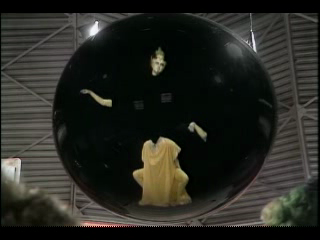
6) The Watcher...I am of two minds about this aspect of the story.  It’s certainly a fairly shaky justification for a regeneration, and the Watcher is an even shakier device for it to happen.  That being said, I give both Bidmead and Nathan-Turner credit for trying to make the whole regeneration epic.  It doesn’t work (the Davison-to-Colin-Baker regeneration works a whole lot better, primarily because the moment is treated as more intimate), but at least it’s there.

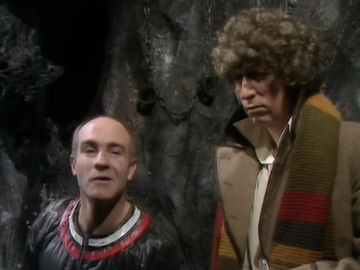
7) Maybe it’s because he’s finally getting his pass out of the series, but Tom Baker is surprisingly subdued and effective in the serial.  There’s a sense of him being aware of his own impending doom (the way he keeps trying to pass off Adric and, later, the girls, off on others seems to emphasize this) and trying hard to keep it together.  Plus he shows absolute contempt for the Master.  There’s that moment at the end of episode where the Master offers his hand to cement an alliance; Baker looks away before shaking his enemy’s hand that speaks volumes about his distaste for the deal.
"Mark my words...one of you is going to have to go..."

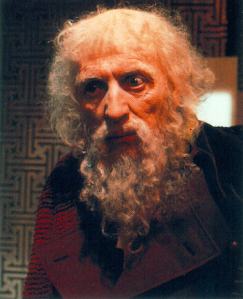
8) John Fraser’s performance as The Monitor is rather intriguing.  There’s a certain sense of, well, modest immodesty to his actions, and the way he rarely speaks in anything other than  conversational tones makes the few moments when he does lose his self-control all the more effective...especially the moment where we learn the true secret of Logopolis.

9) Maybe it’s because the series had been under the influence of Baker for several years, or maybe it’s because of the inexperience of two of the main actors involved in the serial--namely Matthew Waterhouse and Janet Fielding--there’s a level of pantomiminess that serves to make the flow of the serial out of kilter.  The broadness of the reactions in Fielding’s case are particularly jarring.

10) I appreciate the use of the Pharos Project; it dovetails nicely with Bidmead’s mathematics theme, I assume it allowed the budget to stretch so that this serial looks a little cooler than it could have...but I think that the final part is a little too full of everybody running around the grounds, all hunched over in the hopes of not being seen.  This, coupled with the whole ‘nesting Tardisii’ things give the serial a sense of being overinflated.

Overall...Yes, it’s flawed.  Yes, it could be more tightly plotted.  Yes, it suffers from companion-itis.  But it’s got a wonderful nugget of a premise that is very hard science fiction with some excellent performances by Baker and Ainley.  This is absolutely essential viewing.

Wednesday, April 3, 2013

Ten Statements About....DOCTOR WHO STORY ONE HUNDRED AND FIFTEEN: THE KEEPER OF TRAKEN (1980)

"Are you making fun of me?  Well, are you?"

"You will find immobility endurable, Doctor.  I speak from experience.”

1) This is the first of three linked serials, and this structure is one John Nathan-Turner loved to death.  While it’s not the most fondly remembered (The E-Space Trilogy, which was broadcast just prior to this one, tends to be the one most people talk about), it’s the most consistent and coherent of them, and the one that actually succeeds in telling a complete story over its three four-parters.

2) This is the only serial where Matthew Waterhouse’s Adric is the sole companion (at this point, Sarah Sutton’s Nyssa was a one-off character; she was offered the role of companion after Nathan-Turner saw the chemistry she had with Waterhouse)...and you can see here how Adric could have worked.  There’s a definite sense of the Doctor acting as a mentor to this bright young child, and the chemistry is there between Baker and Waterhouse.  I have to wonder if he would be better remembered if Baker had stayed on.

Or if he wasn’t made to share the Tardis with two other companions, but we’ll get to that in future episodes....

3) I didn’t realize it until it was pointed out in one of the documentaries on the DVD, but this is a set-bound episode.  The world of Traken is so well realized as a sort of Shakespearean paradise that you overlook the artificiality of the set. It also helps that so much of the scenes that take place outside take place at night, where that artificiality can be concealed.

4) Johnny Bryne’s script is very clever in how he manages to conceal the true nature of The Melkur until the last episode of this serial, while also making it rather apparent if you know the clues.  This was a massive surprise when the serial was first broadcast (Nathan Turner managed to conceal the big twist expertly in the months leading up), and it’s to Byrne’s credit that the clues are there all along.

5) And speaking of that big reveal....Geoffrey Beevers plays an excellent Master.  Chosen apparently for his deep speaking voice, Beevers makes the ‘eggface’ Master creepy and formidable.  I also think that the choice to let Beever’s eyes remain visible--something that the actor insisted on if he was to take the job--worked, as it makes the sense of him decaying even more profound.  There’s one moment where Beever screams in rage that chills me.
"Alright--I'm going to be all bad-ass now...but
after that, I'll be pretty much useless!  Fear me!"

6) This marks the first of Anthony Ainley’s long tenure as a recurring character...and here, as Tremas, he makes a really excellent ally for The Doctor.  Throughout all three of these serials, Ainley proves how amazing he is as an actor, and how great he could have been before the scripts relegated him to what amounted to a naughty scamp playing pranks on historical figures.

7) Based on her performance here, Sarah Sutton was asked to stay on as Nyssa, and you can kind of see why--she’s wonderful, and potentially would have been another gifted child for The Doctor to mentor.  Plus she’s got this weird fairy tale princess vibe that serves well in contrast to Adric’s urchin.  Pity that, like Ainley, Sutton will be wasted in the future (famously literally sleeping her way through a serial next season), but in this serial and a scant few others she’s pure gold.

8) Wow...I keep trying to remind myself that 1981 was a much different time and that John Nathan-Turner and the special effects crew of Doctor Who never realized that their show was going to be viewed on a high definition digital medium, but the hypno-eye effect that Shiela Ruskin’s Kassia displays is truly goofy.  It looks exactly like what it is--a pair of cardboard eyes placed over Ruskin’s real eyes.  Every time it shows up I start laughing.
SPECIAL EFFECTS!!!!!!!!!

9) So effective is Johnny Byrne’s script that I don’t notice how...sketchy and contradictory Traken society is.  We know there’s a Council, and a Keeper...but if the Traken Union is in perfect harmony, what are the Proctors for?  And what is life like outside the gates of the Council grounds?  We never learn, but because this story is so well paced, so well pr.

10) I’m still trying to wrap my head around the Master’s need to keep a Tardis within a Tardis, especially given that the Master’s Tardis still have a functioning Chameleon Circuit.  It seems so unnecessary.

Overall...a wonderful serial that gives us back one of the Doctor’s greatest foes (who would be magnificently scary for a little while), and a great launch for one of the best ‘trilogies’ of the series.

Friday, March 1, 2013

Ten Statements About....DOCTOR WHO STORY ONE HUNDRED AND TEN: THE LEISURE HIVE (1980)

...and after getting super-old, the Doctor will
try to convince people he's an elk...

1) This is the first serial produced by John Nathan-Turner, who will guide the series until the classic version of the show is put on permanent hiatus in 1990....and boy, does he do whatever he can to differentiate it from the Graham Williams episodes.  The new starfield credits, the new music score, the use of 1980's-style  (i.e. clunky and primitive) CGI, the darker outfit for the Doctor...everything amounts to Nathan-Turner shouting 'We t'ain't your father's Who!'.  And to be fair, the new look does serve to convince us that we've come out of the children's pantomine that the Williams/Adams season had become.

2) ...which isn't to say that the show is without flaws.  The serial is so in love with its new CGI-based optical effects department that it devotes big ol' sequences that go on forever to moments that show off their prowess.  One shot of a starcraft docking is shown in its entirety roughly four times, and another shot of a model of the titular building on a CGI generated background (complete with too-bright sun beating down) seems to be repeated every time director Lovett Bickford runs out of ideas.  And this--along with other moments where Bickford indulges in arty shots like the 360 degree pan of Brighton Beach--slows the pacing of the serial down tremendously.

3) I also wonder if the serial wouldn't have benefited from David Haig not chewing his scenery so vigorously as Pangol.  Haig is so sneerily over the top that there's no doubt that he's the villain, and that distracts from the Mafia-manque story that the serial is supposed to be about...and given how Pangol's story arc results in a particularly bad CGI sequence that goes on for so long we can lovingly appreciate the level of crapitude, maybe it's better his story was minimized a bit.
"Look!  CGI!  It's DA FUUUUTUUUURE!"

4) Pangol's craziness also detract from the whole backstory of the Argolins.  There are these weird hints at what they're all about and their biology--apparently they're plant beings (it's never explicitly stated) whose age is measured by the number of berries or seed-pods on the top of their head.  There's a number of interesting things about Argolin society that is sorta kicked aside for Pangol making nasty references to Greeks, ranting around and overall trying to be Better Than You.

5) I can almost buy the Fomasi.  In tight close up they can actually be a bit unnerving.  Even when I see them in full figure and notice the big cinch-sack like collar, I can suspend disbelief juuuust enough to let the serial flow on.  But I cannot buy the way the villainous Fomasi hide from detection for the bulk of the story....they simply cannot slip into those disguises so easily given their generous form.

6) Here's something that made all of us who weathered the panto silliness of the Graham Williams era happy....this story is based on the admittedly fictitious science of 'tacyonics,' but it's a fictitious science that is both plausible and based on a bit of science fact.  Throughout this first season and part of the next, we're going to see some pretty hardcore science fiction concepts--this season ends with a truly amazing story that's tied in to some pretty heady ideas about psychics and mathematics--and it's really refreshing after what we just endured.

"Raahr!  I's a fluffy monsta!"
7) I'm not quite sure, but there's some weird elements in the serial that seems to have been left on the floor.  There's these frequent hints that there's some form of mutual attraction between Adrienne Courri's Mena and Nigel Lambert's Hardin, yet outside of some quotes, there's nothing concrete we can hang this supposition on.  There's the whole concept of the Fomasi criminal underground.  Plus there are other things that are mentioned, allowed to take its bowed, and never brought up again.  It's kind of frustrating.

8)  Thank God that Lalla Ward is wearing something distinct and flattering to her in that Edwardian bathing outfit with the big ol' hat.  But then, the costuming overall is very clever in a minimalist way, allowing us to get a sense of each character with only the way a garment falls on them.

9) I rather liked the way the story sees the Doctor transformed (something we'll see again in the very next serial).  It shows one of the strengths of the early phase of The Nathan-Turner Years--namely, these serials for the first season and change look for ways to actively challenged and hinder the Doctor.  Seeing this doctor struggle with age and his failing brain cells, seeing him express frustration at being slower intellectually is something the viewer hasn't seen before.  We'll see this a lot in these early Nathan-Turner tales until the arrival of Script Editor Eric Seward screws it all up.

10) You'll notice how the serial quickly, and pretty much gleefully, disposes of K-9 and the Randomizer within the story.  This could be looked upon as Nathan-Turner rushing to convince us that This Is Not Your Father's Who....or if could be the very first indications of Nathan-Turner's pettiness, which we'll see in abundance once he and Seward are a team.

Overall...even with its wonky pacing and weak storytelling choices, this is a decent serial that provides something of a 'mission statement' for this first leg of John Nathan-Turner's era--an era that will sour fairly soon, but right now is bright with promise.

Saturday, January 19, 2013

Ten Statements About....DOCTOR WHO STORY ONE HUNDRED AND SEVEN: NIGHTMARE OF EDEN (1979)

"Raaaahr!  Were's monstas!"

"I shall be charging you with gross neglect of duty. The passengers should be your first concern, yet I find you drunkenly looking on as they are attacked and killed. Well?"
"They're only economy class; what's all the fuss about?"

1) This is the last serial written by Bob Baker, the writing partner of David Martin....and if I wrote this, it'd be my last serial as well because it's thoroughly and absolutely wretched.  Even if we have to assume that the story was, like others in this season, heavily rewritten by Douglas Adams, Baker's tale is so messed up I can't imagine anyone salvaging it.

2) I am absolutely convinced that Lewis Fiander was doing an imitation of Peter Sellers' Dr. Strangelove when assaying the role of Tryst....so much so that between the weird 'vest-with-John-Lennon-specs' outfit and that bizarro accent, Tryst stops the story dead every single time he opens his mouth.

3) What the Hell is Lalla Ward wearing throughout this story--a maternity dress?  That thing is so loose-fitting and so volumous that Romana looks positively lost in that ugly violet thing.

4) You know how I'm convinced that Adams rewrote this script?  There are a whole slew of ideas--the whole crux of the drug running storyline revolves around a matter storage/projection machine--that are given, ummmm, less-than-solid scientific rationalization.  The one quality of the matter projector, namely the way people are able to move back and forth into the projected window, is never explained at all.  We just see The Doctor and Romana jump into the projection of Eden and are asked to accept this.
Monsta Hug!  Monsta Hug!

5) And then there's the monsters....grumblemutter...or should I say 'da monstas.'  The Mandrils are amazingly bad designs, not the least because they sport what looks like big-ass black sausages for a mouth (which, I guess, means they're related in some way to those dorky sea creatures from The Horror Of Party Beach....).  It doesn't help that the cumbersome outfits make moving difficult, and that the zipper and the odd flash of side-flesh when the shirt pulls out from the pants can be clearly seen at points.

6) I will give this one small thing to the serial--there are some tiny moments where the Doctor and Romana actually act like, you know, The Doctor and Romana.  I particularly liked the moment where the Doctor is told he has to traverse a stretch of space liner rife with Mandrils sans K-9 and guns, and Tom Baker grins happily and says, 'I'll have to use my wits.'

7) And while we're on the subject of K-9....David Brierly assays the voice of the little tin dog and as such, this iteration does.  not. work.  The character is actively annoying from the moment it opens its 'mouth.'  And since its co-creator is writing this script, K-9 gets loads to do--most of it embarassing (particularly the moment where K-9 'sniffs' a character when the Doctor introduces him as a friend).

8) Okay, so you want to make this story about the dangers of drugs; I get that.  But do you have to do the Full Reefer Madness to depict how terrible a drug this vraxion is?  I mean, David Daker's Captain Rigg downs just one spiked drink and becomes this lazy, giggling numbnuts instantly.  The choice Daker makes to play this, which all campiness and Adams-esque 'comedy,' detracts from the supposed seriousness of the vraxion threat.
"....and I anticipate a ratio of 10 women for every man...."

9) For a series known for lame and tatty micro-budget designs, this serial hits a new low.  For a supposed luxury liner, the scenes of people in foil jumpsuits in a cardboard corridor manages to break the suspension of disbelief.  There is nothing--not the corridors, not the labs, not the engine rooms--that look like anything other than hastily designed sets.  Usually there's enough interesting things going on we can overlook the cheapness, but given how awful the story is....well.....

10) On the whole, the cliffhangers are subpar.  However, the third episode cliffhanger, where the Doctor seems to evaporate into nothingness when he successfully separates the two ships is pretty good thanks to some really good optical effect.  It doesn't convince us for a second, but at least it's neat.

Overall...One of the worst stories during one of the worst seasons in Classic Who, this serial fails on almost every level.  Avoid at all cost.

Tuesday, January 1, 2013

Ten Statements About....DOCTOR WHO STORY ONE HUNDRED AND FOUR: DESTINY OF THE DALEKS (1979)

Tom Baker and Lalla Ward try to run away
from a heavily rewritten script....

"Dead?  I do not die.  Mark this moment, Doctor.  In the history of the universe, this moment is unique.  Davros lives!"
"Yes, well I can see your long rest hasn't done anything to cure your meglomania.  Have a jelly baby."

1)  And here we begin Lalla Ward's two and a half season tenure as Romana....and we begin it in typical Graham Williams/Douglas Adams fashion with a comedy sequence which shows Romana being very cavilier in her usage of her regenerations to convince the Doctor she should just mimick Princess Astra's form.  It's a tiresome scene that takes up too much time in the first episode of this serial, and it's a definite harbinger of the the way the Williams era will spiral out of control.

2) That being said, I rather like the visual appearance of Romana in this story.  With the long white scarf and the pink suit, she serves as a sort of female mirror image of the Doctor while also retaining her own identity.

3) This is the first of the Dalek stories that begins the devaluation of the characters as villains, primarily because they are subservient to Davros.  As of this moment, they're pepperpot-shaped henchmen to a man in a bad mask.

4) You know, after the series spends a chunk of the last serial devoted to setting up the new status quo of The Randomizer shifting the Tardis, ummmm, randomly with the Doctor having control of where they will end up....they pretty much crap on that by having them show up on Skaro, a place The Doctor has shown up on several times before.
It's the invasion of the cosplaying rasta fashion models!

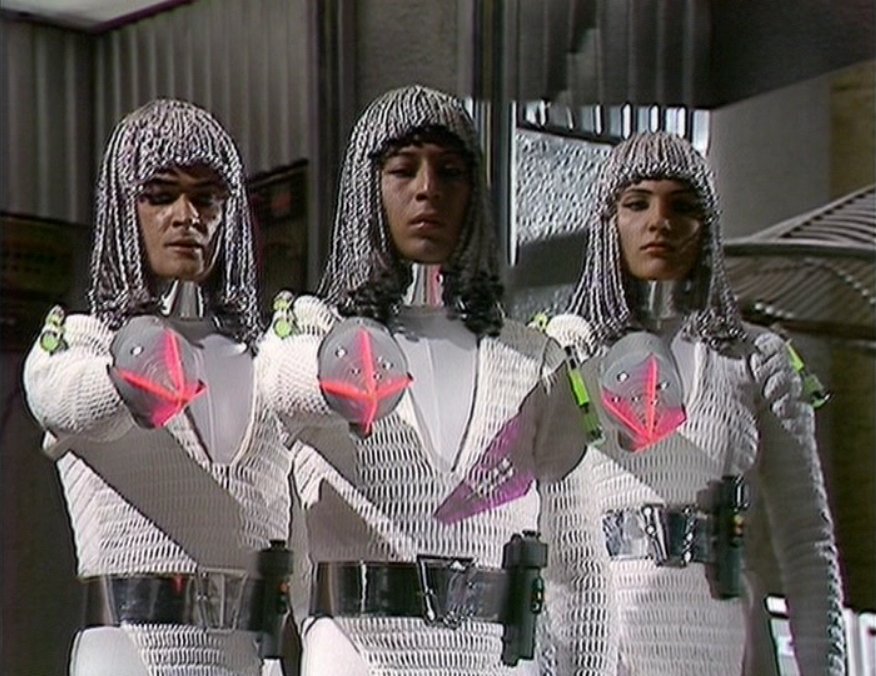
5) The problem with the Movellans is simply that outside of being another race of robots, they've got nothing going for them.  They're just robots who are pure-d-evil, and that's that.  There's nothing that makes them interesting or scary or even notable, which means the tension the story is counting on never develops.  It doesn't help that those mopheads make them look like a bunch of people going trick-or-treating as a rasta disco band.  

6) This is the beginning of the year where the highly overrated Douglas Adams takes over as script editor (who heavily rewrote the script)...which means that Graham Williams' tendency to treat the show as a comedy runs rampant.  The forced humor begins with that regeneration sequence at the top of the story and continues throughout, the low point being the Doctor mocking a Dalek for not being able to climb up a steep incline--which absolutely invalidates the Daleks (already becoming a bit naff due to their subservience to Davros) as scary threats.

7) You know, while there is a legitimate germ of a good idea as to why the Daleks are seeking Davros out....the moment Davros shows up, that germ is discarded save for some stray mentions in dialogue and that endless 'rock/paper/scissors' scene that is supposed to explain why the Daleks need what Davros is supposed to provide them so much.  For that matter....

"I am ready for my close-up, Mr. DeVille...."
8) Is it just me, or does the whole plot disappear thoroughly around the end of episode three?  The second we get the introduction of that atmosphere-burning bomb, the whole thing just degenerates into a lot of silliness with Daleks running around with bombs strapped to their bodies and these two dull alien races getting caught in the crossfire.

9) I think I understand the decision to raid the BBC Wardrobe of all the old Who costumes to kit out the Dalek slave force....but seeing all these recognizable and obviously tatty outfits--some of which are very ill-fitting--only emphasizes the cheapness of this production.  I really have to wonder if the slave force would have been better served by showing up in simple, nondescript outfits because....

10) ...when all is said and done, the slave force and Tim Barlow's Tysson are just there to muddy the waters.  There's so little done with them that they come off as a whole big bunch o' filler....which is sad, because Barlow is generally really good, and plays off of The Doctor well.

Overall...the beginning of one of the darkest era of the series, where canonical elements are treated with contempt by Adams and Williams.  While it may not be the worst Dalek story ever (Russell T. Davies saw to that), it is amongst the worst.  Avoid.

(And speaking of avoid...wait until we get to the next story...)

Sunday, December 16, 2012

Ten Statements About....DOCTOR WHO STORY ONE HUNDRED AND THREE: THE ARMAGEDDON FACTOR (1979)

Oh, oobee do/I wanna be like you/I walk like you/talk like
you, too....

""We have the power to do anything we like, absolute power over every particle in the universe, everything that has ever existed or ever will exist as from this moment. Are you listening to me, Romana?"
"Yes, of course, I'm listening."
"Cause if you're not listening I can make you listen, because I can do anything. As from this moment there's no such thing as free will in the entire universe. There's only my will because I possess the Key to Time."

1)  ...and so the final story of the Key To Time Saga ends with this bloated, epically awful story which serves as an argument against the six-part format, primarily because so much of it is taken up by the equivalent of water-treading.  There is barely enough in this mess for a four-part story; making it a six parter makes for an unbearably slow watching experience.

2) This serial is rife with some wretched performances--and none are as bad as John Woodvine's scenery-devouring turn as The Marshall.  Woodvine pitches his performance at such a melodramatic level where he seems to be shouting every single line--even the ones where he's supposed to be whispering--and comes off as strident and bullying.  Hell, when your performance is so bad you can't even convincing sell the single word 'Fire!' (a word you have to repeat over and over again for an episode and a half because you're stuck in a time loop), well...it's time to go act in another story.  Or show.

3) I'm still scratching my head trying to figure out what the deal was with William Squire's Shadow.  We're literally given no back story whatsoever when it comes to this goof save that he likes to laugh a lot and is an agent of The Black Guardian.  Much like Woodvine, Squire is chewing up the scenery while actually doing very, very little.  And when we learn of The Shadow's ultimate fate--and that the Guardian actually planned for it to happen--you have to wonder why he was sitting there on Xeos doing all this pointless scheming and running around in the first place.
Nooooooo!  Drax!  Go away!  Stupid Drax....

4) This is Lalla Ward's first appearance on Who, and her turn as Princess Astra (coupled with Baker's interest in her) inspired Williams to cast her as Romana when Mary Tamm gets pregnant.  However, even though Astra is integral to the plot and Ward is fairly decent in her performance in comparison to Woodvine, Squire and others, the reason she's so integral is literally forgotten about for about three episodes until someone realizes they need to get back to the Key To Time aspect of the story.

5) ..but then, the scattershot nature of the plot is indicative of the script by Bob Baker and Dave Martin.  Plot developments are dropped suddenly, perils are introduced only to be waved away a few minutes later, whole characters seem forgotten for long stretches, and there are gigantic stretches of plot that seem riveted on just to eat up time.  Add in a shockingly shoddy grasp of science even for this era of classic Who, and you have a monstrous mess.  

6) And then there's...grumblemutter...Barry Jackson's Drax.  An awfully conceived character to begin with given tiresome life by Jackson, Drax is given far too much time to introduce himself as a comedy element the story really didn't need, then seems to complicate the plot solely for the sake of complicating it.  And the biggest problem with him?  He's introduced in the fifth episode, long after the last significant character (the computer Mentalis) was introduced in the second episode.  I have to think that Baker and Martin had so written themselves in a corner that they created Drax solely as a deus ex machina to get the story to wrap up neatly.

7) Look, I know that the science in classic Who can get really wonky....but The Shadow uses a mechanical device designed to control and communicate with living beings to control and communicate with K-9.  Really, Bob Baker and Dave Martin?  Really?

"Of course I am evil...I am able to turn myself into a
negative image, see?  See?
8) Given what she's endured this season, Mary Tamm ends up in this serial being one of the better things in it.  She ends up actually functioning the way she was set up to function in The Ribos Operation, and figures out some of the plot angles before Baker does.  Plus she ends up wearing a modified version of the outfit she wore in Ribos, with the skirt shortened slightly and rather kicky boots, that is extremely flattering to Tamm.  Pity she steps down to become a mother after this serial, because she seems to have found Romana's character again.

9) And while we're on the subject of characters I actually like, I rather enjoyed how Davyd Harries' Shapp is originally presented as The Marshal's lackey who does nothing but follow orders...and ends up transforming over the course of the serial into someone who is opposing his superior's insanity in his own way.  Plus Harries manages to infuse Shapp with a strange sardonic humor of his own that actually serves as a subtle form of comedy relief.  Sadly, he degenerates into a slapstick buffoon (get used to this), but for a while he's a refreshing presence.

10) Of course, all this five-pounds-o'-story-stuffed-into-twenty-pounds-of-television leads to a rather good finale to this ambitious season-long story arc.  The moment where Baker figures out the implications of what having the Key to Time truly are works wonderfully until it's blunted by some of the patented Williams era forced humor.  And the status quo the series ends up with, where the Doctor slaps a 'Randomizer' onto the control console so he and Romana can evade The Black Guardian (well realized by Valentine Dyall) is promising at this point.  Granted, it all goes to Hell starting with the very next serial (and guess what we're covering next time?), but for the time being it leaves the series in a potentially excellent place.

Overall...a boring and aggravating serial that's marred by some horrendous acting and poor plotting.  The final sequence, which is good, does little to alleviate the overwhelming ennui that infuses this pointless tale.

And just a warning...it gets worse.

Sunday, November 18, 2012

Ten Statements About....DOCTOR WHO STORY ONE HUNDRED AND ONE: THE ANDROIDS OF TARA (1978)

When I Googled images for 'Androids Of Tara', this is the
first thing that came up...Sigh...
"You can't trust androids, you know."
"That's funny, you know. That's what some androids say about people."


1) I think it's indicative of the Graham Williams era that one of its greatest serials is one which pretty much slavishly follows The Prisoner of Zenda, only with science fiction trappings like androids interposed within it. Hell, when one of your major actors seems to have been cast solely because of his resemblance to Ronald Coleman is uncanny and The Doctor tells another character that their plan has been done before...well, they're not even bothering to hide it.

2) But one of the reasons this story works so well is the way writer David Fisher finds a way to make the android tech critical to the story. There are certain ways that the plot would not work in this iteration without the presence of androids. And because we accept the use of android tech, the other weird tech aspects--like the electronic crossbows and swords--make a lot more sense

3) A large portion of why this serial is so much fun lies in the performance of Peter Jeffreys as Count Grendel. Especially given the pastiche nature of this episode, there was a need for a larger than life villain, and Jeffreys takes the opportunity to breathe life into a charming cad like the Count. And more importantly, Grendel is smart. He's never made to look the fool by the Doctor--something that will become a problem as we get deeper into Williams' reign--and bases his strategies on logic and a love of cunning. He's so fun that when he's allowed to escape, you almost wish they found a way to bring the Count back.

4) I find it really refreshing that Fischer gets rid of the whole Key To Time aspect of the story within the first ten minutes so he can then dive into the silliness and craziness of the actual tale. Yes, there are moment when the Key fragment becomes the focus of the scene, but usually it's there only to tell us more about the character who's bringing it up, as in the moment where we learn just how intelligent Lois Baxter's Madame Lamia really is.
"I am going to ask you to take your hand off my ass politely..."

5) I think I've mentioned how much I enjoyed it whenever Tom Baker took up a sword and got all Erroll Flynn, right? Well, this is manna for me, as Baker gets to ride a horse, and engages in a climatic sword fight with Jeffreys that is really cool.

6) Since I mentioned her before, I rather liked the way Lois Baxter found a way to infuse Madame Lamia with more nuance than she really needed. One gets the sense that Lamia is clever, maybe even more clever than Grendel, but allows herself to be used due to a combination of Tara's caste system and her own feelings for the Count. It's a pity that she's written out about halfway through the tale, because some of her interactions with the Count and Romana are pretty cool.

7) This is arguably the last time we'll see the Mary Tamm version of Romana being, well, a useful and willful counterpoint to the Baker Doctor. She's the one who sticks to the mission of finding the Key fragment, after all. But there's this tendency to the 'wailing frail' archetype, as she gets kidnapped not once, but twice, and struggles to ride a horse that's a sign of things to come. Hell, when we finally meet her in her dual role as The Princess Strella, we're rather struck by how much more proactive she's in.
"The pellet with the poison is in the vessel with
the pestle--the Hell you say!"

8) God, that freaking pig-midget monster thing. Thankfully, unlike the Shrivenzale of the first Key To Time story,it's only used once and glimpsed very briefly...but it still is an embarassment that points out the chintziness of the show's production at this time.

9) I do wonder if the story wouldn't have been more effective if the serial at the very least moved away from the very Zenda-esque trappings we see here. Because the costuming and sets are all reminiscent of that Ronald Coleman classic, we're constantly reminded of the source material. It's made even more peculiar given the rather fetching outfit Romana produces as 'what all the fashionable Tarans are wearing this year,' which looks nothing like the very Edwardian fashions we see on display here.

10) Even though Williams is very much enamored of K-9--hell, the little monster originated under his reign--it's interesting how they're already finding way to write it out for key scenes. While we do get a lot of K-9 making things easy for Baker, the climax literally dumps him in a boat in the middle of the moat...and it's just an echo of things to come once John Nathan-Turner takes over.

Overall...one of the better stories in the Graham Williams era in spite of its slavishly following the playbook of a classic film.

Friday, September 28, 2012

Ten Statements About....DOCTOR WHO STORY NINETY-NINE: THE PIRATE PLANET (1978)

"You're complaining about your scarf?  Look at me, sah.
LOOK.  AT. ME."
"You commit mass destruction and murder on a scale that's inconceivable and you ask me to appreciate it just because you happen to have made a brilliantly concieved toy out of the mummified remains of planets?"
"Have some care, Doctor. It is not a toy!"
"THEN WHAT'S IT FOR?"

1) This, the second serial for the 'Key To Time' season, is the first of two (three if you count 'Shada,' the story that was meant for Season 17 but never finished due to a strike) written by Douglas Adams. And as such, it is all over the place, and features gags being set up just for the sake of gags. I have grown to not appreciate Mr. Adams' brand of humor, although I will admit that it is less intrusive in its cleverness than some of his other works.

2) Like the previous story, this serial features an over-the-top bad guy in Bruce Purchase's Captain. Unlike that previous story, Purchase's over-the-topedness is marginally more entertaining...and when we learn that his bluster is a conscious choice to conceal a deeper motivation, it adds a level of depth that Paul Seed's Graff Vynda K lacked. That being said...

3) ...there are story elements in this story, especially involving The Captain and his assistant, Andrew Robertson's Mr. Fibuli, that mirrors the previous story so closely there's a fierce sense of deja vu. It makes me wonder if both stories would have benefitted from being separated by another, less similar stories.

4) This is the second story featuring Romana, and we're still at the point where Romana is a Very Good Idea Indeed. This is the first time where the character separates from The Doctor for some scenes, and Mary Tamm's mixture of slight innocence and haughtiness plays well when contrasted with The Captain.

5) And of course we continue to see the kiddification of the series under Graham Williams. For every element that seems kinda horrific and adult (the ultimate fate of these planets that The Captain mines to obsolescence is particularly terrifying, especially given The Captain's intention of using Earth next), there's stuff obviously put in to amuse the children like the electronic parrot that engages in a battle with K-9.
"Tell us more about your affair with Churchill, grammy!"

6) Okay, I know that the big reveal involves who really is the big bad of this serial is supposed to be the main shock....but it's telegraphed . There are so many prominent shots of this person that we know there's something wrong. Plus when that person's true nature is reveal, the actor's performance is pretty, well, bad. It's almost as if you wish The Captain remained the villain of the piece.

7) I truly wonder if David Warwick's Kimus and Primi Townsend's Mula are necessary to the plot. When all is said and done, they don't really do much, as The Doctor and Romana is the one who does the heavy lifting. Kimus in particular seems useless save to spout some anti-Captain rhetoric and provide some mild exposition about Queen Xanxia...but there's no reason not to collapse his character into Mula, who at least has the excuse of being the sister of one of the Mentiads.

8) And speaking of the Mentiads, while I will agree they do have a purpose in the story, they are indicative of one of the many problems I have with Adams as a scriptwriter...namely that he doesn't know when to stop throwing new ideas into the mix. As with pretty much everything he wrote, this serial at times come off as an sausage so overstuffed that it's exploded. There's so many ideas thrown into this pot, a number of these things leak out and just sit there messily.
"Ahhhh, this is boring...let's go watch TWILIGHT:
BREAKING DAWN PART II."

9) While this story has not aged well in my eyes, there is one magnificent moment that almost redeems it all. The scene where The Doctor confronts The Captain over the display case of destroyed planets, debating whether it is a marvel of science or an abomination, stands out. The way Baker tries to rationally explain why he won't applaud the Captain's efforts, then explodes in righteous, overpowering anger when the Captain rebukes him shows us a Doctor we won't be getting much for the bulk of the Williams era.

10) Reasons why I am no longer endeared by the vaunted Douglas Adams humor #42: after three and a half episodes of carefully constructed plotting, or building up the mystery and getting all our ducks in the row, we get this torturous set up so that Adams can spring a play on the phrase 'throwing a spanner in the works.' That the climax is a joke blunts the impact of said threat, and makes the entire story up to that point several gradients of irrelevant.

Overall...a well-constructed story for the most part that frequently gets derailed by Adams' tendency to reach for a laugh. Some good performances redeem it somewhat, but the fact that this is one of the better stories of this season says more about the season and not the story itself.

Wednesday, August 29, 2012

Ten Statements About....DOCTOR WHO STORY NINETY-EIGHT: THE RIBOS OPERATION (1978)

Much like Sarah Jane, this Scottish brunette is not just a
pretty face...
"You want me to volunteer, is that it? And if I don't?"
"Nothing."
"You mean nothing'll happen to me?"

"Nothing. Ever."


1) And here we are at 'The Key To Time,' the 16th Season. And, as with most of the serials for this season, this is a story where moments of brilliance float in the middle of great seas of dullness. We're at the point where Williams seems to treat the show solely as a kid's show, coupled with his constant dancing about in an effort to keep Tom Baker engaged in the show--an action that will lead to one of the worst seasons of the classic series. Luckily, this is not that season.

2) The biggest new development is the introduction of the companion Romana, played by the stunning Scottish actress Mary Tamm. And even though Tamm proved to be...limited as an actress, she does manage to give Baker someone to work off of in a new way. Romana, because she is a Time Lady, is able to be confrontational with this Doctor about his shortcomings and lack of education, creating an interesting 'practical knowledge vs. learned knowledge' tension that isn't played off of enough.

3) The actual set-up for this season, written by Anthony Read and Graham Williams, features the Baker Doctor literally humbled in the presence of Cyril Lucking's White Guardian. It's really very well done, both as a change of pace and as a piece of exposition. We get to see Baker trying to exert himself in resisting the Guardian's wishes, but the very subtle threat (see the quote above) seems to put him back in line. Lucking plays the character well, and the scene is expertly done.
As Tom Baker's tenure went longer and longer, he began to
forget things...like turning off the lights in the refrigerator...

4) ...and then we're plunged into the story itself and it's...well, it's not very good. There's a definite sense that writer Robert Holmes really wanted to write a pilot for a show about a pair of intergalactic con-men and forced it into a Who serial. That whiff of back-door pilot never leaves the series even when it's focusing on The Doctor and Romana.

5) That being said, the con-men are responsible for one truly brilliant moment. When Nigel Plaskett's Unstoff reveals to Timothy Bateson's shunned and broken Binro that yes, his theories about the stars are absolutely true is what this show should be about--a great little nugget of wonder in the middle of this sad, plodding little serial.

6) I know there may be people who love Paul Seed's rather, ummm, vigorous performance as the Graff Vinda K, but I'm not one of them. He's so over-the-top, and seems to be proclaiming every line as if he just ate a particularly bitter lime. Plus--he does that weird Holmes trick (we'll see it again in The Caves of The Androzoni) of addressing the camera directly for one of the cliffhangers!

7) Even though they really don't do much with the setting, I do appreciate how the visual designers chose to give the setting a very Russian feel. It's the sort of thing we don't see often in science fictional settings, and it does give the serial a somewhat unique feel.

8) This may be the first serial where The Doctor--who, not three seasons ago, actively refused to kill The Daleks, the greatest source of evil in the galaxy--actively kills someone. I'm not sure if the reason I find this so distasteful is that it's the beginning of a long slippery slope that will end with Peter Davison waving a gun about and Sylvester McCoy, ummm, blowing up Skaro. It's a sign of some very, very bad things to come.

9) ....and then there's the Shrivenzale. This is an example of a creature that maybe--maybe--if it was kept in the shadows might've been effective, but every time we see it straight on looks ridiculous. I particularly like the one shot at the top of episode two where we see the Shrivenzale scrabbling to gain purchase against the stone floor to eat some Romana butt....and we see the rubber claws literally bending back in on itself. Thankfully we see only a little bit of these dopey monsters, but since they're the only real monstrous thing in this story their crapitude sticks out.
"Hello, we're the backdoor pilot people...can you spare a serial
to let us tell the audience our premise?

10) I think when you come down to it, the thing that bugs me the most about this story is how dismissive Holmes is of large chunks of the story he's created. He's obvious way more interested in Garron and Unstoffe than in anything else that's going on that the parts that don't directly involve those two (like, let's say, stuff involving The Seeker and her psychic abilities) are written in a grey, plodding way. Maybe this is because of Williams' interference and forcing the Key To Time framework on it, but it's very, very minor Holmes....and in this case, minor Holmes is not good Holmes.

Overall...there are some good moments in this story, particularly involving the set up for The Key To Time. But ultimately, this is a weird and bland tale that reads like a backdoor pilot that justifiably wasn't picked up.

Wednesday, August 15, 2012

Ten Statements About....DOCTOR WHO STORY NINETY-SIX: UNDERWORLD (1978)

"....maybe if I sit hunched up like this, I won't fall out of my
top so often...."
"But that'd just a myth, a story!"
"Myths often have a grain of truth in them, if you know where to look."

1) You will notice that large portions of this story look very different from previous serials. That's because, due to budget constraints, the bulk of the story was done using a model of a tunnel system chormakeyed in behind the actors. And while it is a unique look, it's not neccesarily a good look. The actors frequently look as if they're floating in space, and it's hard not to notice the sameness of all the rock behind them. Still, I give the production team credit for trying something new.

2) This is the penultimate Leela serial, and it's easy to see why Louise Jameson didn't want to come back the following season. Leela has pretty much become an infantilized child at this point, simpering and acting like a dolt and having tantrums left right and center. None of the insight and intelligence that Leela had under Hinchcliffe survives, leading us to wonder why The Doctor wants to hang with her in the first place. Plus the more modest version of the 'leather' tankini (obviously fashioned out of cloth) that covers up her butt but somehow cannot manage to sit comfortable under her bustline, resulting in many moments where we see Jameson struggling to adjust her outfit to prevent a pop-out moment.

3) Truth be told, there's a fundamental reason why I've been dragging my feet on writing up this 10 Statements is because....well, this serial is relentlessly boring. This is not like some of the later Williams serials (and trust us, we'll get to them down the line) where their awfulness bursts from the story like an overripe piece of fruit; this is a story that just sits there for long stretches and does nothing to distinguish itself one way or another. You're likely to forget it the moment the closing credits roll on the last segment.
It's not easy to float on a fabricated set....

4) Remember how I spent a lot of time talking about how Hinchcliffe frequently utilized horror motifs to liven up his tenure? Well, here we see Williams utilizing one of his favorite motifs--namely, utilizing mythology and classic literature and resetting them in a science fiction setting. There will be times where it works (wait until I sing the praises of The Androids of Tara), frequently, like here, it doesn't. This is because unlike Hinchcliffe, who found ways to obscure and change around his inspiration, Williams just marches out his inspiration aspects and asks us to marvel at how he's doing a riff on Jason and The Argonauts or Damocles or any one of a number of stories. Hell, he frequently has The Doctor pointing out the similies throughout this story.

5) You can see here that Williams has reoriented the series to become more child-oriented, which means that there's a broader sense of humor in effect. And that humor is pretty nonsensical, beginning with the opening scene with The Doctor painting....something. It's something that's still subtle at this point (it'll get reeeeaaaalllly broad once we pass the Key To Time season), but it's real jarring when placed next to Hinchliffe's more mature stories.

6) As much as I blanch at Leela's treatment and debrained status in this story, I do like the way she takes on a mentoring relationship she has with Idas, comforting and advising him much as The Doctor advises her. My favorite moment is a very, very sparse handful of positive moments arise from this mentoring, when Leela tells Idas 'The Doctor has saved many fathers,' when the young man frets over the fate of his father.
Yes, they're ribbed...for her pleasure.

7) Perhaps the oddest thing about this serial is how it carries on the borderline radical political stance that colored the previous serial, The Sun Makers. There's a moment in the third part where the story literally stops for a few minutes so that a random female Trog explains to The Doctor and Leela how they're pawns in a massive capitalist scheme where they're worked to exhuastion, the Seers orchestrating cave-ins that control the population so that the population won't exhaust their resources so that.... It's a dreadfully confusing moment that stops the painfully slow narrative flow of the story dead.

8) With all the pointless bullcrap that goes on in this story, I will say that the cliffhanger for the first part of this story is not only really novel, but plays on William's interest (an interest that is, shall we say, spottily displayed throughout his three year tenure) in hard science. The idea of the spaceship becoming a new planet due to gravity is pretty freaky, but it's very much in keeping with the physics of the situation. Were that the other two cliffhangers were as inventive.

9) Okay, the look of the Guards and the Seers (at least until they take their helmets off) are really intriguing....until you realize they have no reason to have that seven eyelets at each character's sightline. I get that, in keeping with the Jason and The Argonauts' theme of the serial, these costumes are supposed to signify that they're analogs to the Hydra, but still--what's the cultural reason for this change?

10) Even with all the mugging and dismissiveness The Doctor displays--even after he seems invested in the Minyans' quest given the part that race plays in Time Lord history--I do appreciate the way he sticks up for the Trogs and refuses to let them be ejected by arguing how they are the true race banks of the Minyans. It's indicative of these stray moments throughout the Williams stories where The Doctor isn't playing games and behaving like a goof, and is actually revealed as the Smart Crusader we know and love.

Overall...a boring, boring story that's sadly far more indicative of the Williams era that you would think. Hell, it may end up making you angry at how Williams seems to have squandered the set up he inherited from Hinchcliffe.

Tuesday, August 7, 2012

Ten Statements About....DOCTOR WHO STORY NINETY-TWO: THE HORROR OF FANG ROCK (1977)

"I have a bad feeling about this, Leela...it is as if a different,
less competant person is controlling our adventures..."
"Gentlemen, I've got news for you. This lighthouse is under attack, and by morning we might all be dead. Any worries?"

1) This is the first story of Graham Williams' tenure as the series' producer, and it'll prove to be a dark, dark time in the show's history. A lot of people give Williams a pass because his few highpoints are very, very high (The Key To Time), and because he got Douglas Adams to be script editor and to write a story or two. Since I think of Adams as a man with a very limited repertoire who showed more contempt for Who than affection, and The Key of Time hit and miss...well, I'm not all that impressed.

2) That being said--much like the last time we had a transition between producers, this story feels much more like a product of the previous administration. There's a definite Hinchcliffian Gothic feel to the story thanks to the atmospheric set designs and a clever script by Terence Dicks. In its way, this is the perfect melding between Hinchcliffe's very complex, very adult storytelling and Williams' much more simplistic, more child-oriented way of doing things.

3) The biggest indication of the sea change lies in Leela herself. It's a lot more subtle than it'll be in later serials, but there's a noticeable dumbing down of the character, as well as a general display of ignorance on her part. Louise Jameson does her best to deal with this schizophrenic revision, but it's obvious even when Dicks' script tries to create some continuity (the outburst where the Doctor defends her contention that there's been a drop in temperature is particular stands out) that she's not the person Philip Hinchcliffe intended her to be any more.
"So to review...you're greedy, you're honorable, you're a
screamer, and you're inexperienced....got that, Leela?"

4) While I appreciate that Dicks gives all of the supporting characters some time to define themselves, even inconsequential ones such as Ralph Watson's Ben and Annette Woollet's Adelaide, not all of them are worth it. Adelaide, in particular, is next to useless, being there mainly to sniff about Leela being a savage and screaming. A lot.

5) The weirdest thing about Leela is this story, incidentally, is how much I like her dressed in the slacks and cable-knit sweater she sports for the bulk of this story. The sweater takes away the rather silly leather tankini, which looks more bizarre in each new setting (but then, I'll learn to miss the original leather tankini when Williams introduces his new version later in the season), and seems to emphasize her viciousness. Heaven help me, here is the one time I find her sexy.

6) We should probably address the Rutan. Okay, I appreciate the (apparently spur-of-the-moment) choice to connect this monster to the Sontarans, the fact that it is...well, a giant dayglo green jellyfish with goofy shaky lines for eyes. The story does manage to conceal and obfuscate the appearance of the monster through shooting it through the foggy outsides of the lighthouse...but once it reveals itself to the Doctor on the steps in the fourth part, it's hard to take it seriously at all.

Evil Jello Molds are always a disappointment.
7) ...especially given how gleefully creepy Colin Douglas is when the Rutan sneaks around disguised at Ruben. Not saying a word, his only reaction a wicked grin, Douglas' performance during this sequence is wonderful to watch. It makes up for some of the cliched elements of the character in the earlier parts of the story.

8) That whole last segment of the fourth page seems a bit...gratuitous, innit? I understand the need to repel the Rutan invasion fleet, but the whole 'we're going to convert the lighthouse into a laser weapon using Lord Grubby-Hands' diamonds he happens to keep on hand' development stinks of last minute improvisation designed to take up a few minutes and give Louise Jameson an excuse to ditch those uncomfortable contact lenses.

9) Given where Williams' tenure goes over his next couple of seasons, I have to give the story credit for continuing the fatalism and darkness of the Hinchcliffe era. Outside of The Doctor and Leela, no one really survives. Okay, some of that lack of survival was welcome--I'm looking at you, Adelaide the Screamer--but even the characters who behave in a heroic matter get their asses electrocuted. And this fatalism also leads to a scene where The Doctor admonished Leela for exulting in her killing the Rutan which is brief, but effective.

10) The very end may seem rather innocuous, with the Doctor quoting the poem that partially inspired this story...but this is just the first appearance of a lazy trope Williams uses again and again where he acknowledges his source material at the end. And trust me, it gets tired quickly.

Overall...a fairly good transitionary story that has within the seeds to why I do not care much for Graham Williams' tenure as producer. And while it gets much worse as we delve deeper into this dark time of Classic Who, this tale can be tentatively recommended.

Sunday, July 29, 2012

Ten Statements About....DOCTOR WHO STORY NINETY: THE ROBOTS OF DEATH (1977)

What a difference a leather tankini makes....
"They use them in the construction centers. If ever we used the stop circuits and turned off all our robots, they'd have to go back to a construction center for reactivation. On arrival each would be marked with a disc like that to show it is a deactivated robot. The technicians call them corpse markers."

1) We're now in the Leela era, the very brief period (I was surprised to realize this period lasted only three stories over a single season) that serves as a transition between the Baker Doctor's two major companions. I am not as big a fan of Leela as most men--the leather tanktop and shorts thing didn't do anything for me, and Louise Jameson does little for me--but under Hinchcliffe she is an intriguing character. As we'll see in this story, she's a highly intelligent woman who was raised in a society where she didn't the tools or the inclination to stimulate her braininess. This leads to the Doctor taking her on as a companion to mold and shape her into the person he sees she can be. Of course, after the fourteenth season, Leela falls into the hands of Graham Williams and becomes something a lot less intriguing, but we won't talk about that now.

2) This story and the one that follows it is unique in the Hinchcliffe canon in that they take their inspiration not from horror but mystery tropes. Even though there are references to the robots being 'the walking dead' (said reference leading to a great little piece of exposition about the fear of robots by Baker), this is at its core a sci-fi trade dress version of the Agatha Christie classic Ten Little Indians interwoven with generous helping of Isaac Asimov's Robot stories. And the way Hinchcliffe and writer Chris Boucher fits that novel's plot to service the series is nothing short of stunning.

3) And to emphasize this connection to Christie's Edwardian-era mysteries, the world of this story is really well designed. There is a definite whiff of Art Deco in much of the fixtures around the ship and the costumes of the characters. It hints at a greater culture and aesthetic, and probably didn't cost all that much given the amount of atmosphere it delivers.

4) One of the nicer touches is how Boucher flips Ten Little Indians' main plot conceit in having the character most people overlook as one of the heroes....and what a character he is. Gregory de Polnay's D83 is a magnificent temporary companion to the Doctor...and I love the impression I get that D83 strives to be a better 'robot,' leading to The Doctor insist that he's becoming more human. Plus we get inherent comic relief in some of his natural reactions.
"I love you man."  "No, I love YOU, man!"

5) I really appreciate how our supporting cast all have very distinct personalities that feed into the Christie conceit. And it's funny how the character who ultimately turns out to be the villain is the one who a) has the most reasonable excuse for knowing the thing that would otherwise give him away and b) seems the most level-headed and reasonable, leading us to mark him off the suspect list immediately.

6) Granted, a case can be made for Russell Hunter being written off as a scenery chewing goof, especially in the middle part of the story. But there's some sort of depth to Uvanov that makes him a much more compelling character than the callous slave driver we meet in part one. And once we learn some of what makes him tick, it makes him a joy to watch in the story's final act.

7) Even though it was obviously a model, I am fascinated with the workings of the sand miner. Besides being something of a novel setting, the shots of the miner trundling along, turbines working give it a sense of atmosphere and otherworldliness. It's the sort of small thing Hinchcliffe does that provide depth to each story.

(Plus...for someone who hates enclosed spaces, the cliffhanger for Part One freaked me out)

"Hello, I'm here to judge the Silliest Sci-Fi Costume Contest..."
8) The main reason this story freaks me out is how so many of the cast are robots--and since robots are not living things, they can be seen on a family television show mangled, torn up and otherwise mutilated. There's one shot where Poole comes across a robot whose head is smashed in, but the attacker apparently tried to fix up with electrical tape, that still gives me nightmares.

9) I love all the little tips of the hat Boucher's script gives to Isaac Asimov's Robot stories, from the references to the Laws Of Robotics to the introduction of 'Grimwade's Syndrome.' It gives the threat a fuller feel beyond the ol' 'Yaaah! Killer Robots!'...which in turn gives the story more gravity.

10) While I really appreciate that The Doctor entrusts Leela to enact the very Pulp-like solution to the story (like Doc Savage, The Doctor doesn't kill his enemy, but lets him bring about his own demise), the gentle mockery of Leela seems out of place, especially if we assume the Doctor's motivations for taking her on as a companion lie in his recognizing her intelligence. Sadly, this is a harbinger of things to come, when the Graham Williams era comes in and treats Leela more and more like a comic foil for Baker's Doctor.

Overall... wonderfully frightening little whodunit with loads of atmosphere, and one of the best stories of the post-Sarah Jane Hinchcliffe era.

Thursday, July 12, 2012

Ten Statements About....DOCTOR WHO STORY EIGHTY-SEVEN: THE HAND OF FEAR (1976)

"Sarah Jane, in recognition of your long service to the series,
we're going to make you dress up as an infantilized tomgirl..."

"Eldrad must live!"


1) And now we're at the end of the Tom Baker/Elisabeth Sladen/Philip Hinchcliffe era. And it's to the credit of Hinchcliffe that he acquiesced to Sladen's wish and not killed her off (like the original, French Foreign Legion themed final story was supposed to) or married her off like so many other female companions, but left her wandering down the road whistling a jaunty tune. That being said....

2) YE GODS, what an awful outfit she's saddled with. I kinda understand why they seem to have infantilized Sarah for her final appearance--namely to emphasize the creepiness of her possessive self--but that thing is just heroically ugly. At least she got rid of the even more ugly headband she sports in the open quarry scene.

3) I like how the script by Bob Barker and Dave Martin, knowing that one of the key players is at the end of her journey, seems to gleefully play with certain tropes, starting with the idea of starting their adventure in an actual quarry as opposed to a quarry masquerading as a distant planet and ending with the punchline to Sarah's final scene.

4) I personally like the concept and design of The Castrians, especially the first version of Eldrad as played by Judith Paris. I think it's the first time we've had the idea of non-carbon based life forms outside of psychic/energy intelligences like The Nestenes and The Mandragora Helix. Plus it allows the script to give us something of a cue in the language that The Doctor Knows What's Going Down with Eldrad' in episode four.
"I know there are men who find 'baby blues' attractive...but not
usually when they're glowing like that."

5) Now I know there are moments where we're to infer that Sarah's being particularly put upon (her being controlled by Eldrad being the biggest one), but I have to confess that even seeing those moments the final blow-up that prompts the departure of Sarah Jane seems....sudden and out of place. This might be because Sladen reportedly didn't want Sarah Jane's leaving to be the center of the story, but the story is very Sarah-centric, and even then it seems like an abrupt decision on her part.

6) Given the slightness of this story, Baker and Martin manages to give every character a little screen time, right down to the demolitions guy in the quarry and the doctor who checks out The Doctor after the fact. None of these guys seem rote stereotypes at all.

7) ...although my favorite of these one-off characters is Glyn Houston's Professor Watson. Houston takes what could've been an off-the-peg administrator and give him a nuanced life. It helps that he has loads of chemistry with his assistant, Frances Pidgen's Miss Jackson, although my favorite scene with him involves his placing a call to his family. He never actually tells them of the seriousness of the disaster, but Houston's physicality sells the point a hundredfold.

8) I actually find the ultimate fate that awaits Eldrad when he tricks The Doctor and Sarah into returning to Kastria kinda bittersweet but satisfying. The whole idea of this monstrous figure all alone on a dead planet he wished to turn into an army bent on war, surrounded by all his inventions designed to make that happen, is very fitting. The added chase afterwards seems...gratuitous after the elegant closure to the story.
"Dude, that is the crappiest corn costume I've ever seen."

9) With all this being said, and with the understanding that this is a script that features chunks that were improvised or worked out by Baker, Martin and script editor/compulsive rewriter Robert Holmes, I have to express some dissatisfaction at the reprise of the gauntlet structure we saw previously in Pyramids of Mars. This is a sad ghost of the puzzles and traps of that story, although I will admit that I liked the idea that The Doctor and Sarah are immune to many of the traps because they're, you know, not silicon-based.

10) If the reason for ending their partnership seems arbitrary--after all, The Doctor thinks nothing of dragging Leela to Gallifrey in The Invasion of Time less than two seasons hence--the possessions Sarah packs seems even more arbitrary. A single flower? A tennis racket? She can't be carrying too much clothes in that little suitcase.

Overall...while it has its flaws, this is a great send-off to one of the greatest companions of all time. Essential viewing.
Friday, June 29, 2012

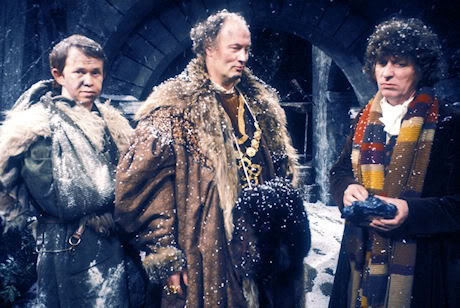
Ten Statements About....DOCTOR WHO STORY EIGHTY-SIX: THE MASQUE OF MANDRAGORA (1976)

Apparently, Philip Hinchcliffe had one last nightmare in
store before Sarah Jane before bidding her farewell...
"Do you tell the future?"
"Sometimes."
"Can you tell mine?"
"No."
"Why not?"
"Because you don't have future unless you listen to me."

1) I honestly didn't realize that this serial was shot at Portmerrien of The Prisoner and Fawlty Towers fame until the documentary pointed this out. The way the story is shot, coupled with the usual gorgeous BBC period interiors and costumes in the other scenes, create a legitimate atmosphere for what has to be one of the most atmospheric stories in the Hinchcliffe run.

2) This, the penultimate story in Elisabeth Sladen's initial tenure as Sarah Jane Smith, does not give her much to do....in fact, there's little for either her or the Doctor to do for long stretches of the tale. But writer Louis Marks (an expert in the Renaissance) has created such an engaging tale that we don't notice that our heroes have disappeared for stretches of time.

3) One of the clever elements in this story is how we're led to believe that the villain is John Laurimore's gloriously scenery chewing Count Frederico---when the real nasty customer is Norman Jones' Heironymous, who is deliciously mean and manipulative...leading to Frederico having something of a 'face turn' in the very end, just long enough for Heironymous to consume him with helix energy.

4) Yes, the Cult of Mandragora's appearance is rather primative in their optically goodness, but the simpleness of the Cult being so consumed that all that's left is glowing yellowish-orange light occupying their robes is highly effective. Plus the shots of Heironymous' mask, the glow shining through the holes, are really, really cool.

5) Especially given that Sarah Jane leaves this season, I greatly like the fact that the script plays with the idea that Gareth Armstrong's Guiliano seriously crushes on Sarah but never follows it to the conclusion that kills the story arc of so many of the companion. Hell, one of my favorite scenes involves Guiliano trying to impress Sarah with his theories about the Earth being round.
"I rather like this control room.  I think I'll keep it until, I don't
know, a new producer decides he doesn't like it..."

6) Once more, we get Philip Hinchcliffe giving us little fiddly bits that enhance the greater mythology of Who. The whole sequence introducing the new control room features shout backs to both the Third and Second Doctor that implies some untold stories. Plus we have the genius moment where The Doctor susses out that Sarah has been hypnotized by Heironymous because she wonders why she can understand Italian which leads to an explanation as to why everyone seems to speak English in the Whoniverse (namely that he gifts all his companions with the ability to telepathically understand languages). It's the sort of thing that only Hinchcliffe seems to be able to do with subtlety and grace.

7) This is the serial that introduces what is easily my favorite iteration of the Tardis control room. I love this set! Baker seems totally at home in this set, which also seems to emphasize that this is a being separate from time and space. The set is only used for this season, and depending on who you listen to it was junked because either the sets warped in storage, or because Graham Williams thought it wasn't 'sci-fi' enough. If the reason is the later, Graham Williams needs to be kicked in the ass repeatedly, and it's another reason I don't care for his tenure.
One of the charms of this serial is the realization that the
real bad guy is the one who looks like the sidekick...

8) Once more, there are these little grace notes provided by the overwhelming chemistry between Baker and Sladen. The thing that really is driven home is how, even though Sarah spends a little too much time as either a hostage or a mind controlled pawn, she is integral to setting the final act in motion, acts as a mediator between the Doctor and other characters and--most importantly--calls the Doctor on the carpet when he's busy goofing off with the suggested costumes Guliano gives him. Plus the interplay in the opening episode of the story, where she is wandering the Tardis with The Doctor, is priceless.

9) I really have to wonder if Tom Baker secretly dreams of being Errol Flynn or Douglas Fairbanks--this story shows us a very physical Doctor, riding horses, engaging in sword fights, and otherwise acting like a dashing rogue. It's obvious that there are portions of the sword fight he has with Frederico's men which uses a stand-in, but a couple of shots are obviously Baker, and you can see the joy on his face when he's doing this stuff.

10) I was a little confused by the Madragora Helix's behavior in the serial. There's this sense in the first part and change that the Helix is just some rogue, runaway monstrosity cutting an out of control swath...it's not until the Helix has contact with Hieronymous' that it starts to show not only a form of intelligence, but a heightened example of same. It's like those first appearances are there to remind us that there is a supernatural component to the tale. The story might hang together better if they had treated those early appearances of the Helix better.

Overall...a wonderful last hurrah before one of the greatest alliances in Who history is dissolved, this has all of the Hinchcliffe elements, plus some great performances. Recommended.