Showing posts with label Lalla Ward. Show all posts

Friday, March 1, 2013

Ten Statements About....DOCTOR WHO STORY ONE HUNDRED AND TEN: THE LEISURE HIVE (1980)

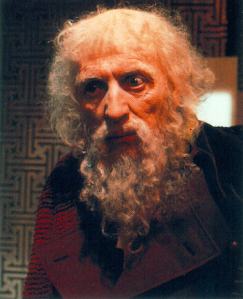
...and after getting super-old, the Doctor will
try to convince people he's an elk...

1) This is the first serial produced by John Nathan-Turner, who will guide the series until the classic version of the show is put on permanent hiatus in 1990....and boy, does he do whatever he can to differentiate it from the Graham Williams episodes.  The new starfield credits, the new music score, the use of 1980's-style  (i.e. clunky and primitive) CGI, the darker outfit for the Doctor...everything amounts to Nathan-Turner shouting 'We t'ain't your father's Who!'.  And to be fair, the new look does serve to convince us that we've come out of the children's pantomine that the Williams/Adams season had become.

2) ...which isn't to say that the show is without flaws.  The serial is so in love with its new CGI-based optical effects department that it devotes big ol' sequences that go on forever to moments that show off their prowess.  One shot of a starcraft docking is shown in its entirety roughly four times, and another shot of a model of the titular building on a CGI generated background (complete with too-bright sun beating down) seems to be repeated every time director Lovett Bickford runs out of ideas.  And this--along with other moments where Bickford indulges in arty shots like the 360 degree pan of Brighton Beach--slows the pacing of the serial down tremendously.

3) I also wonder if the serial wouldn't have benefited from David Haig not chewing his scenery so vigorously as Pangol.  Haig is so sneerily over the top that there's no doubt that he's the villain, and that distracts from the Mafia-manque story that the serial is supposed to be about...and given how Pangol's story arc results in a particularly bad CGI sequence that goes on for so long we can lovingly appreciate the level of crapitude, maybe it's better his story was minimized a bit.
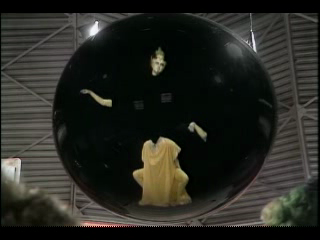
"Look!  CGI!  It's DA FUUUUTUUUURE!"

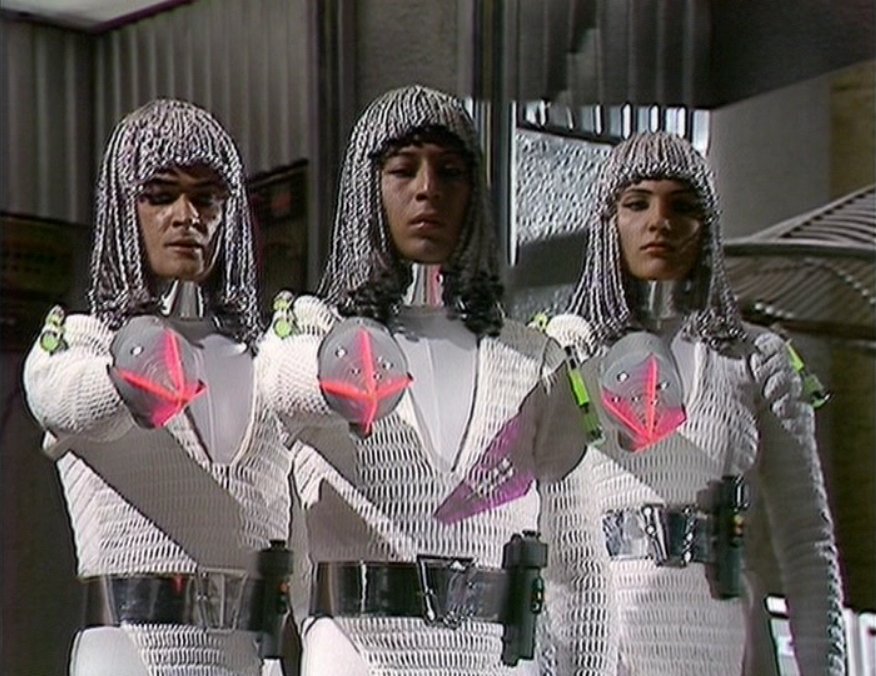
4) Pangol's craziness also detract from the whole backstory of the Argolins.  There are these weird hints at what they're all about and their biology--apparently they're plant beings (it's never explicitly stated) whose age is measured by the number of berries or seed-pods on the top of their head.  There's a number of interesting things about Argolin society that is sorta kicked aside for Pangol making nasty references to Greeks, ranting around and overall trying to be Better Than You.

5) I can almost buy the Fomasi.  In tight close up they can actually be a bit unnerving.  Even when I see them in full figure and notice the big cinch-sack like collar, I can suspend disbelief juuuust enough to let the serial flow on.  But I cannot buy the way the villainous Fomasi hide from detection for the bulk of the story....they simply cannot slip into those disguises so easily given their generous form.

6) Here's something that made all of us who weathered the panto silliness of the Graham Williams era happy....this story is based on the admittedly fictitious science of 'tacyonics,' but it's a fictitious science that is both plausible and based on a bit of science fact.  Throughout this first season and part of the next, we're going to see some pretty hardcore science fiction concepts--this season ends with a truly amazing story that's tied in to some pretty heady ideas about psychics and mathematics--and it's really refreshing after what we just endured.

"Raahr!  I's a fluffy monsta!"
7) I'm not quite sure, but there's some weird elements in the serial that seems to have been left on the floor.  There's these frequent hints that there's some form of mutual attraction between Adrienne Courri's Mena and Nigel Lambert's Hardin, yet outside of some quotes, there's nothing concrete we can hang this supposition on.  There's the whole concept of the Fomasi criminal underground.  Plus there are other things that are mentioned, allowed to take its bowed, and never brought up again.  It's kind of frustrating.

8)  Thank God that Lalla Ward is wearing something distinct and flattering to her in that Edwardian bathing outfit with the big ol' hat.  But then, the costuming overall is very clever in a minimalist way, allowing us to get a sense of each character with only the way a garment falls on them.

9) I rather liked the way the story sees the Doctor transformed (something we'll see again in the very next serial).  It shows one of the strengths of the early phase of The Nathan-Turner Years--namely, these serials for the first season and change look for ways to actively challenged and hinder the Doctor.  Seeing this doctor struggle with age and his failing brain cells, seeing him express frustration at being slower intellectually is something the viewer hasn't seen before.  We'll see this a lot in these early Nathan-Turner tales until the arrival of Script Editor Eric Seward screws it all up.

10) You'll notice how the serial quickly, and pretty much gleefully, disposes of K-9 and the Randomizer within the story.  This could be looked upon as Nathan-Turner rushing to convince us that This Is Not Your Father's Who....or if could be the very first indications of Nathan-Turner's pettiness, which we'll see in abundance once he and Seward are a team.

Overall...even with its wonky pacing and weak storytelling choices, this is a decent serial that provides something of a 'mission statement' for this first leg of John Nathan-Turner's era--an era that will sour fairly soon, but right now is bright with promise.

Saturday, January 19, 2013

Ten Statements About....DOCTOR WHO STORY ONE HUNDRED AND SEVEN: NIGHTMARE OF EDEN (1979)

"Raaaahr!  Were's monstas!"

"I shall be charging you with gross neglect of duty. The passengers should be your first concern, yet I find you drunkenly looking on as they are attacked and killed. Well?"
"They're only economy class; what's all the fuss about?"

1) This is the last serial written by Bob Baker, the writing partner of David Martin....and if I wrote this, it'd be my last serial as well because it's thoroughly and absolutely wretched.  Even if we have to assume that the story was, like others in this season, heavily rewritten by Douglas Adams, Baker's tale is so messed up I can't imagine anyone salvaging it.

2) I am absolutely convinced that Lewis Fiander was doing an imitation of Peter Sellers' Dr. Strangelove when assaying the role of Tryst....so much so that between the weird 'vest-with-John-Lennon-specs' outfit and that bizarro accent, Tryst stops the story dead every single time he opens his mouth.

3) What the Hell is Lalla Ward wearing throughout this story--a maternity dress?  That thing is so loose-fitting and so volumous that Romana looks positively lost in that ugly violet thing.

4) You know how I'm convinced that Adams rewrote this script?  There are a whole slew of ideas--the whole crux of the drug running storyline revolves around a matter storage/projection machine--that are given, ummmm, less-than-solid scientific rationalization.  The one quality of the matter projector, namely the way people are able to move back and forth into the projected window, is never explained at all.  We just see The Doctor and Romana jump into the projection of Eden and are asked to accept this.
Monsta Hug!  Monsta Hug!

5) And then there's the monsters....grumblemutter...or should I say 'da monstas.'  The Mandrils are amazingly bad designs, not the least because they sport what looks like big-ass black sausages for a mouth (which, I guess, means they're related in some way to those dorky sea creatures from The Horror Of Party Beach....).  It doesn't help that the cumbersome outfits make moving difficult, and that the zipper and the odd flash of side-flesh when the shirt pulls out from the pants can be clearly seen at points.

6) I will give this one small thing to the serial--there are some tiny moments where the Doctor and Romana actually act like, you know, The Doctor and Romana.  I particularly liked the moment where the Doctor is told he has to traverse a stretch of space liner rife with Mandrils sans K-9 and guns, and Tom Baker grins happily and says, 'I'll have to use my wits.'

7) And while we're on the subject of K-9....David Brierly assays the voice of the little tin dog and as such, this iteration does.  not. work.  The character is actively annoying from the moment it opens its 'mouth.'  And since its co-creator is writing this script, K-9 gets loads to do--most of it embarassing (particularly the moment where K-9 'sniffs' a character when the Doctor introduces him as a friend).

8) Okay, so you want to make this story about the dangers of drugs; I get that.  But do you have to do the Full Reefer Madness to depict how terrible a drug this vraxion is?  I mean, David Daker's Captain Rigg downs just one spiked drink and becomes this lazy, giggling numbnuts instantly.  The choice Daker makes to play this, which all campiness and Adams-esque 'comedy,' detracts from the supposed seriousness of the vraxion threat.
"....and I anticipate a ratio of 10 women for every man...."

9) For a series known for lame and tatty micro-budget designs, this serial hits a new low.  For a supposed luxury liner, the scenes of people in foil jumpsuits in a cardboard corridor manages to break the suspension of disbelief.  There is nothing--not the corridors, not the labs, not the engine rooms--that look like anything other than hastily designed sets.  Usually there's enough interesting things going on we can overlook the cheapness, but given how awful the story is....well.....

10) On the whole, the cliffhangers are subpar.  However, the third episode cliffhanger, where the Doctor seems to evaporate into nothingness when he successfully separates the two ships is pretty good thanks to some really good optical effect.  It doesn't convince us for a second, but at least it's neat.

Overall...One of the worst stories during one of the worst seasons in Classic Who, this serial fails on almost every level.  Avoid at all cost.

Tuesday, January 1, 2013

Ten Statements About....DOCTOR WHO STORY ONE HUNDRED AND FOUR: DESTINY OF THE DALEKS (1979)

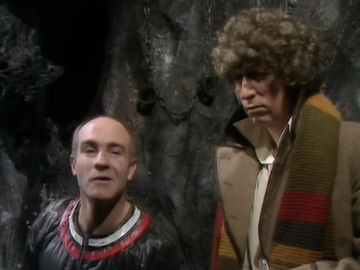
Tom Baker and Lalla Ward try to run away
from a heavily rewritten script....

"Dead?  I do not die.  Mark this moment, Doctor.  In the history of the universe, this moment is unique.  Davros lives!"
"Yes, well I can see your long rest hasn't done anything to cure your meglomania.  Have a jelly baby."

1)  And here we begin Lalla Ward's two and a half season tenure as Romana....and we begin it in typical Graham Williams/Douglas Adams fashion with a comedy sequence which shows Romana being very cavilier in her usage of her regenerations to convince the Doctor she should just mimick Princess Astra's form.  It's a tiresome scene that takes up too much time in the first episode of this serial, and it's a definite harbinger of the the way the Williams era will spiral out of control.

2) That being said, I rather like the visual appearance of Romana in this story.  With the long white scarf and the pink suit, she serves as a sort of female mirror image of the Doctor while also retaining her own identity.

3) This is the first of the Dalek stories that begins the devaluation of the characters as villains, primarily because they are subservient to Davros.  As of this moment, they're pepperpot-shaped henchmen to a man in a bad mask.

4) You know, after the series spends a chunk of the last serial devoted to setting up the new status quo of The Randomizer shifting the Tardis, ummmm, randomly with the Doctor having control of where they will end up....they pretty much crap on that by having them show up on Skaro, a place The Doctor has shown up on several times before.
It's the invasion of the cosplaying rasta fashion models!

5) The problem with the Movellans is simply that outside of being another race of robots, they've got nothing going for them.  They're just robots who are pure-d-evil, and that's that.  There's nothing that makes them interesting or scary or even notable, which means the tension the story is counting on never develops.  It doesn't help that those mopheads make them look like a bunch of people going trick-or-treating as a rasta disco band.  

6) This is the beginning of the year where the highly overrated Douglas Adams takes over as script editor (who heavily rewrote the script)...which means that Graham Williams' tendency to treat the show as a comedy runs rampant.  The forced humor begins with that regeneration sequence at the top of the story and continues throughout, the low point being the Doctor mocking a Dalek for not being able to climb up a steep incline--which absolutely invalidates the Daleks (already becoming a bit naff due to their subservience to Davros) as scary threats.

7) You know, while there is a legitimate germ of a good idea as to why the Daleks are seeking Davros out....the moment Davros shows up, that germ is discarded save for some stray mentions in dialogue and that endless 'rock/paper/scissors' scene that is supposed to explain why the Daleks need what Davros is supposed to provide them so much.  For that matter....

"I am ready for my close-up, Mr. DeVille...."
8) Is it just me, or does the whole plot disappear thoroughly around the end of episode three?  The second we get the introduction of that atmosphere-burning bomb, the whole thing just degenerates into a lot of silliness with Daleks running around with bombs strapped to their bodies and these two dull alien races getting caught in the crossfire.

9) I think I understand the decision to raid the BBC Wardrobe of all the old Who costumes to kit out the Dalek slave force....but seeing all these recognizable and obviously tatty outfits--some of which are very ill-fitting--only emphasizes the cheapness of this production.  I really have to wonder if the slave force would have been better served by showing up in simple, nondescript outfits because....

10) ...when all is said and done, the slave force and Tim Barlow's Tysson are just there to muddy the waters.  There's so little done with them that they come off as a whole big bunch o' filler....which is sad, because Barlow is generally really good, and plays off of The Doctor well.

Overall...the beginning of one of the darkest era of the series, where canonical elements are treated with contempt by Adams and Williams.  While it may not be the worst Dalek story ever (Russell T. Davies saw to that), it is amongst the worst.  Avoid.

(And speaking of avoid...wait until we get to the next story...)

Sunday, December 16, 2012

Ten Statements About....DOCTOR WHO STORY ONE HUNDRED AND THREE: THE ARMAGEDDON FACTOR (1979)

Oh, oobee do/I wanna be like you/I walk like you/talk like
you, too....

""We have the power to do anything we like, absolute power over every particle in the universe, everything that has ever existed or ever will exist as from this moment. Are you listening to me, Romana?"
"Yes, of course, I'm listening."
"Cause if you're not listening I can make you listen, because I can do anything. As from this moment there's no such thing as free will in the entire universe. There's only my will because I possess the Key to Time."

1)  ...and so the final story of the Key To Time Saga ends with this bloated, epically awful story which serves as an argument against the six-part format, primarily because so much of it is taken up by the equivalent of water-treading.  There is barely enough in this mess for a four-part story; making it a six parter makes for an unbearably slow watching experience.

2) This serial is rife with some wretched performances--and none are as bad as John Woodvine's scenery-devouring turn as The Marshall.  Woodvine pitches his performance at such a melodramatic level where he seems to be shouting every single line--even the ones where he's supposed to be whispering--and comes off as strident and bullying.  Hell, when your performance is so bad you can't even convincing sell the single word 'Fire!' (a word you have to repeat over and over again for an episode and a half because you're stuck in a time loop), well...it's time to go act in another story.  Or show.

3) I'm still scratching my head trying to figure out what the deal was with William Squire's Shadow.  We're literally given no back story whatsoever when it comes to this goof save that he likes to laugh a lot and is an agent of The Black Guardian.  Much like Woodvine, Squire is chewing up the scenery while actually doing very, very little.  And when we learn of The Shadow's ultimate fate--and that the Guardian actually planned for it to happen--you have to wonder why he was sitting there on Xeos doing all this pointless scheming and running around in the first place.
Nooooooo!  Drax!  Go away!  Stupid Drax....

4) This is Lalla Ward's first appearance on Who, and her turn as Princess Astra (coupled with Baker's interest in her) inspired Williams to cast her as Romana when Mary Tamm gets pregnant.  However, even though Astra is integral to the plot and Ward is fairly decent in her performance in comparison to Woodvine, Squire and others, the reason she's so integral is literally forgotten about for about three episodes until someone realizes they need to get back to the Key To Time aspect of the story.

5) ..but then, the scattershot nature of the plot is indicative of the script by Bob Baker and Dave Martin.  Plot developments are dropped suddenly, perils are introduced only to be waved away a few minutes later, whole characters seem forgotten for long stretches, and there are gigantic stretches of plot that seem riveted on just to eat up time.  Add in a shockingly shoddy grasp of science even for this era of classic Who, and you have a monstrous mess.  

6) And then there's...grumblemutter...Barry Jackson's Drax.  An awfully conceived character to begin with given tiresome life by Jackson, Drax is given far too much time to introduce himself as a comedy element the story really didn't need, then seems to complicate the plot solely for the sake of complicating it.  And the biggest problem with him?  He's introduced in the fifth episode, long after the last significant character (the computer Mentalis) was introduced in the second episode.  I have to think that Baker and Martin had so written themselves in a corner that they created Drax solely as a deus ex machina to get the story to wrap up neatly.

7) Look, I know that the science in classic Who can get really wonky....but The Shadow uses a mechanical device designed to control and communicate with living beings to control and communicate with K-9.  Really, Bob Baker and Dave Martin?  Really?

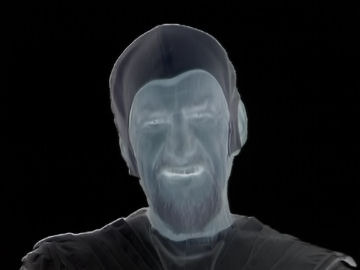
"Of course I am evil...I am able to turn myself into a
negative image, see?  See?
8) Given what she's endured this season, Mary Tamm ends up in this serial being one of the better things in it.  She ends up actually functioning the way she was set up to function in The Ribos Operation, and figures out some of the plot angles before Baker does.  Plus she ends up wearing a modified version of the outfit she wore in Ribos, with the skirt shortened slightly and rather kicky boots, that is extremely flattering to Tamm.  Pity she steps down to become a mother after this serial, because she seems to have found Romana's character again.

9) And while we're on the subject of characters I actually like, I rather enjoyed how Davyd Harries' Shapp is originally presented as The Marshal's lackey who does nothing but follow orders...and ends up transforming over the course of the serial into someone who is opposing his superior's insanity in his own way.  Plus Harries manages to infuse Shapp with a strange sardonic humor of his own that actually serves as a subtle form of comedy relief.  Sadly, he degenerates into a slapstick buffoon (get used to this), but for a while he's a refreshing presence.

10) Of course, all this five-pounds-o'-story-stuffed-into-twenty-pounds-of-television leads to a rather good finale to this ambitious season-long story arc.  The moment where Baker figures out the implications of what having the Key to Time truly are works wonderfully until it's blunted by some of the patented Williams era forced humor.  And the status quo the series ends up with, where the Doctor slaps a 'Randomizer' onto the control console so he and Romana can evade The Black Guardian (well realized by Valentine Dyall) is promising at this point.  Granted, it all goes to Hell starting with the very next serial (and guess what we're covering next time?), but for the time being it leaves the series in a potentially excellent place.

Overall...a boring and aggravating serial that's marred by some horrendous acting and poor plotting.  The final sequence, which is good, does little to alleviate the overwhelming ennui that infuses this pointless tale.

And just a warning...it gets worse.