Showing posts with label Louise Jameson. Show all posts

Wednesday, August 15, 2012

Ten Statements About....DOCTOR WHO STORY NINETY-SIX: UNDERWORLD (1978)

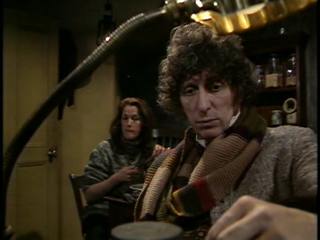
"....maybe if I sit hunched up like this, I won't fall out of my
top so often...."
"But that'd just a myth, a story!"
"Myths often have a grain of truth in them, if you know where to look."

1) You will notice that large portions of this story look very different from previous serials. That's because, due to budget constraints, the bulk of the story was done using a model of a tunnel system chormakeyed in behind the actors. And while it is a unique look, it's not neccesarily a good look. The actors frequently look as if they're floating in space, and it's hard not to notice the sameness of all the rock behind them. Still, I give the production team credit for trying something new.

2) This is the penultimate Leela serial, and it's easy to see why Louise Jameson didn't want to come back the following season. Leela has pretty much become an infantilized child at this point, simpering and acting like a dolt and having tantrums left right and center. None of the insight and intelligence that Leela had under Hinchcliffe survives, leading us to wonder why The Doctor wants to hang with her in the first place. Plus the more modest version of the 'leather' tankini (obviously fashioned out of cloth) that covers up her butt but somehow cannot manage to sit comfortable under her bustline, resulting in many moments where we see Jameson struggling to adjust her outfit to prevent a pop-out moment.

3) Truth be told, there's a fundamental reason why I've been dragging my feet on writing up this 10 Statements is because....well, this serial is relentlessly boring. This is not like some of the later Williams serials (and trust us, we'll get to them down the line) where their awfulness bursts from the story like an overripe piece of fruit; this is a story that just sits there for long stretches and does nothing to distinguish itself one way or another. You're likely to forget it the moment the closing credits roll on the last segment.
It's not easy to float on a fabricated set....

4) Remember how I spent a lot of time talking about how Hinchcliffe frequently utilized horror motifs to liven up his tenure? Well, here we see Williams utilizing one of his favorite motifs--namely, utilizing mythology and classic literature and resetting them in a science fiction setting. There will be times where it works (wait until I sing the praises of The Androids of Tara), frequently, like here, it doesn't. This is because unlike Hinchcliffe, who found ways to obscure and change around his inspiration, Williams just marches out his inspiration aspects and asks us to marvel at how he's doing a riff on Jason and The Argonauts or Damocles or any one of a number of stories. Hell, he frequently has The Doctor pointing out the similies throughout this story.

5) You can see here that Williams has reoriented the series to become more child-oriented, which means that there's a broader sense of humor in effect. And that humor is pretty nonsensical, beginning with the opening scene with The Doctor painting....something. It's something that's still subtle at this point (it'll get reeeeaaaalllly broad once we pass the Key To Time season), but it's real jarring when placed next to Hinchliffe's more mature stories.

6) As much as I blanch at Leela's treatment and debrained status in this story, I do like the way she takes on a mentoring relationship she has with Idas, comforting and advising him much as The Doctor advises her. My favorite moment is a very, very sparse handful of positive moments arise from this mentoring, when Leela tells Idas 'The Doctor has saved many fathers,' when the young man frets over the fate of his father.
Yes, they're ribbed...for her pleasure.

7) Perhaps the oddest thing about this serial is how it carries on the borderline radical political stance that colored the previous serial, The Sun Makers. There's a moment in the third part where the story literally stops for a few minutes so that a random female Trog explains to The Doctor and Leela how they're pawns in a massive capitalist scheme where they're worked to exhuastion, the Seers orchestrating cave-ins that control the population so that the population won't exhaust their resources so that.... It's a dreadfully confusing moment that stops the painfully slow narrative flow of the story dead.

8) With all the pointless bullcrap that goes on in this story, I will say that the cliffhanger for the first part of this story is not only really novel, but plays on William's interest (an interest that is, shall we say, spottily displayed throughout his three year tenure) in hard science. The idea of the spaceship becoming a new planet due to gravity is pretty freaky, but it's very much in keeping with the physics of the situation. Were that the other two cliffhangers were as inventive.

9) Okay, the look of the Guards and the Seers (at least until they take their helmets off) are really intriguing....until you realize they have no reason to have that seven eyelets at each character's sightline. I get that, in keeping with the Jason and The Argonauts' theme of the serial, these costumes are supposed to signify that they're analogs to the Hydra, but still--what's the cultural reason for this change?

10) Even with all the mugging and dismissiveness The Doctor displays--even after he seems invested in the Minyans' quest given the part that race plays in Time Lord history--I do appreciate the way he sticks up for the Trogs and refuses to let them be ejected by arguing how they are the true race banks of the Minyans. It's indicative of these stray moments throughout the Williams stories where The Doctor isn't playing games and behaving like a goof, and is actually revealed as the Smart Crusader we know and love.

Overall...a boring, boring story that's sadly far more indicative of the Williams era that you would think. Hell, it may end up making you angry at how Williams seems to have squandered the set up he inherited from Hinchcliffe.

Tuesday, August 7, 2012

Ten Statements About....DOCTOR WHO STORY NINETY-TWO: THE HORROR OF FANG ROCK (1977)

"I have a bad feeling about this, Leela...it is as if a different,
less competant person is controlling our adventures..."
"Gentlemen, I've got news for you. This lighthouse is under attack, and by morning we might all be dead. Any worries?"

1) This is the first story of Graham Williams' tenure as the series' producer, and it'll prove to be a dark, dark time in the show's history. A lot of people give Williams a pass because his few highpoints are very, very high (The Key To Time), and because he got Douglas Adams to be script editor and to write a story or two. Since I think of Adams as a man with a very limited repertoire who showed more contempt for Who than affection, and The Key of Time hit and miss...well, I'm not all that impressed.

2) That being said--much like the last time we had a transition between producers, this story feels much more like a product of the previous administration. There's a definite Hinchcliffian Gothic feel to the story thanks to the atmospheric set designs and a clever script by Terence Dicks. In its way, this is the perfect melding between Hinchcliffe's very complex, very adult storytelling and Williams' much more simplistic, more child-oriented way of doing things.

3) The biggest indication of the sea change lies in Leela herself. It's a lot more subtle than it'll be in later serials, but there's a noticeable dumbing down of the character, as well as a general display of ignorance on her part. Louise Jameson does her best to deal with this schizophrenic revision, but it's obvious even when Dicks' script tries to create some continuity (the outburst where the Doctor defends her contention that there's been a drop in temperature is particular stands out) that she's not the person Philip Hinchcliffe intended her to be any more.
"So to review...you're greedy, you're honorable, you're a
screamer, and you're inexperienced....got that, Leela?"

4) While I appreciate that Dicks gives all of the supporting characters some time to define themselves, even inconsequential ones such as Ralph Watson's Ben and Annette Woollet's Adelaide, not all of them are worth it. Adelaide, in particular, is next to useless, being there mainly to sniff about Leela being a savage and screaming. A lot.

5) The weirdest thing about Leela is this story, incidentally, is how much I like her dressed in the slacks and cable-knit sweater she sports for the bulk of this story. The sweater takes away the rather silly leather tankini, which looks more bizarre in each new setting (but then, I'll learn to miss the original leather tankini when Williams introduces his new version later in the season), and seems to emphasize her viciousness. Heaven help me, here is the one time I find her sexy.

6) We should probably address the Rutan. Okay, I appreciate the (apparently spur-of-the-moment) choice to connect this monster to the Sontarans, the fact that it is...well, a giant dayglo green jellyfish with goofy shaky lines for eyes. The story does manage to conceal and obfuscate the appearance of the monster through shooting it through the foggy outsides of the lighthouse...but once it reveals itself to the Doctor on the steps in the fourth part, it's hard to take it seriously at all.

Evil Jello Molds are always a disappointment.
7) ...especially given how gleefully creepy Colin Douglas is when the Rutan sneaks around disguised at Ruben. Not saying a word, his only reaction a wicked grin, Douglas' performance during this sequence is wonderful to watch. It makes up for some of the cliched elements of the character in the earlier parts of the story.

8) That whole last segment of the fourth page seems a bit...gratuitous, innit? I understand the need to repel the Rutan invasion fleet, but the whole 'we're going to convert the lighthouse into a laser weapon using Lord Grubby-Hands' diamonds he happens to keep on hand' development stinks of last minute improvisation designed to take up a few minutes and give Louise Jameson an excuse to ditch those uncomfortable contact lenses.

9) Given where Williams' tenure goes over his next couple of seasons, I have to give the story credit for continuing the fatalism and darkness of the Hinchcliffe era. Outside of The Doctor and Leela, no one really survives. Okay, some of that lack of survival was welcome--I'm looking at you, Adelaide the Screamer--but even the characters who behave in a heroic matter get their asses electrocuted. And this fatalism also leads to a scene where The Doctor admonished Leela for exulting in her killing the Rutan which is brief, but effective.

10) The very end may seem rather innocuous, with the Doctor quoting the poem that partially inspired this story...but this is just the first appearance of a lazy trope Williams uses again and again where he acknowledges his source material at the end. And trust me, it gets tired quickly.

Overall...a fairly good transitionary story that has within the seeds to why I do not care much for Graham Williams' tenure as producer. And while it gets much worse as we delve deeper into this dark time of Classic Who, this tale can be tentatively recommended.

Sunday, July 29, 2012

Ten Statements About....DOCTOR WHO STORY NINETY: THE ROBOTS OF DEATH (1977)

What a difference a leather tankini makes....
"They use them in the construction centers. If ever we used the stop circuits and turned off all our robots, they'd have to go back to a construction center for reactivation. On arrival each would be marked with a disc like that to show it is a deactivated robot. The technicians call them corpse markers."

1) We're now in the Leela era, the very brief period (I was surprised to realize this period lasted only three stories over a single season) that serves as a transition between the Baker Doctor's two major companions. I am not as big a fan of Leela as most men--the leather tanktop and shorts thing didn't do anything for me, and Louise Jameson does little for me--but under Hinchcliffe she is an intriguing character. As we'll see in this story, she's a highly intelligent woman who was raised in a society where she didn't the tools or the inclination to stimulate her braininess. This leads to the Doctor taking her on as a companion to mold and shape her into the person he sees she can be. Of course, after the fourteenth season, Leela falls into the hands of Graham Williams and becomes something a lot less intriguing, but we won't talk about that now.

2) This story and the one that follows it is unique in the Hinchcliffe canon in that they take their inspiration not from horror but mystery tropes. Even though there are references to the robots being 'the walking dead' (said reference leading to a great little piece of exposition about the fear of robots by Baker), this is at its core a sci-fi trade dress version of the Agatha Christie classic Ten Little Indians interwoven with generous helping of Isaac Asimov's Robot stories. And the way Hinchcliffe and writer Chris Boucher fits that novel's plot to service the series is nothing short of stunning.

3) And to emphasize this connection to Christie's Edwardian-era mysteries, the world of this story is really well designed. There is a definite whiff of Art Deco in much of the fixtures around the ship and the costumes of the characters. It hints at a greater culture and aesthetic, and probably didn't cost all that much given the amount of atmosphere it delivers.

4) One of the nicer touches is how Boucher flips Ten Little Indians' main plot conceit in having the character most people overlook as one of the heroes....and what a character he is. Gregory de Polnay's D83 is a magnificent temporary companion to the Doctor...and I love the impression I get that D83 strives to be a better 'robot,' leading to The Doctor insist that he's becoming more human. Plus we get inherent comic relief in some of his natural reactions.
"I love you man."  "No, I love YOU, man!"

5) I really appreciate how our supporting cast all have very distinct personalities that feed into the Christie conceit. And it's funny how the character who ultimately turns out to be the villain is the one who a) has the most reasonable excuse for knowing the thing that would otherwise give him away and b) seems the most level-headed and reasonable, leading us to mark him off the suspect list immediately.

6) Granted, a case can be made for Russell Hunter being written off as a scenery chewing goof, especially in the middle part of the story. But there's some sort of depth to Uvanov that makes him a much more compelling character than the callous slave driver we meet in part one. And once we learn some of what makes him tick, it makes him a joy to watch in the story's final act.

7) Even though it was obviously a model, I am fascinated with the workings of the sand miner. Besides being something of a novel setting, the shots of the miner trundling along, turbines working give it a sense of atmosphere and otherworldliness. It's the sort of small thing Hinchcliffe does that provide depth to each story.

(Plus...for someone who hates enclosed spaces, the cliffhanger for Part One freaked me out)

"Hello, I'm here to judge the Silliest Sci-Fi Costume Contest..."
8) The main reason this story freaks me out is how so many of the cast are robots--and since robots are not living things, they can be seen on a family television show mangled, torn up and otherwise mutilated. There's one shot where Poole comes across a robot whose head is smashed in, but the attacker apparently tried to fix up with electrical tape, that still gives me nightmares.

9) I love all the little tips of the hat Boucher's script gives to Isaac Asimov's Robot stories, from the references to the Laws Of Robotics to the introduction of 'Grimwade's Syndrome.' It gives the threat a fuller feel beyond the ol' 'Yaaah! Killer Robots!'...which in turn gives the story more gravity.

10) While I really appreciate that The Doctor entrusts Leela to enact the very Pulp-like solution to the story (like Doc Savage, The Doctor doesn't kill his enemy, but lets him bring about his own demise), the gentle mockery of Leela seems out of place, especially if we assume the Doctor's motivations for taking her on as a companion lie in his recognizing her intelligence. Sadly, this is a harbinger of things to come, when the Graham Williams era comes in and treats Leela more and more like a comic foil for Baker's Doctor.

Overall... wonderfully frightening little whodunit with loads of atmosphere, and one of the best stories of the post-Sarah Jane Hinchcliffe era.