Showing posts with label Modern Westerns. Show all posts

Tuesday, January 31, 2017

Ten Statements About....THE MAGNIFICENT SEVEN RIDE! (1972)

"I know I look nothing like George Kennedy or Yul Brynner.
Just go with it."
“Well, should we bury 'em?"
“The living need us more."

1) Maybe it’s because Lee Van Cleef is a different kind of actor than either Yul Brynner or George Kennedy, but his Chris Allen is a lot more ruthless and near-unfeeling in his deadpanedness.  At times, his attitude is downright offputting.

2) Even though it all happens off-screen, this film is awful rapey.  Not only is it implied strongly that villain Del Toro and his men have had their way with the women of Magdelena, but it’s explicitly stated that Mariette Hartley’s Arietta was violated before she was killed.

3) And speaking of Del Toro--because the character doesn’t appear until literally the last moment, we’re never given the sense of him the previous films gave us of their bad guys.  As a result, he’s a paper tiger, a target for the seven to shoot at.

4) I don’t care how hard you try, it’s impossible to make the sight of our heroes’ horses strolling along around an uncovered wagon look majestic.

"Watch it...critics right around this corner.  And they ain't
pretty!"
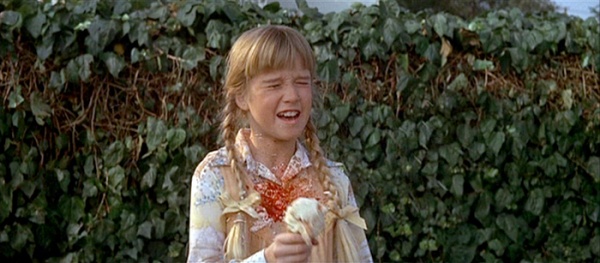
5) For a village of Mexican farmers, the women are all uniformly white.

6) By having the kid Chris holds partially responsible for Arietta’s death killed (off screen) by someone else, it sort of blunts the character’s arc.  If they had allowed the kid to be a part of Del Toro’s gang and confront Chris in the climax, the film would have had a more satisfying spine.

7) This film is so...drab.  The main characters are dressed not in the easily definable, colorful outfits of previous films in the series, but in dark, lookalike clothing.

"You gals are mighty white..."
8) I miss the ‘getting the band together’ sequences the previous films had.  The remaining five members are literally picked up in one fell swoop at the prison.

9) You know what would have made it easier to tell the seven apart?  Saying their names more than once, and even then in an offhanded way.

10) Gee, it’s nice to know that Chris gets over the death of his pregnant wife quick enough to take up with Stephanie Powers.  Good way to engender character sympathies, writers.

Overall...a tired, dull and lackluster last entry in the series with just enough of a scuzzy edge to it to make it unappealing.

Sunday, April 22, 2012

Ten Statements About....ASSAULT ON PRECINCT 13 (1976)

One of the most important shots--both figurative and literal--
in a film that establishes that No One Is Safe....
"What does it mean?"
"It means they don't care. They're not afraid to die, any of them. They want to rip us apart no matter what the cost. It means...to the death."


1) You know, I've said this before, but it needs to be said again--nothing, but nothing sounds like a John Carpenter soundtrack. From the moment the martial strains of the theme starts over the black screen, you know whose territory you're in.

2) I like how Carpenter, through the way he introduces the little girl only to have her casually shot dead, makes it very clear that no one is safe--a message further reinforced when both Starker and Julie die during the course of the film.

3) Now, see....here's how you set up an intriguing anti-hero. We never learn much about Napoleon Wilson outside of maybe his crime and the fact that he's a Real Big Figure when it comes to law enforcement. But then...we don't need to know much. Thanks to Darwin Josten's performance, we know everything we need to know--that he's got a code of honor, that he's level headed, that he respects people who give him respect. And that makes us willing to root for him when the siege happens.

4) I know that this is an unofficial remake of Rio Bravo--something Carpenter does variations on several times throughout his career--but I have to also wonder if Carpenter was influenced mightily by George Romero. There are a number of moments that mirror Night of The Living Dead, and the way the marauding bands are shot sort of slipping in and out of shadows makes them seem like zombies.

These three people have been through Hell...and only
John Carpenter knows their full backstory....
5) I give much respect to Carpenter for being able to recognize when the film benefits from being quiet. There are long stretches of this film that occur in total or near silence, and those stretches help to increase the tension, while allowing him to continue building up his characters and getting us to give them our sympathy.

6) However, something I do think muddles the waters is the opening battle between the cops and the Street Thunder Gang. An argument could be made that the film could be streamlined a bit, making the death of the little girl collateral damage in a drive-by or similar crime and sidestepping that battle completely. That would also make the situation a little more 'personal,' as the choice to give aid to the girl's father would prompt the gang to focus on this place.

7) The whole idea of establishing that this is a precinct that's being closed down, that will have its utilities cut in the morning, is very clever on a number of levels. For one, it gives us a reason why most of the action takes place in near darkness--which allows Carpenter to save on special effects at points. For another, it gives the exterior an air of normalacy that the mostly faceless, silent throng can use to their advantage. And it also emphasizes the isolation of our heroes--while also gleefully shoring up the horror movie ambiance that this film has. It's no wonder Irwin Yalbans saw this and realized Carpenter would be perfect for his Babysitter Murders project.
They may be convicts heading for Death's Row...but they
are heroes in one sense or another....

8) Some words should be said about Laurie Zimmer's Leigh. What impresses me about her is how she's competent, but in no ways a super woman--and the fact that she has a chemistry with both Josten and Austin Stoker's Bishop shores up her own character. And the fact that romantic interest is implied by never paid off on...well, there are some directors who can learn from Carpenter's handling of this.

9) And I'm going to make it clear--I respect that the moments of comic relief (the two cops searching for all this carnage to increasing frustration; the way Wilson and Wells resolve who has to risk their lives, etc.) are funny but also fraught with a touch of unease so that the increasing tension of the scenario is not disrupted.

10) I respect the fact that just as Carpenter spent some time thinking through the scenario, he spent some time showing through their actions that these gang members are not idiots. And because they're not idiots, the heroes are raised up in our eyes since they have to struggle to outlast them.

Overall...a clever little actioner that shows a lot of what made John Carpenter the mega-super-star he was in the late 70's and early 80's, a film that can be looked at as a blueprint for future films in his ouvre.

Sunday, July 10, 2011

Ten Statements About....THE WILD BUNCH (1969)

Is there a more iconic shot in modern American western cinema?
"We're not gonna get rid of anybody! We're gonna stick together, just like it used to be! When you side with a man, you stay with him! And if you can't do that, you're like some animal, you're finished! We're finished! All of us!"

 
1) You know--even as someone who's primary fame has been in horror, I've rarely seen an opening sequence quite as disturbing as this film's moments with a group of smiling children torturing scorpions by dropping them into a mass of ants and then burning them. It echoes not only Bishop and his crew's final fate...but in retrospect puts a sinister face on one of the film's general themes--namely, that all men, even cruel ones like the Wild Bunch, yearn to be innocent like children again. Transposed against these children....well, we have our doubts.

2) On BiTD, I've made comments about how Peckinpah and Leone shared a lot of credit in changing the face of the Western. Here's another thing they share--a love of faces. The opening robbery and gun battle (which, let's be honest, would be the climax of most other westerns) is frequently punctuated by reaction shots of townspeople wincing in horror at all the carnage. and speaking of carnage...

3) I don't think anyone pays as much attention to the aftermath of carnage as Peckinpah. The sequences of T.C and Coffer wandering over the streets filled with bodies arguing over who shot who first and who gets to keep which boots emphasizes the banality with which this extremely violent world is treated.

There's nothing quite so intimidating as William
Holden with a machine gun.
4) While there literally any bad performances in this film, my favorite has to be Ernest Borgnine's Dutch. There's something in the way he uses that toothy smile of his where you're not sure if he's enjoying himself or anticipating the fun of slitting your own throat. Plus, the genuine friendship he has with Holden's Bishop is palatable and alive....

5) Here's something Peckinpah shares with another great genre filmmaker of the 60's and 70's, George Romero--namely, the fact that in this film the Wild Bunch fucks it up for themselves. All the mistakes they make are made because they act against their instinct and attempt some degree of honesty and fairness. It's not killing the one straggler after the initial robbery that dooms this crew; it's trying to help Angel even after he violates one of Bishop's direct orders.

6) I know a lot of people claim Peckinpah's world is a man's world...but it's not. It's an individual's world. Notice how every time a part of an official institution--the railroad, the military, etc.--tries to do something, they are thoroughly incompetent, unable to compete with Bishop's crew. And the only person who has a chance to capture the Bunch--Robert Ryan's Thornton--is literally hamstrung by the group of goofuses the railroad forces on him.

That this is the moment that seals the titular bunch's doom
is all the more amazing given Borgnine's performance.
7) Reason This Film Could Not Be Made Now #58: no Hollywood studio nowadays would allow the moral ambiguity of Dutch leaving Jaime Sanchez' Angel with Mapache. They would make Dutch fight to keep him right there and then, which would kill the whole third act's conflict and dull the impact of the final gunfight (of course, the final gunfight would end with at the very least Bishop and Dutch triumphant and still alive for a potential sequel, so....)

8) We hear Bishop say 'Let's Go' throughout the film...but we do so to set up the final time he says it, just before the remaining Bunch head off to their fates. Holden is such a great actor and infuses those two syllables with so many different emotions in that moment--sadness, weariness, acceptance--that's it's positively chilling.

9) When I was younger, a lot was made of Peckinpah's overuse of slow motion. Watching this now, I can see that while there are some slow motion moments, it's used sparingly. However, Peckinpah uses some tricks--like bisecting a single action with a quick cut away to stretch out the moment--that makes us think he's using slow motion.

10) It's very deliberate that the two people who do survive this film are the two who have shown a capacity to adapt--Thornton, who adapts to becoming something of a lawman to escape prison time, and Edmund O'Brien's Sykes, who adapts to become a cook so he's useful to Bishop long after he's too old to fight. When they ride off with the rebel troops, it closes the book on the West Bishop and Dutch thrived in...driven home by Peckinpah's choice to freeze frame the final image and pull away from it as it morphs into a still photograph.

Overall...an essential film if you're at all interested in the development of the Western, a film that is so known for its violence that people forget the emotional depth and nuance that is its true strength.

Sunday, June 5, 2011

BETTER IN THE DARK Rides Out...Leone Style!

In this episode, we celebrate one of the architects of The Modern Western, Sergio Leone--and use our discussion of this Great, Great Man to talk about the genre of the Spaghetti Western as a whole.

All this, plus we answer listener mail about anime, silent film comedians and whether super-heroes are inherently silly.

When A Man With A Rifle Meets A Man With A Gun...The Man With The Gun Clicks!