Showing posts with label Patrick Bachau. Show all posts

Wednesday, October 15, 2014

Ten Statements About....PHENOMENA (1984)

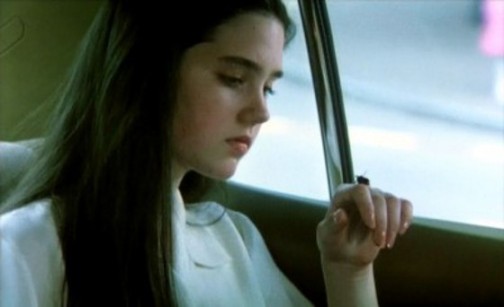
It's Jennifer Connelly playing with a blog...there's a fetish for
that, isn't there?
1) You want some proof that Dario Argento is interested solely in the moment and not in the story?  Look at how the killer turns out to be a character who literally appears in the beginning, disappears completely from the film, only to reappear in the third act to behave totally in opposition to how her behavior was in that long ago first scene.

2) Supposedly, Argento intended this to be ‘a fairy tale for adults’....and once you know that information, you can see the Brothers Grimm influence throughout, from the evil house in the woods to the kindly old wise man to the guardian spirit saving our heroine.  Okay, granted the guardian spirit in this case is a mass of bugs, but still....

3) You know, people always focus on the weird gore when it comes to Argento and they don’t realize the man has a real eye.  There are a number of compositions in this movie that use color to draw the eye.  Some of the shots of Jennifer Connelly’s Jennifer walking through these vast fields really pop because of Argento’s decision to have Connelly wear an Alice-In-Wonderland-style all white dress.  And speaking of Connelly....
"So I'm going to slash Daria Nicoldi and bite Jennifer
Connelly's thumb...anything else, Don?"

4) ...for someone assaying her second film role in a movie whose director is notorious for putting his female leads through the wringer, Connelly really acquits herself amazingly well.  She manages to both be creepy and otherworldly while also keeping the audience empathy, primarly through the genuinely sweet interactions she has both with Donald Pleasance’s  McGregor and Federica Mastroianni’s Sophie.

5) What a freakin’ weird soundtrack, switching from heavy metal songs to long time Argento collaborators Goblin to cues from the original Dawn of The Dead.  Admittedly there are moment where this strange Frankensteined things works, but there are other times when you know the soundtrack should be underplaying things and Argento has chosen to have Lemmy from Motorhead screaming in your ear.

6) It’s interesting how Patrick Bauchau looks vaguely sinister even when he’s playing a good guy cop who’s actively interested in helping Jennifer.  Of course, this being a film set in Argento’s Universe, he ends up being not so competent, and dies in the third act.
It's a woman's head going through plate glass....there's a
fetish for that somewhere...oh, yeah, in Argento's house!

7) It’s obvious that even though Tenebrae was made between this and the two ‘Mother’ films, this movie is much more influenced by the look and feel of Suspiria and Inferno.  Argento is still exploring monochromatic compositions and unconventional set-ups, and his sometimes infuriating habit of throwing stuff in not because it strengthens the story but because it contributes to the feel he’s trying to achieve (I’m looking at you, sleep walking Jennifer Connelly) is very much in the forefront here.

8) Even though she slashed Daria Nicoldi and bit Jennifer Connelly’s thumb, I am struck by the performance of Tanga as McGregor’s chimpanzee assistant Inga.  Whether through intelligence or manipulation by her owner, Tanga manages to convey actual emotion, especially affection towards her master and rage at his killer.  And while we can see Inga as one of Jennifer’s protectors, we also realize that she is acting out of grief for the man who showed her care and affection.

9)  Considering what Argento has his then-wife Nicoldi do, and what happens to his daughter Fiore...well, he must have conflicted feelings about his family.

10) You know, given how much is made of how sinister Dalila Di Lazzaro’s Headmistres is and how antagonistic she is to Jennifer, having her literally drop out of the picture whole makes no sense.  She doesn’t even have enough screen time to qualify as a red herring.

Overall...one of those films that made Argento’s reputation before he went diving in the shit barrel, it’s an essential view for people interested in what we all see in the man, and for people curious about seeing Jennifer Connelly at her very beginnings.

Sunday, January 27, 2013

Ten Statements About....CHOOSE ME (1984)

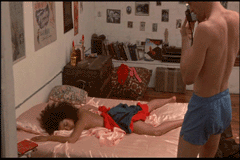
"Yep....I'm taking naked photos of Rae Dawn
Chong...sucks to be me."

"You can't go around asking every woman you kiss to marry you."
"Why not?  I only kiss women I marry."

1) One of the reasons why I feel this is one of the examples--if not the example--of Alan Rudolph's art is how artificial it looks.  Even though this is supposed to Los Angeles, the streets outside of Eve's Lounge and elsewhere are obviously studio backlots...and it adds into the stylization in the look and the emotional feel of both the setting and the characters herein.  And this artificiality extends to some of the interiors, like the movie-poster laden loft of Rae Dawn Chong's Pearl.  This conscious artifice helps make the unreality of an L.A. that apparently is occupied by only these sextet of people seem more real.

2) I can see why Keith Carradine was something of Rudolph's male muse.  Yes, he's a handsome man, but there's a certain darkness in his eyes (something that Rudolph exploits fully in his next film, Trouble In Mind) that is disquieting.  His face is the perfect avatar of the Rudolph aesthetic.

3) One of the most amazing conceits of the film is how we're told that Carradine's Mickey is incapable of telling the truth...and yet, we get evidence halfway that maybe Mickey's various stories are the truth.  The concept is introduced very carefully, very subtlety, and then never brought up...which leads us to another reason why I love Rudolph as a writer/director--he trusts us enough that he allows us to come to our own conclusions.
"Yep...Genivieve Bujold makes me lunch and
then sleeps with me..my life is soooo bad."

4) Wow...so Carradine gets to kiss in order Lesley Ann Warren, Rae Dawn Chong, and Genevieve Bujold.  He gets to see Chong naked and sleeps with Bujold....

Yeah, Keith.  Tough life.

5) As interesting as Mickey is, Bujold's Nancy is even more so--probably because we know even less about her.  She professes to be incapable of falling in love, insists on talking to her therapist only on the phone...and yet there's that bizarre scene where we see her dressed up to the nines and caressing her very exposed thighs while her therapist tries to stop her from....something.  It's one of the most disquieting scenes because we don't understand how exactly Nancy's mania expresses itself.  And when she does transform in the third act, it's relavatory.

6) ...which leads me to wonder if Nancy and Lesley Ann Warren's Eve aren't meant to represent two aspects of the same person--to be precise, two extremes of the same person.  Eve looks to put her sexual past behind her, whereas Nancy seems to want to use some expression of sexuality as a way to abandon her emotional repression.  There is the sense that one of these two women would gladly become the other.

7) Alan Rudolph should be ranked with Quentin Tarantino as a director who knows how to use music, although he approaches his music use differently.  In this film, he has Teddy Pendegrass do the whole soundtrack, which results in a score that's as sensuous and smoky as the film itself, a score that comments on the action and is more than just background noise.
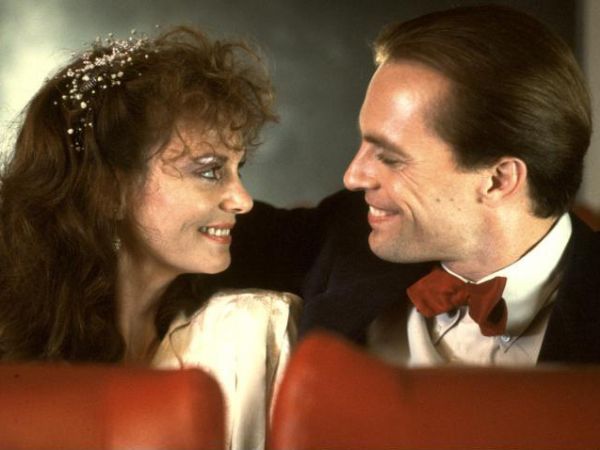
"Yep...I make out with and marry Lesley Anne Warren...how
I hate my life!"

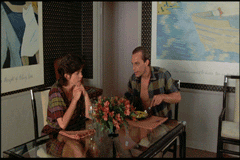
8) Once you get past the sight of him with a full set of hair, Patrick Bachau's Zack is at turns both the villain and the comic relief, the one hint of true menace in a world of artifice and randomness.  While we get the impression he's a gangster (you can't have an Alan Rudolph film at this point in his career without there being a gangster), he's not an effective one; and since his main purpose in the film is to be frustrated at every turn by Mickey's talent for finding and romancing all his women --leading up to his dead spot perfect, hilarious last line, it works.  It looks so weird seeing him in this film.

(And the same goes for seeing John Laroquette as Eve's bartender...particularly because he seems to tower over everyone else in the film.)

9)  If there's one regret I have about Rudolph's career, it's that he seems to resist giving into the magic realism his world seems tailor made for.  There are some very sparse moments when he indulges in the practice, like when we see Nancy physically appear behind Eve for a second during a phone conversation the two are having, or when the prostitutes who hang out outside Eve's Lounge start doing what appears to be ballroom dances.  I think if Rudolph had embraced this tendency, he may be better remembered today

10) I love the fact that even though this film seems to have a happy ending, Rudolph refuses to go all in--there are brief moments, especially the last shot of the film, that hint at both Eve's and Nancy's stories haven't resolved themselves in a positive way.

Overall...very moody and stylized (I will always contend that Rudolph films aren't romantic comedies so much as romances where strange and funny stuff sometimes happen), this is a prime litmus test for whether you will like his idiosyncratic oeuvre.  I happen to love his work, and consider this one of the crown jewels of his career.