Showing posts with label Anthony Ainley. Show all posts

Friday, August 1, 2014

Ten Statements About....DOCTOR WHO STORY ONE HUNDRED TWENTY-THREE: TIME-FLIGHT (1982)

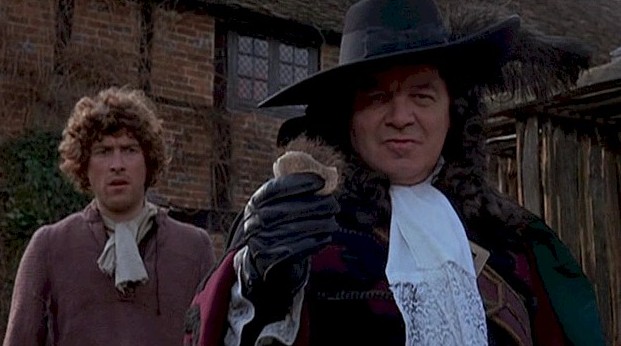
"And later I will go to ComicCon in this outfit and
fool everyone!"
“What's happened to the Xeraphin?” 
“Transferred to the center of the Master's Tardis.” 
“What does that mean?” 
“It means the Master has finally defeated me."

1) This story was written by long time Who director Peter Grimwade.  As a writer, Grimwade...makes an exceptional director.  This is just a sad and confusing story that has a strong whiff of Grimwade making it up as he goes along.

2) Nothing dates a story quite like having it revolve around a then ‘cutting edge’ technological wonder.  The way this serial fetishizes the Concorde makes it seem awful quaint in retrospective.

3) That being said, I’m almost willing to forgive the dated Concorde love for the inclusion of Richard Easton’s Captain Stapley.  The latest of this season’s Temporary Companions, Stapley is a lot of fun, and even has a pair of ‘companions’ of his own.  I particularly like how he unwittingly helps the Doctor plot The Master’s downfall.  And speaking of The Master...
Somehow I don't think the 'Possessed Sway'
will catch on as a dance craze....

4) ...what.  the.  Hell is the Master doing cosplaying as a fat-ass Persian sorcerer?  It’s not as if he expected The Doctor to pop up in this continuum.  He seems to wearing that uncomfortable looking fat suit solely because he can.  It’s ridiculous, and I was relieved when he rid himself of the Khalid identity at the end of the second part.

5) So are the Plasmatons a lesser version of the Xeraphin, a sort of creation pulled out of the Master’s mind by his leeching off of the Xeraphin’s psychic energy, freeform psychokinetic servants or....

Why am I ruminating on this?  They’re crap, right up there with Omega’s Jelly Bean Men from The Three Doctors in terms of silly looking.

6) Here’s one of my main problems with the Anthony Ainley version of The Master--he always seems to be doing stuff to fix things that went wrong with either a) himself or b) his TARDIS.  All this complicated bull is set up by him just so he can jump start his ionic column.
"It's not a crap matte...it's part of the story!"

7) Here’s where the benefit of having only two companions work--both Nyssa and Tegan have something to do, and for a change, Nyssa actually gets to do a little more than Tegan (which is odd, given that you would think the stewardess would have more to do in a serial where a commercial airplane has a prominent role).  Okay, granted, most of it is Sarah Sutton getting all stiff and channel-y as the Xeraphin try to communicate through her, but still...

8) So when it comes to the Xeraphin’s psychic defenses, they throw illusions up of Adric (makes sense, given that the mental pain caused by his death is still fresh), the Melkur (makes sense given the Xeaphin have tapped into Nyssa’s mind) and...a Terraleptil?  Even admitting how much I like the Terraleptils, that’s a pretty sad admission that so far, the Davison era has seriously poor monsters.  Why didn’t the Xeraphin throw the Master at them, given the pain he's caused both of the companions?  It’s not like Ainley’s appearance would blunt the ‘surprise’ of him being Khalid.

9) Not only is the Heathrow shooting way gratuitous, with long sequences taking in parts one and four, it draws too much attention to itself, as if Nathan-Turner is screaming, ‘Hey Look!  We’ve got enough of a budget to do location shooting!’  Much like the use of the Concorde having no purpose in the story, all this Heathrow love is pointless.

Well, at least they get rid of Teg--wait, what?

10) I give the serial credit for not only accepting the limitations of its low budget, but using it as an advantage when it comes to the scenes of the characters under the delusions caused by The Master.  The obvious matte shots of the background seems out of place until you realize those shots are psychic fabrications!

Overall...a terrible, terrible end to the nineteenth season of Who.  The nonsensical story, the too-long Heathrow elements, the dumb behavior of the Master....all these elements combine to provide a story that eminently missable.

Wednesday, July 24, 2013

Ten Statements About....THE BLOOD ON SATAN’S CLAW (1971)

Ladies and gentleman...the Hot Face Of Evil!
"You must have patience, even while people die. Only thus can the whole evil be destroyed. You must let it grow."

1) The thing I find the most fascinating about this picture is how it’s dominated by Patrick Wymark’s Judge and Linda Hayden’s Angel Blake--and yet both actors only appear sporadically, especially Wymark.  It’s to the credit of these two actors that they manage to cast a shadow over the story even when they’re nowhere to be seen.

2) The film also greatly benefits from being shot on location using mostly natural lighting.  There is a definite sense of veracity to this small town, which makes the strange and disturbing things that happen all the more creepy.

3) God is Linda Hayden gorgeous.  And while I still think she is while she’s wearing that ridiculous sheet and the black crepe-ish eyebrows in the third act, her Angel Blake is a tutorial in how to be seductively evil.  There are moments when director Piers Haggard just focuses ever-so-briefly on Angel, and the way she’s staring, or the way her lips just curls gently into a smile, speaks volumes about the darkness in her heart.
"Verily, this cookie has gone bad..."

4) Apparently, this script was written as three shorter films set in three different time periods before Haggard insisted on them being integrated into one story...and you know, that integration works to heighten the sense of this small rural town in Jacobean England falling into utter chaos.

5) One of the reasons I love films from this period of British cinema is how they’re populated by these amazing character actors that bring life even to their briefest scenes.  I was particularly taken with Howard Goorney’s unnamed Doctor and Anthony Ainley’s naturalist Reverend Fallowfield, who bring a little nuance to their every moment on screen.

6) Perhaps the thing that I find so disturbing about the events in the film is how it’s almost entirely caused by a group of kids who seem to think they’re playing.  And to make things even worse, Haggard adds these two old people in amongst the kids, laughing and smiling in encouragement that adds a whole layer of unsettlement to the proceedings.

7) According to Haggard, the centerpiece of this film--the ritual (incestuous, necrophiliac) rape and murder of Wendy Padbury’s Cathy, was improvised on the day.  If that’s the case, it’s a magnificent piece of on-the-spot filmmaking. It’s truly scary for the way Haggard seems to play with our expectations, leading us to imagine all sorts of fates for Cathy...until we see what Angel has in store for the hapless young girl and we realize it’s much, much worse.

8) The greatest unsung hero in making this film so great is composer Mark Wilkinson, whose weird, woodwinds-intensive score that tweets and twitters like the crows that serve as one of the movie’s motifs.  The way it seems to insinuate itself quietly, commenting on the events as they grow more and more out of control, contributes to the overall sense of unease in the story.
"Collect All My Parts And I Will Be....A MONSTA!!!"

9) Okay...that freakin’ paper mache’ devil.  What the.....?  In a film that so skillfully creates mood and atmosphere and maintains such a creepy feel, the goofy looking demon hoping around just kills a lot of said atmosphere.

10) And while we’re on the subject, while I don’t think it has the buzz-kill aspect of paper mache’ devil, I find it amusing that The Judge warns people he will use unimaginable methods to kill the evil, and ‘unimaginable methods’ apparently equals a big honking sword, two mean dogs, and that deaf mute guy who got thrown off the roof in The Spy Who Loved Me.

Overall...a really amazing little horror film that manages to create a disturbing atmosphere throughout.  One of the great jewels in the crown of Tigon’s career, and a shame that it’s not available on DVD or Blu-Ray in the United States.

Wednesday, July 10, 2013

Ten Statements About....DOCTOR WHO STORY ONE HUNDRED AND SIXTEEN: LOGOPOLIS (1980)

Now that he's established, this Master gets to
being truly, seriously scary....
“Logopolis is not the universe."
“But it is. Logopolis is the keystone. If you destroy Logopolis, you unravel the whole causal nexus.”

1) There is no doubt, right from the first part of this serial, that Janet Fielding’s Tegan Jovanka is going dominate the companion screen time....and given the abrasiveness and bossiness of the character (it’s not for nothing that at one point during her tenure she’s referred to as ‘a mouth on legs’), this does not bode well for the tenure of incoming Doctor Peter Davision.

2) And the fact that Nathan Turner has fallen in love with Tegan results in his impulse add of Sarah Sutton’s Nyssa becoming inconsequential.  Nyssa just appears out of nowhere in the second part of the story, and seems to be there solely so The Master can have someone to use that weird arm-controlling device in part three.  Admittedly, there is an attempt to bind her together thematically with the other companions when her planet is destroyed (a moment where Sutton shines), but the fact that she’s there Just Because is glaring.

3) Christopher H. Bidmead’s script is typical in its hard science concepts, especially when it comes to Logopolis itself.  The moment the TARDIS lands on this planet and we start to unravel the mystery and purpose behind it, the serial never lets up.  And Bidmead trusts us enough as an audience to grasp these principles without talking down or stopping everything to explain what’s going on.  That allows for the story to flow evenly and allow us to concentrate on the characters and what’s happening to them.
"Free at last, free at last!"

4) This is the first full serial that reveals Anthony Ainley’s Master to the world, and man is he pretty damn scary!  Even though he’s saddled with that odd outfit with the black frock coat and ornate silver collar that made me refer to it as ‘the gay pirate’ uniform, Ainley creates a very malevolent and--more importantly--opportunistic figure who thinks nothing of taking advantage of a serious situation he caused by accident to blackmail the entire universe.

5) I have to wonder why Bidmead allows the whole sequence concerning the nesting Tardisi, as it really doesn’t pay off much save for watching Tegan wander around and around the Tardis looking for an exit.  This is something we’ll see a number of times throughout the Peter Davison series, where there seems to be two separate and unconnected acts that run through the serial.

6) The Watcher...I am of two minds about this aspect of the story.  It’s certainly a fairly shaky justification for a regeneration, and the Watcher is an even shakier device for it to happen.  That being said, I give both Bidmead and Nathan-Turner credit for trying to make the whole regeneration epic.  It doesn’t work (the Davison-to-Colin-Baker regeneration works a whole lot better, primarily because the moment is treated as more intimate), but at least it’s there.

7) Maybe it’s because he’s finally getting his pass out of the series, but Tom Baker is surprisingly subdued and effective in the serial.  There’s a sense of him being aware of his own impending doom (the way he keeps trying to pass off Adric and, later, the girls, off on others seems to emphasize this) and trying hard to keep it together.  Plus he shows absolute contempt for the Master.  There’s that moment at the end of episode where the Master offers his hand to cement an alliance; Baker looks away before shaking his enemy’s hand that speaks volumes about his distaste for the deal.
"Mark my words...one of you is going to have to go..."

8) John Fraser’s performance as The Monitor is rather intriguing.  There’s a certain sense of, well, modest immodesty to his actions, and the way he rarely speaks in anything other than  conversational tones makes the few moments when he does lose his self-control all the more effective...especially the moment where we learn the true secret of Logopolis.

9) Maybe it’s because the series had been under the influence of Baker for several years, or maybe it’s because of the inexperience of two of the main actors involved in the serial--namely Matthew Waterhouse and Janet Fielding--there’s a level of pantomiminess that serves to make the flow of the serial out of kilter.  The broadness of the reactions in Fielding’s case are particularly jarring.

10) I appreciate the use of the Pharos Project; it dovetails nicely with Bidmead’s mathematics theme, I assume it allowed the budget to stretch so that this serial looks a little cooler than it could have...but I think that the final part is a little too full of everybody running around the grounds, all hunched over in the hopes of not being seen.  This, coupled with the whole ‘nesting Tardisii’ things give the serial a sense of being overinflated.

Overall...Yes, it’s flawed.  Yes, it could be more tightly plotted.  Yes, it suffers from companion-itis.  But it’s got a wonderful nugget of a premise that is very hard science fiction with some excellent performances by Baker and Ainley.  This is absolutely essential viewing.

Wednesday, April 3, 2013

Ten Statements About....DOCTOR WHO STORY ONE HUNDRED AND FIFTEEN: THE KEEPER OF TRAKEN (1980)

"Are you making fun of me?  Well, are you?"

"You will find immobility endurable, Doctor.  I speak from experience.”

1) This is the first of three linked serials, and this structure is one John Nathan-Turner loved to death.  While it’s not the most fondly remembered (The E-Space Trilogy, which was broadcast just prior to this one, tends to be the one most people talk about), it’s the most consistent and coherent of them, and the one that actually succeeds in telling a complete story over its three four-parters.

2) This is the only serial where Matthew Waterhouse’s Adric is the sole companion (at this point, Sarah Sutton’s Nyssa was a one-off character; she was offered the role of companion after Nathan-Turner saw the chemistry she had with Waterhouse)...and you can see here how Adric could have worked.  There’s a definite sense of the Doctor acting as a mentor to this bright young child, and the chemistry is there between Baker and Waterhouse.  I have to wonder if he would be better remembered if Baker had stayed on.

Or if he wasn’t made to share the Tardis with two other companions, but we’ll get to that in future episodes....

3) I didn’t realize it until it was pointed out in one of the documentaries on the DVD, but this is a set-bound episode.  The world of Traken is so well realized as a sort of Shakespearean paradise that you overlook the artificiality of the set. It also helps that so much of the scenes that take place outside take place at night, where that artificiality can be concealed.

4) Johnny Bryne’s script is very clever in how he manages to conceal the true nature of The Melkur until the last episode of this serial, while also making it rather apparent if you know the clues.  This was a massive surprise when the serial was first broadcast (Nathan Turner managed to conceal the big twist expertly in the months leading up), and it’s to Byrne’s credit that the clues are there all along.

5) And speaking of that big reveal....Geoffrey Beevers plays an excellent Master.  Chosen apparently for his deep speaking voice, Beevers makes the ‘eggface’ Master creepy and formidable.  I also think that the choice to let Beever’s eyes remain visible--something that the actor insisted on if he was to take the job--worked, as it makes the sense of him decaying even more profound.  There’s one moment where Beever screams in rage that chills me.
"Alright--I'm going to be all bad-ass now...but
after that, I'll be pretty much useless!  Fear me!"

6) This marks the first of Anthony Ainley’s long tenure as a recurring character...and here, as Tremas, he makes a really excellent ally for The Doctor.  Throughout all three of these serials, Ainley proves how amazing he is as an actor, and how great he could have been before the scripts relegated him to what amounted to a naughty scamp playing pranks on historical figures.

7) Based on her performance here, Sarah Sutton was asked to stay on as Nyssa, and you can kind of see why--she’s wonderful, and potentially would have been another gifted child for The Doctor to mentor.  Plus she’s got this weird fairy tale princess vibe that serves well in contrast to Adric’s urchin.  Pity that, like Ainley, Sutton will be wasted in the future (famously literally sleeping her way through a serial next season), but in this serial and a scant few others she’s pure gold.

8) Wow...I keep trying to remind myself that 1981 was a much different time and that John Nathan-Turner and the special effects crew of Doctor Who never realized that their show was going to be viewed on a high definition digital medium, but the hypno-eye effect that Shiela Ruskin’s Kassia displays is truly goofy.  It looks exactly like what it is--a pair of cardboard eyes placed over Ruskin’s real eyes.  Every time it shows up I start laughing.
SPECIAL EFFECTS!!!!!!!!!

9) So effective is Johnny Byrne’s script that I don’t notice how...sketchy and contradictory Traken society is.  We know there’s a Council, and a Keeper...but if the Traken Union is in perfect harmony, what are the Proctors for?  And what is life like outside the gates of the Council grounds?  We never learn, but because this story is so well paced, so well pr.

10) I’m still trying to wrap my head around the Master’s need to keep a Tardis within a Tardis, especially given that the Master’s Tardis still have a functioning Chameleon Circuit.  It seems so unnecessary.

Overall...a wonderful serial that gives us back one of the Doctor’s greatest foes (who would be magnificently scary for a little while), and a great launch for one of the best ‘trilogies’ of the series.