Showing posts with label Donald Pleasance. Show all posts

Wednesday, October 15, 2014

Ten Statements About....PHENOMENA (1984)

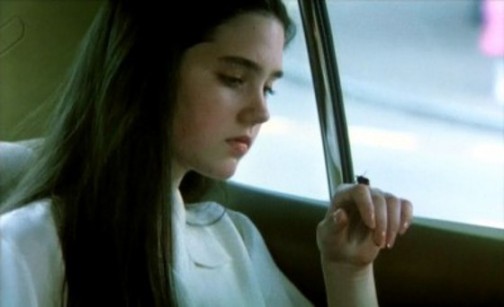
It's Jennifer Connelly playing with a blog...there's a fetish for
that, isn't there?
1) You want some proof that Dario Argento is interested solely in the moment and not in the story?  Look at how the killer turns out to be a character who literally appears in the beginning, disappears completely from the film, only to reappear in the third act to behave totally in opposition to how her behavior was in that long ago first scene.

2) Supposedly, Argento intended this to be ‘a fairy tale for adults’....and once you know that information, you can see the Brothers Grimm influence throughout, from the evil house in the woods to the kindly old wise man to the guardian spirit saving our heroine.  Okay, granted the guardian spirit in this case is a mass of bugs, but still....

3) You know, people always focus on the weird gore when it comes to Argento and they don’t realize the man has a real eye.  There are a number of compositions in this movie that use color to draw the eye.  Some of the shots of Jennifer Connelly’s Jennifer walking through these vast fields really pop because of Argento’s decision to have Connelly wear an Alice-In-Wonderland-style all white dress.  And speaking of Connelly....
"So I'm going to slash Daria Nicoldi and bite Jennifer
Connelly's thumb...anything else, Don?"

4) ...for someone assaying her second film role in a movie whose director is notorious for putting his female leads through the wringer, Connelly really acquits herself amazingly well.  She manages to both be creepy and otherworldly while also keeping the audience empathy, primarly through the genuinely sweet interactions she has both with Donald Pleasance’s  McGregor and Federica Mastroianni’s Sophie.

5) What a freakin’ weird soundtrack, switching from heavy metal songs to long time Argento collaborators Goblin to cues from the original Dawn of The Dead.  Admittedly there are moment where this strange Frankensteined things works, but there are other times when you know the soundtrack should be underplaying things and Argento has chosen to have Lemmy from Motorhead screaming in your ear.

6) It’s interesting how Patrick Bauchau looks vaguely sinister even when he’s playing a good guy cop who’s actively interested in helping Jennifer.  Of course, this being a film set in Argento’s Universe, he ends up being not so competent, and dies in the third act.
It's a woman's head going through plate glass....there's a
fetish for that somewhere...oh, yeah, in Argento's house!

7) It’s obvious that even though Tenebrae was made between this and the two ‘Mother’ films, this movie is much more influenced by the look and feel of Suspiria and Inferno.  Argento is still exploring monochromatic compositions and unconventional set-ups, and his sometimes infuriating habit of throwing stuff in not because it strengthens the story but because it contributes to the feel he’s trying to achieve (I’m looking at you, sleep walking Jennifer Connelly) is very much in the forefront here.

8) Even though she slashed Daria Nicoldi and bit Jennifer Connelly’s thumb, I am struck by the performance of Tanga as McGregor’s chimpanzee assistant Inga.  Whether through intelligence or manipulation by her owner, Tanga manages to convey actual emotion, especially affection towards her master and rage at his killer.  And while we can see Inga as one of Jennifer’s protectors, we also realize that she is acting out of grief for the man who showed her care and affection.

9)  Considering what Argento has his then-wife Nicoldi do, and what happens to his daughter Fiore...well, he must have conflicted feelings about his family.

10) You know, given how much is made of how sinister Dalila Di Lazzaro’s Headmistres is and how antagonistic she is to Jennifer, having her literally drop out of the picture whole makes no sense.  She doesn’t even have enough screen time to qualify as a red herring.

Overall...one of those films that made Argento’s reputation before he went diving in the shit barrel, it’s an essential view for people interested in what we all see in the man, and for people curious about seeing Jennifer Connelly at her very beginnings.

Monday, July 1, 2013

Ten Statements About....YOU ONLY LIVE TWICE (1967)

"Wait a minute...you're short, you're bald, and you have a
weak chin.  Give me a real master villain!"
“James Bond. Allow me to introduce myself. I am Ernst Stavro Blofeld. They told me you were assassinated in Hong Kong."
“Yes, this is my second life."
“You only live twice, Mr. Bond."

1) This is unique amongst the Bond films for the fact that it’s written by someone outside of the Eon Productions family--namely Roald Dahl.  And as much as I love Dahl as a writer (he’s one of the greatest short story writers ever) and a novelist, this script is very nonsensical and has the kind of ‘and then this happens, and then this happens’ make-it-up-as-it-goes-along feel that comes to dominate the series once the Roger Moore era rolls around.

2) Boy, does Sean Connery look old at times....which might be why he made the decision to leave the franchise during its filming.  He looks particularly old as he goes undercover as a Japanese fisherman (don’t ask).

3) I find it fascinating how this is one of the only Bond films--if not the only Bond film--where the bulk of the gadgets don’t come from Q.  The only thing Desmond Llewellyn gives Bond is Little Nelly; the exploding cigarettes and the ninja mufti is all Tiger Tanaka’s work.  And the ninja angle gives this film a unique feel the previous Bonds don’t have.  And speaking of Tanaka...
"I'm Japanese, damnit...JAPANESE!" 

4) Tetsuro Tamba is great as the head of the Japanese Secret Service.  Since he’s closer to Connery’s age (or at least looks closer to his age), there’s more of a sense of them treating each other as peers.  Plus he’s cool as crap in his own right, what with his own private railway car, ninja school and the ability to call up electromagnet-enabled helicopters at will.

5) While Mie Hama’s Kissy Suzuki is the featured Bond Girl, it’s real curious as to how little she actually is featured.  She doesn’t even show up until after the halfway mark, and doesn’t do much except run around in a very fetching white bikini.  Plus, she’s not all that interesting--and I have to assume that’s the script’s fault because I’ve seen Mie elsewhere and know she’s capable of being engaging.

6) And more puzzling, Connery has more screen time (and way more chemisty) with Akiko Wakabayashi’s Aki.  Aki has a great dry sense of humor that works extremely well with Connery and does a lot more than Kissy.  She definitely feels more like the prime Bond Girl, and while her ultimate fate has more impact due to her screen time, some of the energy goes out of the film when Wakabayashi is no longer in it.
Yep...pretty much the only reason Mie Hama is in this movie.

7) I’m not a big fan of the Japan depicted within this film.  There is a definite sense of Japan as a modern country--which it certainly was becoming at the time--and yet we see people wandering around in traditional Japanese dress at time.  This is particularly jarring when we see Aki tailing Bond at the beginning of Act One, dressed as a geisha in a sea of men and women in suits (I know that this might be Lewis Gilbert trying to make make Aki stand out so we know she’s different, but still....)

And we’re not going to talk about the Fishing Village That Time Forgot....

8) You know...given that this was the culmination of a tease started back with the first film, and the climax of the first leg of this series, the revelation of Donad Pleasance as Blofeld seems a little lax.  He ends up being rather unimposing and less freakish and colorful than the underlings he sent before him (well, other than Largo.  No one’s more boring than Largo yet.).  His interaction with Bond is rather bland and his running like a girl once his plan blows up in his face is laughable.  And speaking of that plan...

9) ...there are some moments that are seriously goofy.  The whole thing with Karin Dor's Helga Brandt and the plane with the wooden plank makes no sense, and the idea of using a big ass spaceship that opens up to swallow smaller spaceships seems rather exorbitant.  And Dahl seems bored whenever some details are needed.  The moment when Blofeld blackmails the Generic Asians for a larger payment calls out for a little expository dialogue...and none comes.

10) The Ken Adams volcano set is pretty impressive--it netted Eon Productions an Oscar--but the film seems to engage in a little too much set porn as Gilbert lovingly goes over every nook and cranny of this area without much of a point.  There’s a particular moment near the end of Act Two where we just asked to take in this fortress for roughly five minutes before another drawn out scene in Blofeld’s sprawling office.  If they made these picturesque moments a little more streamlined, maybe the film would’ve flowed better.

Overall...not a great entry, mainly due to Dahl’s rather peculiar script, even though there are some great moments.  Not a good coda for this leg of the Bond series (although, to be fair, it’s a little better than either of Connery’s return to the roles).

Tuesday, July 17, 2012

Ten Statements About....ESCAPE FROM NEW YORK (1981)

Yep...most naturalistic finishing blow eeeeever....
"Remember, once you're inside you're on your own."
"Oh, you mean I can't count on you?"
"No."
"Good!


1) Boy, is this script lean. The only guy who's really verbose is Lee Van Cleef's Hauk, and even he's terse and to the point. Carpenter apparently knows we're not here to watch exposition, so he's more than happy to move along and get us to the fights, the car chases and the nastiness.

2) Even for Carpenter, who's noteworthy for populating his films with characters that break away from being stereotypes, this is a film full of vivid characters. Even those characters with scant face time, like Frank Doubleday's sawtoothed Romero, or Charles Cyphers' Secretary of State, have their moments in the sun. As such, it's very hard to choose stand outs....

3) ...however, I will cite a couple, beginning with Van Cleef's Hauk. I particularly like how Hauk has a weird sort of respect that he never out and out admits to Russell's Plissken. He seems to admit it to others--defending his choice, running interference for him and continuing to buy him time--but the closest he comes to admitting how much he values Snake is when he offers him a job at the end. Van Cleef's confidence and body language says more than enough about his thoughts.

4) And then there's the tag team of Harry Dean Stanton's Brain and Adrienne Barbeau's Maggie. I love how we're never quite sure where these two are standing in regards to Snake and the situation with the President. Even though we only get their backstory in a line or two of dialogue, Stanton and Russell makes this relationship's veracity through their physicality toward each other. And the beauty of this is how these two do unpleasant things, but in no way become evil in our eyes because this is the world they've been living in for the last nine years and duplicity is the only way they can survive.

5) I can overlook that the majority of this film is shot not in New York, but in East St. Louis---if the script didn't have such a cavalier attitude towards New York City's geography, starting with their stubborn insistence that there is a '69th Street Bridge.' There is literally no way that Snake's progress through this city makes any sort of sense. It's as if the entire lower half of Manhattan was squooshed together into one square mile. I know this prolly wouldn't bother most people, but for me it nags and nags...

"Of course you should let me in...I'm the most New York thing
in this film!"
6) You'll notice I haven't mentioned much about Russell's Snake Plissken at all...and that's because the genius of Russell's performance is how the film doesn't so much happen because of him but in spite of him. The majority of Plissken's success is due to luck and circumstance--he only directly affects the story a scant handful of time. But because the character Russell creates is so well-structured and charismatic, we continue to assume he is the hero and not just our P.O.V. It's a trick Russell and Carpenter pull off again in Big Trouble In Little China, and it's a thing of beauty.

7) The reason I like Ernest Borgnine's Cabbie isn't because he provides comic relief in this film. It's because he makes it very clear early on that he's been driving a cab for thirty years...which means he chose to stay in New York when it was converted to a prison. In a film filled with things pretending to be New York, Cabbie is the most authentically New York thing in the place!

"Either I shoot you, or the viewers learn we're in St. Louis...
no one wins, Harry!"
8) I know Donald Pleasance worried about being a U.S. President with a British accent....but I didn't find him out of place. I assumed he was a Bostonian Brahmin--and given his role is smallish, it doesn't detract much at all. Pleasance does manage to walk that fine line of making him callous, maybe even dismissive without being a monster (unlike what we got in the sequel in Cliff Robertson).

9) And I appreciate that this is a political satire where the script doesn't spell everything out for you. We know just enough from the opening crawl to know that this is a country in decline, that things are going to fall apart a lot faster in the future, and that this is where we may be going. And I equally appreciate the fact that pay off of this film utilizes a musical, subliminal call for looking to the past to erase the disasters that could be forthcoming.

10) I gotta be honest...for a film that's supposedly action oriented, there's a lot of clunky action. The whole fight scene with Ox Baker's Slag is particularly awkwardly staged, as is the 'firefight' on the World Trade Center and, well, pretty much every fight in here. If it wasn't for the physicality of Russell, I suspect we'd look on these set pieces a lot less kindly.

Overall...a film that is pretty ungainly, but is well-redeemed by a whole raft of great characterization and a subtle script that spreads its satire lightly and not with great nasty gobs of stuff falling all over itself (unlike the sequel, which maybe I'll get to one day).

Saturday, October 29, 2011

Ten Statements About....PRINCE OF DARKNESS (1987)

"Let's do The Time Warp Agaaaaaaaiiin!"
"I've got a message for you, and you're not going to like it."

1) You gotta give credit where credit is due--I think Carpenter's choice of Victor Wong as his Professor Quatermass manque was brilliant, as it helps obscure the fact that what he's doing is an unofficial Quatermass movie. I think most people would have expected Donald Pleasance to play the academic with the knowledge that could shatter the world....

(Of course, if you don't want to tip your hand, you shouldn't write the film under the pen name of 'Martin Quatermass'...but we'll get to that towards the end of this entry)

2) It's not his pornstache that makes Jameson Parker's Brian a character we're inclined to dislike--it's his distant line readings and his stalkerly behavior toward Lisa Blount's Catherine. After experiencing such plucky and larger-than-life heroes in Carpenter's cv as Jack Burton and Snake Plissken, Parker's underplaying of his character grates. But then....

As a results of the horrible events of this film, Jameson
Parker suddenly realizes he's saddled with the worst pornstache
eeeeever.
3) Catherine is such an odd character herself, very mercurial and far too analytical. She's just as off-putting as Brian....which leads me to conclude that this is one of those movies where the main characters are voids.
(But we'll get to that towards the end of this entry)

4) I don't think it's intentional, but the fact that the demonic forces seem to be primarily homeless people and women makes the politics of this film seem rather icky. All the jokes about male chauvinism and the scene where two of the men beat up and defenstrate a possessed female colleague don't help dispel that impression, either.

5) And speaking of those homeless people/zombie types (lead by Alice Cooper)...I really wonder if they were necessary. They smack a little of Carpenter's perchance for second guessing himself, an element he added after the fact to allow us more kills and icky maggot shots.

The true mission of our heroes is to protect the
world's ugliest lava lamp...
6) Yes it sometimes comes off as forced, but I actually appreciate Dennis Dun's Walter quite a bit. His exasperation at being literally forced into a closet and desperate attempts at levity--more to calm himself than to get a reaction out of the female possessed waiting outside--manages to amuse me.

7) It's not the gooey make-up that makes the ultimate version of Susan Blanchard's Kelly's possession work--it's the strange, twitchy body language she develops that makes her seem like a particularly spastic, excitable child.

8) I will admit that some of the psuedo-science makes an odd sort of sense, especially the fact that the liquid nature of the creature allows for it to take over other organisms easily as it's absorbed into the body. But a lot of it seems made up at the spur of the moment, especially the whole mirror thing that occupies the last fifteen minutes of the film.

9) The sad thing about the ending, which teases that Brian has gone through a similar transformation to the one Kelly went through, thus allowing him to break into this mirror dimension to retrieve Catherine, is that the combination of the lack of chemistry between Parker and Blount and the curious nature of their relationship serves to deprive us of any sense that Brian is capable of trying this, or that he's motivated enough to try it.

10) While Carpenter doesn't indulge in the clip shows Brian DePalma inflicts on the public in the name of high art, the 'winking references' in this film are thoroughly over the top. Besides the Martin Quatermass stunt, Carpenter names characters after writers John Wyndham and Dennis Etchinson; has Brian make reference to transferring from Kneale University, named after the creator of Quatermass; names another character after B-Movie actress Susan Cabot; and even names Donald Pleasance's priest Loomis, a reference to his character in the Halloween series. It ends up being more distracting than surprising.

Overall...I keep getting the impression this is a film I should like, but I've watched it several times and I never get over the fact that it lacks coherence and ends up being a bunch of crazy crap that seems to happen with a slew of scientific argle bargle designed to conceal that fact.