Showing posts with label Stephen King adaptations. Show all posts

Thursday, October 23, 2014

Ten Statements About....CHRISTINE (1983)

Just a reminder--someone drove this car while it was on fire!
"Let me tell you a little something about love, Dennis. It has a voracious appetite. It eats everything. Friendship. Family. It kills me how much it eats. But I'll tell you something else. You feed it right, and it can be a beautiful thing, and that's what we have."

1) The first thing that strikes me is how quiet this film is for a Carpenter film.  The music cues are few and far between during the first hour, and we don’t hear that signature Carpenter synth whine until that hour is almost over.

2) Good ol’ Keith Gordon.  It’s obvious that Arnie is something of a nothing role, and the script is very confused as to whether he’s meant to be a dupe of Christine or a willing co-conspirator (something we never get resolved, even up to his ultimate fate), but Gordon does everything he can with this role.  What little there is that elevates Arnie from a series of stereotypes is all Gordon.

3) This is another film which is specifically meant to be a period piece (it’s set in 1978), but is not enhanced in any way by its setting.  I suspect Carpenter does this to remain ‘true’ to the novel, but there’s nothing in the novel that demands that period be used.  And given how almost everyone is styled in the 80‘s (check out the hair on Alexandra Paul’s Leigh!), it’s a pointless exercise.
"But Mr. Kot-tah said I could beat on the nerd...."

4) You know, I would accept the seriousness of the bullies in this movie if they weren’t played by a bunch of goofballs.  William Ostrander’s portrayal of Buddy, in particular, is laughable; the man comes off as Cosplay John Travolta.  Thankfully, their presence is limited and their tickets punched before they get too annoying.

5) You wanna know why I love practical effects?  Because there’s an immediacy to these set pieces you just can’t get with CGI.  When you realize that at one point in this movie an actual human being drove a car that was set entirely on fire after another human being blew up an actual gas station, you appreciate what you’re seeing all the more.

6) I really liked Robert Proskey’s Darnell.  While he comes off as very antagonistic, it’s obvious that he’s not.  This makes his death after Christine’s killing spree an indicator of how evil ‘she’ is, as he’s drawing his shotgun to get at the perceived thief, not the car itself.
"Stupid movie...I'll become a director and show everyone how
to direct with style....stupid movie...." 

7) Some people just have old faces...right, Harry Dean Stanton?

8) I find it fascinating how Carpenter has Gordon visually go through different levels of classic 50‘s rebellious teen.  He goes from typical geek to the windbreaker of James Dean to the leather of Marlon Brando the deeper into his mania he gets.  It’s like Arnie becomes symbiotically linked with Christine and is pulled backwards in time psychologically by her.

9)  I’m not sure if Carpenter resisted the urge for Alexandra Paul’s Leigh and John Stockwell’s Dennis to grow romantically close in the third act (it’s been years since I read King’s novel, but my gut says he did pull the trigger on this)...but it never quite works out.  Now granted, this might be because of Paul’s rather stilted performance, but there’s still a whiff of ‘it’s in the script’ to this development.

10) I think that the film benefits from Christine being established as evil right on the assembly line, as it throws out all the ambiguity of the book’s reasoning for her becoming this steel-and-glass ghost.  By just letting us know that Christine is a malevolent entity right from the start, she becomes a motorized version of Michael Meyers, and we accept that its malevolence just exists.

Overall...not the greatest of Carpenter’s films, and arguably the beginning of his decline, it still has some merit thanks to the practical stunt work and the performance by Gordon.

Thursday, June 7, 2012

Ten Statements About....THE SHINING (1980)

"I'm not going to be a movie star?  NOOOOOOOOO!!!!"
I think we should discuss Danny. I think we should discuss what should be done with him."

1) I know this is a bizarre way to start this 10 Statements...but the soundtrack that Kurbrick puts together piecemeal from various sources is one of the most disturbing soundtracks I've ever heard. The weird atonal pieces from classical performer Bela Bartok are particularly upsetting.

2) One of the reasons I suspect Kubrick cast this film the way he did is because he wanted to tell as much of this film with the character's faces. So much of this movie is moved forward by the reaction shots of these people--hell, a major plot point rests on watching Scatman Crothers' eyes widen and mouth drop open--that he needed these particular actors, even if some of them are much older than the characters are portrayed in the book.

3) That being said, one of the weakest links (not the weakest link, as we'll get to later) is Shelly Duvall's Wendy. She seems to spend the entire film whining, crying and screaming to the extent that it rejiggers the relationship in the book into something much more overtly abusive and parasitic than it was in the book. While that's a definite choice, and one that was successful in the context of this film (people still talk about this version while the Garris telemovie remains mostly forgotten), it also blunts Wendy's 'resourcefulness' to the point where I wondered where Jack's talk of her being so came from in Act Three.

4) I have to assume, given how Kubrick always approached everything with a extreme attention to detail, that the weird fairy tale echoes were intentional, especially in regards to the hedge maze. I realize it was created because special effects at the time made recreating the hedge animals of the book impossible, but having this maze be 'the dark woods' Danny has to enter to avoid the monster his father becomes is actually more appropriate in the context of the movie.
wait a minute...those are real girls...THOSE AREN'T
MIDGETS!!!!!

5) Of course, the sad thing is that Danny Lloyd is not an actor. Yes, there are moments where he works--the whole sequence where he retreats and leaves Tony in charge is pretty good--but the bulk of his performance is lackluster and obviously artificial. We're not even going to talk about the ludicrousness of his facial expressions whenever he starts to 'shine.'

6) I respect what Kurbrick is doing with the whole sequence where Scatman Crothers' Hallorann comes to Danny's rescue only to have said rescue dashed almost immediately (although ironically, said 'rescue' ends up successful). However, I do think that all the time we spend watching him realize the danger, fly out to Colorado, arrange for the Snocat, etc. ends up building up the expectations to the point where his sudden dispatch is a disappointment rather than a shock.

7) Everyone mentions Joe Turkel's Lloyd, probably because his exchanges with Jack are quotable...but to me the scariest character overall is Philip Stone's Delbert Grady. Part of it is the subtle way Kubrick introduces him, allowing us to slowly realize who he is, but mainly it's because in this film full of quiet horror Grady is the most quietly monstrous--telling Jack the most horrific things in the most reasonable of ways.
With Kubrick, it's not this point that's scary...it's what happens
getting up to this point.

8) You know, at first I thought some of those shots of Jack Nicholson sitting there looking like a comedy goof were ludicrous...until I noticed how Kubrick changes the color palette whenever Jack 'enters' the world of the Overlook. When he's in the 'real' world, the palette is stark and harsh, but when he's lost in the Overlook, the colors become warm and comfortable. Of course, the world where he's the most at home is the world he should never, ever be in....

9) I find it riveting how, the deeper we get into Jack's psychosis, the more the camera begins to 'identify' with him, to the point where it follows the line of his axe whenever he swings it. This is how you use a moving camera--to emphasize the fact that Jack's no longer stable, but is absolutely unstable.
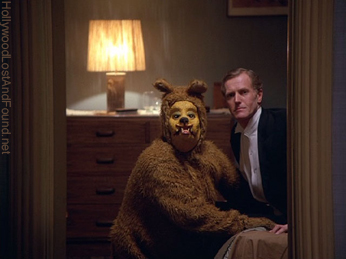
Furries...this is what you look like to us.

10) To me, the effectiveness of the scare scenes is because they're so sparse on the ground and rely on us to put together what's going on. If a lesser director (like, Jan de Bont or you know...oh, Mick Garris) had handled this, we would have gotten an avalanche of special effects full of goopy, gooey ghosts instead of a couple of carefully placed apparitions with only minimal grotesqueness. Hell, the most disturbing stuff isn't the decaying old lady but the two girls--who I swore were adult actors made up until I saw them in the documentary short on the DVD being introduced to Nicholson--or the strange tableau with the figure in the animal costume. Kubrick trusts us to make stronger scenarios in our head than he can provide himself.

Overall...a truly amazing horror film notable for how deliberate and subtle it is...so subtle that all the overtly hammy elements serve as the breathers, and not the moments of silence in between.

Tuesday, November 1, 2011

Ten Statements About....VERONICA MARS SEASON TWO, EPISODE ONE 'Normal Is The Watchword' (2005)...Plus some words on how we got here...

The biggest surprise about Veronica's lovelife is that it doesn't
include Duncan or Logan...no, wait....
"This is Neptune. Nothing happens accidentally."
To the surprise of everybody--including series creator Rob Thomas--Veronica Mars was renewed. At the time, it was the lowest-rated drama series to ever be picked up for a second season, and the only new show on UPN's 2004 schedule to be on its 2005 schedule. Part of the reasoning was because the show had garnered some celebrity fans. In an article in Entertainment Weekly, Stephen King of all people praised the show as being 'Nancy Drew meets Philip Marlowe.' Kevin Smith posted on his blog called it the best show on television, and Joss Whedon actually expressed envy over how well-crafted the season finale was. This resulted in both Smith and Whedon taking small parts in Season Two.

But I have to think somebody at Viacom, which owned both UPN and CBS, took a shine to the show. During the summer, key episodes of the first season were presented on CBS during prime-time on Friday. And a new advertising push spurred on by these celebrity endorsements preceded the show's return in late September of 2005. It's obvious that there was a desire for this show to succeed.

Which leads us to....

1) Well, it's the second year and even though Thomas and company decide to try to fool us into thinking we're back in the 'done-in-one-mini-mysteries' structure at first, it doesn't mean that things haven't been shifted around. And it's clever how Thomas is able to hold off some of the major revelations--especially the ones about the way the Veronica-Duncan-Logan-Meg rectangle has shifted--until late in the episode.

2) Now knowing he has another full season, Thomas chooses to make a few changes--primarily ratcheting up the '09er/PCHer tension through one of the loose ends in last season's finale. It allows for him to comment on then-current concerns, like the introduction of metal detectors in inner-city schools, without venturing out of Neptune proper.

3) We also get a couple of new additions to the cast. Along with Ryan Hansen and Kyle Gallner's Casablancas brothers being fully promoted to regulars (and we'll see the genius of that as we go along) and the addition of Charisma Carpenter, fresh from Angel, as Kendall Casablancas, Dick and Cassidy' stepmom, we get Steve Guttenberg's Woody Goodman. Of course, the brillance of introducing Guttenberg up front as a recurring character is that we're automatically assuming he's this season's Aaron Ecchols, a bad guy who will somehow be involved in the overarc. As we'll learn....yes and no.

There are ways to introduce Whedonverse actresses to
bolster ratings, and there are ways....
4) On the other hand...the presence of Goodman also introduces a puzzling new aspect to Neptune--namely that it's a large enough market for it to support an MLB team, The Sharks. This is really peculiar given how close Neptune has been established as being to San Diego, and how Keith Mars was depicted as a Padres fan (there was even a subplot in one episode last season that had Veronica saving up to send her dad to Padres Fantasy Camp). This element really adds nothing to the season's overarc, and it simply muddies the continuity between the two.

5) Okay, I lied...the Sharks angle does give Thomas an excuse to introduce the Cooks, Jeffrey D. Sam's Terrance and his daughter, Tessa Thompson's Jackie. I suspect that Jackie was introduced to give Wallace a concrete love interest this season, but as we'll learn. this character is so badly written that we'll wish the Cooks weren't bolted onto this season's overarc so awkwardly. but then....

6) As we'll see, the series doesn't quite know what to do with Wallace this season. While he's a major portion of this episode, once more acting as Watson to Veronica's Holmes, his role gets reduced quite rapidly to the point where he literally drops out of sight for the middle portion of the season. It's a criminal underuse of Percy Daggs.

7) I have to admit...when we get the story about how Veronica and Duncan got back together, I love that we never find out what was written inside the birthday fortune cookie. Thomas is confident enough in the audience that has followed this show to this moment to know they will come up with the right answer to that question.

8) I appreciate that Thomas doesn't let Veronica and Weevil stay buddy-buddy like they were in Season One...but that the relationship and the respect hasn't degraded to the point where they're not there for each other. Yes, the words in their scene get heated (and sets up one of the sub-plot threads for this season), but in the end it is Weevil who offers Veronica a ride--not because he has to, but because he recognizes that she is one person he can count on.

Believe it or not, what precedes this shot is the biggest
suprise of this episode....
9) Of course, mention should be made of the sudden, blink-and-you-miss-it uncredited cameo by Amanda Seyfried as Lily, running out of the corner of Veronica's eye to lead her to Weevil. It's an indicator that the magic realism aspect of the series is not quite going away just yet...

10) And here's where Thomas pulls the rug out from under us...after all the indication that this season's mystery was going to involve the murder of a PCHer apparently at Logan's hand, we get the actual start of this season's overarc--the crash of the school bus and the death of all within. And it becomes apparent from the one quick, horrific shot of the path the bus took to its watery grave that what Thomas has in mind is a lot more grandiose than what he's been letting us in on.

Overall...if we ignore how some of these plot threads sour, this is an excellent start to the second season, climaxing in that one moment of magnificent misdirection that makes it clear that things are going to get darker...maybe even darker than they were last season.

Monday, October 31, 2011

Ten Statements About....PET SEMATARY (1989)

Denise Crosby...scarier live or undead?  Discuss....
"I'll bite, Judd. What's the bottom of the truth?"
"Well, sometimes dead is better. The person you put up there ain't the person who comes back."

1) I don't care how nice she acts, Denise Crosby always looks sinister...which I guess is appropriate for this film, huh?

2) Boy, does Dale Midkiff's Louis come off as a douche, even when he's trying to be nice. I suspect that's not so much the character but the way Midkiff affects this very level, flat monotone when acting that makes it seem like that.

3) Thank goodness for Fred Gwynne's Judd. While he is as understated as both Crosby and Midkiff, Gwynne does give the film a certain texture and life when he is onscreen. And the thing I find the most fascinating is how you never know Judd's true motivations--whether he introduces Louis to the MicMac burial grounds out of genuine concern for his new friend...or something darker.

"You need to commit sui--no, wait...that was the other movie."
4) I wonder if King had intentionally created Brad Greenquist's Victor to reflect the role Griffin Dunne had in An American Werewolf In London...because I can see the parallels very clearly.

5) While I don't think Crosby sells the speech that accompanies it very well, Rachel's revelation about her sister's death is probably the most harrowing sequence of the film. Not only because it's one of the rare times we see emotion in both Crosby and Midkiff, but because the make-up effect used to depict Zelda literally makes her into something strange and alien and yes, nightmarish.

6) I find it interesting how, even with its R rating, director Mary Lambert uses great restraint when dealing with Gage's death. The way the brief glimpses of the aftermath of the acccident give way to a succession of snapshots from Gage's life and the tasteful way the funeral scene is handled (if I remember the book correctly, Gage's body actually falls out of the casket during the scuffle between Louis and his father) makes us feel for the life that was lost and not dwell on the horror of his death...for that's still to come.

7) The scene between Judd and Louis after Gage's death, where Judd reveals why 'Dead is Better,' and conveys his own fears that he might have put things in motion that led to Gage's death, illustrates more than anything how different Midkiff and Gwynne are as actors. There seems to be genuine feeling in Judd's voice as he tries to dissuade Louis that leads logically to his breaking down in the end, whereas Louis retains that same even keel, that same baseline that doesn't waver. Maybe Midkiff felt he was trying to convey how Louis was dead inside emotionally, but since he doesn't waver from that same note throughout the film, we get no sense of the change in the character's outlook.

8) I like how, during the sequence where Rachel decides she needs to come back to check on Louis, Lambert does several compositions where that creepy portrait of Zelda--with a black cat that resembles Church at her feet--towers over her, as if to remind us of how in this film's world, screwing with death and the dying has its consequences.

Apparently, Gage likes to play rough...terminally so...
9) That succession of scenes at the beginning of Act Three--Rachel's nightmare about Zelda, the optical effects trying to scare Louis into turning back, the fading and reappearing Victor--really seem weirdly out of place given how low key the film has been up until this point. It isn't even a sign of things ramping up, as we're back to more subtle scares sans special effects once Gage comes back.

10) The thing that makes Back-From-The-Dead Gage so truly terrifying is that yes, he's a malevolent entity, but still with the mindset of a young child who doesn't comprehend life and death yet, someone who probably truly believes that slicing up old men and former Star Trek: The Next Generation actresses consitutes playtime...which makes his admonishment of 'No fair,' when Louis gains the upper hand a degree of unease.

Overall...although it does suffer quite a bit from dating with time and a pair of central performances that needed a bit more life and nuance, this is still a more or less restrained adaptation of a King novel...and still may stand as one of the better ones.