Showing posts with label film noir. Show all posts

Sunday, October 28, 2012

Ten Statements About....THE NIGHT STALKER (1972)

This film takes place in a time when people were scared
of vampires!
"This will be the last time I will ever discuss these events with anyone. So when you have finished this bizarre account, judge for yourself its believability...and then try to tell yourself whenever you may be it couldn't happen here."


1) With the casting of Darren McGavin in this role, we witness the perfect fusion of character and actor. Even though the role was not written with him in mind, Carl Kolchak seems tailor made for McGavin's hardboiled sensibilities, resulting in a reporter who seems to harken back to an earlier time, a man who believes in breaking past the truth....resulting in him knowing the secrets of the universe and, Cassandra-like, being shunned for it.

2) And it's fortunate McGavin--whose prior claim to fame was playing Mike Hammer on television--fit the role so well, because so much of Richard Matheson's excellent script is structured like a hardboiled crime film in its pacing, its language and its visual look. And because the first act of the film plays like a straight detective story about a serial killer stalking Las Vegas, the ultimate revelation about who and what Janos Skozeny is becomes all the more shocking.

3) You know, Gail is pretty much a thankless task assayed by a mediocre actress in Carol Lynley...but it has to be admitted that she has a real chemistry with McGavin, and gives us a very rare aspect of the character we don't get in either the sequel or the television series that resulted from this film's success. Seeing her interact with Carl softens him slightly and grounds him as a human being--thus giving those moments where he's desperate and scared have more impact.

4) Another thing that makes this film so unique is the way director John Llewellyn Moxey goes with a cinema verite style. The way the scenes play out in the first twenty minutes of the film seems so naturalistic....and yet there are these weird, strange elements in these very same scenes. It's another reason why the film feels real to us, making the surreal elements feel all the more shocking when they emerge.
Down these mean Las Vegas Streets one of the greatest
characters in televsion history drives.....

5) ...and another thing that helps create the veracity of this film? We don't see Barry Atwater's Janos Skorzeny until over twenty minutes of the movie's seventy-five minutes running time, and don't see him clearly until thirty minutes. That's an eternity when you take into account this was designed to run with commercial breaks. It makes us almost accept that this might be a legitimate crime thriller about a killer he thinks he's a vampire...until we see Atwater's shadowy over-the-shoulder form strangling a german shepherd while its owner looks on frozen in fear.

6) One of the genius touches of Matheson's script is something that becomes a hallmark of the character--namely, the little character sketch of each victim we get before she makes her disappearance. It further re-enforces the film noir atmosphere of the movie and gives us a degree of sympathy for what amounts to cannon fodder. And given each mini-essay is being recited in McGavin's wonderfully world-weary and cynical voice...well, it works.
 
7) You know, even though the film has that wonderful score by Robert Cobert that's this combination of jazz and electronic howls and screams, I love how so much of the movie happens quietly. There are long stretches where the only sound is the dialogue and ambient background noise. Moxey trust the script so much he allows it to stand out unsweetened by music--something that would never happen in the modern day.
Anyone wh knows their film noir knows this triumph
will end up leaving a bitter taste in Kolchak's mouth...

8) This film also benefits one hundred percent from being shot recognizably on location in Las Vegas. The shots of Kolchak driving down the Strip, or of these people wandering through the casinos once more add to the reality of the story and makes it feel realer than other comtemporary horror films.

9) As much as I love McGavin's portrayal of Kolchak, I suspect I wouldn't love it so much if he wasn't paired up with Simon Oakland's Vincenzo. It's not just that McGavin and Oakland's chemistry is palatable, or that they both play up to and subvert the cliche of their roles...it's that the tension between them makes the ultimate resolution of their relationship as reporter and editor all the more impactful. Oakland's entire role plays up to that single line...'You're a Hell of a reporter,' and when we hear that line, delivered in that way, we know what's about to happen is Not Going To Be Good.

10) ...which brings us to the ending, and I love how dark it is. Kolchak saves the city, and is thanked with the threat of prison, his story being suppressed, being forcibly separated from his fiance' and run out of town. This is absolutely in keeping with the film noir world view that Curtis, Moxey and Matheson has maintained since the first moment of the story. And it leads to the exquisite last moment, where Kolchak makes a decision about what to do with what he knows, which is at turns funny and appropriate.

Overall...one of my favorite television films, a film noir crime story with a strong supernatural element that has at its core one of the greatest television characters in history. Essential viewing.

Friday, October 19, 2012

Ten Statements About....DARK CITY (1998)

Sometimes psychiatric methods take really, reall weird turns...
"These do bring back memories. This one is still warm. What is it? The recollections of a great lover? A catalog of conquests? We will soon find out. You wouldn't appreciate that, would you, Mr. Whatever-your-name is? Not the sort of conquest you would ever understand. Let's see, a touch of unhappy childhood, a dash of teenage rebellion, and last but not least, a tragic death in the family."


1) This is, without a doubt, Alex Proyas' crowning achievement. Forget the goth twittering of The Crow and the work-for-hire stuff he's been trapped in ever since this one crapped out at the box office--this is a truly visionary piece of work that at times is a detective thriller, at times a film noir, at times a horror film, at times a science fiction film and in the end, one of the coolest super-hero films of all time! And that all these disparate elements slide around together seamlessly, not interfering with each other in telling this one single story is astounding.

2) And you know what's really amazing? This is a film where the lack of backstory is woven into the film proper, yet you get a real sense of every character's life out of the context of the movie itself. Part of this is sharp screenwriting by Proyas, Lem Dobbs and David Goyer, but part of this is just the smart acting choices by Rufus Sewell, William Hurt, Jennifer Connelly and others. The performances are so insightful, so intelligent that I believe that, for example, Hurt's Inspector Bumstead had this long career in the police force. Hell, I would cheerfully watch a syndicated television show of Bumstead's adventures.

3) I am fascinated at how Proyas plants these little prescient echoes of future plot developments in earlier scenes, like how the simple act of Sewell's John Murdock placing a dying fish in a bathtub foreshadows where he is going to go to seek sanctuary later on, or the maze in Dr. Schieber's office gives us a visual warning as to one of the film's biggest reveals.

This train may lead you around in circles...that'll lead you
to something you might not want to see....
4) And while we're on the subject of the good Dr....Keifer Sutherland is amazing in this film. While the initial impression is that Sutherland is playing at being Peter Lorre, you realize as you go deeper into the film how Dr. Schrieber's affectations indicate something much more nuanced and, ultimately, much more tragic.

5) No film of this sort can work without a memorable villain, and Richard O'Brien's Mister Hand is more than worthy of the task. O'Brien's physicality just sets the hackles of the back of the neck, and the true irony is how he's even more unsettling the more human he becomes. It's he, and not Ian Richardson's leader, that becomes the Stranger's standard bearer.

Okay, so that little kid who hangs out with Mr. Hand is just as creepy....even more so when we finally hear his one line of dialogue.

6) Make no bones about it--while there are strong suspense and action elements throughout this film, the science fictional elements are not only vital but integral to this plot. There is no way for the film to work without the presence of the Strangers and their experiment. And that gives the film an extra level of flavor to it.

7) ...and the film provides us with a couple of things we never saw before in 1999. Not only that, those things we never saw before are major plot points that move the story forward. The impact of these moments are made all the more impactful by seeing them through Murdock and, later on, Bumstead's eyes--since we emphasize with these characters, their wonder and shock are transferred to us.

I know she looks half-asleep...but trust me, it makes sense.
8) I appreciate how the characters around Murdock seem to gain more awareness the more information Murdock gets. Hurt, Connelly and the others seem positively asleep in the first act, only for them to become more vivid once the layers of the mystery is revealed...

9) ...and while we're on the subject of Jennifer Connelly's Emma, I love the fact that the fate that happens to her at the top of the third act is not a complication, but a way to give Murdock something he truly wants when he achieves his full potential and provides a wonderful coda to the film as a whole.

10) And thankfully, the CGI here is used not in making crazy creatures (the Strangers' true nature are used very sparingly), but in creating the effects of the 'tuning'--which in turn opens up Proyas' creativity, resulting in some innovative fight and chase scenes that take advantage of the mutable nature of the titular Dark City. I know some people might grouse about some similarities to Inception...but Proyas was here first.

Overall...one of the most brilliant science fiction films of all time, a personal favorite, and must-viewing for anyone who wants to see how you can successfully infuse the genre with elements from other styles without obscuring it. Well acted, well written and contains something I promise you'll never have anticipated seeing.

Tuesday, December 20, 2011

Ten Statements About....THE MALTESE FALCON (1941)

One of the greatest movie P.I.'s of all time...
"When a man's partner is killed, he's supposed to do something about it. It doesn't make any difference what you thought of him. He was your partner and you're supposed to do something about it. And it happens we're in the detective business. Well, when one of your organization gets killed, it's-it's bad business to let the killer get away with it, bad all around, bad for every detective everywhere."
 
1) Humphrey Bogart could not have done this film with anywhere near the effectiveness that he shows here without climbing his way up through Warner Brothers' ranks as a heavy. Since John Huston's script maintains Sam Spade's rather fluid attitude towards morality, Bogart needed to be able to show a shadier side to make his manipulation of events believable.

2) I really enjoy how Mary Astor's Brigid never, ever says she kind and good and pure--hell, even when she's 'playing schoolgirl,' she is always telling Sam that she's Very Bad News. And you know what? She's Very Right.

3) You know one little touch that I thought was genius? The working relationship between Lee Patrick's Effie and Sam. Huston's script makes it rather clear that Effie is one Damn Smart Customer, and Sam relies on her intelligence and intuition--Hell, it's almost as if Effie is an unofficial partner in the firm.

Two of these people are supposed to be dangerous...
the other one is.
4) Another brilliant touch--when you come down to it, Sydney Greenstreet's Caspar Guttman and Peter Lorre's Joel Cairo are children in men's bodies; if we didn't know it by the third act, the way their interactions disintegrate into schoolyard accusations when they realize they've been had makes it clear. But the fact that they're distinctive and 'scary' individuals, it further obscures the fact that we met real villain in the very first scene.

5) Of all the 'villains,' the one I was taken the most by in this viewing was Peter Lorre. Remember, this was Lorre before he became a parody of himself, and he's actually pretty scary for all his feigned civility. There's something unnerving about how reasonably he orders Sam around while waving his gun, and his body language is strange and off-putting in all the right ways.

6) One of the reasons I bemoan the death of black and white is how being deprived of a color pallete allowed good directors to find other ways to convey emotion and characterization. Some of Huston's choices, like showing Sam and his partner separated by their name plate, or choosing to only show the phone when Sam receives news of Archer's death, are more engaging because they're unusual.

7) You know, I don't think this film could have been made now simply because we never, ever get a sense of whether Sam is on the up and up or not. If made now, the script would make Sam much more heroic and wouldn't mince words on how virtuous he is. Huston is able to get away with a moral ambiguity--Hell, the reason Sam gives up Brigid is because, if we're to believe him, it's bad for business to let Archer's death go unpunished--because the audience is willing to accept shades of grey.

"Look, Guttman...I'll bet you the Falcon isn't filled
with peanut butter creme!"
8) But what we do get is that Sam, whether heroic or villainous, is very good at his job. Simple things like sending Brigid into the next room to get him money long enough for him to check the labels on her clothes and try to confirm her story makes it clear how clever he is.

9) Compare Sam's instincts to Archer, who comes off in his one brief scene as, well, a bit of a goof. It's clear that Sam's partner is motivated for taking the case because he likes Brigid's look (and her money). It's his behavior that makes me wonder if Sam lets him take on the case on purpose--not because he wanted him dead, but because Sam doesn't trust her even at this early point in the story.

10) And The Falcon of the title is the ultimate MacGuffin. Even though we're told this is the item around which the story revolves, it's nothing but a feint. The story is about Archer's murder, not a hunt for a statue. And the only statue we do find is a replica; we never learn if the original even exists except in the mind of these two children in adult's bodies.

Overall...a key, essential film that drives home what a movie star is thanks to Bogart's performance. It may not be the first film noir, but it certainly is one of the movies that laid down much of the blueprint for this wonderful genre.

Sunday, December 11, 2011

Ten Statements About....BLADE RUNNNER--The Final Cut (1982)

Ford's character owes more to Sam Spade than Flash
Gordon....
"Commerce is our goal here at Tyrell. More Human Than Human is our motto. Rachel is an experiment, nothing more."

1) Just as Alien was an old dark house horror film, it's obvious that Ridley Scott intended this film to be a film noir detective thriller, and everyone acts accordingly, right down to how pretty much everyone smokes and drinks like their lives depended on it. I particularly like the way production designer Lawrence J. Paull manages to find a way to make the costumes and sets a true melding of futurist and 40's esthetic.

2) There literally isn't a bad performance in the film's 117 minute running time. Even Sean Young. Yes, she's skittish and hesitant like a baby deer and seems a bit emotionally flat--but that's the character. All the identified replicants have broad, child-like personalities that makes them seem off from the identified humans (save Sebastian, but he's set apart by his disease), so in the context, Young's performance works.

3) And here's something I didn't notice until this viewing--there are a number of moments with Young's Rachel, particularly in the major scene she shares with Deckard at the halfway mark, where Scott switches to a Steadicam. Those moments, mainly when it involves Rachel in close-up, display a very subtle unsteadiness not to the insane shakey-cam levels we've experienced recently, but almost subliminally noticable. These shots seem to emphasize Rachel's skittishness as she leaves the sheltered world of Tyrell and enters Deckard.

Damn...they don't make women like her anymore...
4) One of the reasons this film works so well is that outside of Harrison Ford (and even Ford is still in the early stages of his big style stardom), none of the actors are particularly well-known. Even Brion James, who probably had the biggest cv at this point amongst the main players, was known for secondary heavy roles. This creates a veracity that feeds into our accepting the world painted here whole.

5) I miss actresses like Joanna Cassidy, who had an unselfconsciousness about their bodies. There's really no doubt that it's all her in that scene where Dekard runs down Zora, and she is spectacular.

6) I find it fascinating how the Tyrell and Sebastian suss out what Roy and Priss are quickly, and respond not with the revulsion you'd get from Deckard's debriefing scene, but a pleased wonder. I particularly find Tyrell's discussion with Roy, explaining how they've tried a number of things to cure the short lifespan, fascinating...the fact that he argues how Roy should embrace the brevity of his life displays a certain depth corporate questionable types wouldn't display in the many imitators afterwards.

7) The biggest difference between this version and the theatrical one is, of course, the lack of Ford's voiceover. The film is still understandable, as the plot is pretty straightforward and linear...however (and here comes some heresy) the voiceover might not be out of place. This is for almost an hour and thirty minutes a film noir, where the voiceover is a standard trope. However....

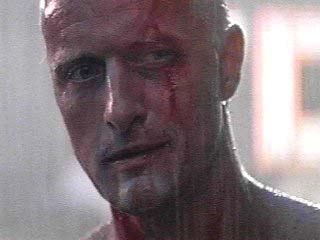
His origins may be Frankenstien, but make no mistake--
Roy Batty is the big bad wolf.
8) There's a decided, but not jarring, shift in the film from the moment Deckard enters the Bradbury Hotel from film noir to a horror film. I'd say it becomes an old style horror movie, with Priss and Roy literally playing monster in stalking and trying to kill Deckard. Hell, Roy's howling as he runs around naked save for black biker shorts makes it explicit that this last replicant has become a modern day Wolf Man hunting the prey that seeks to end the life it wants to extend.

9) It's been so long since I've seen this film that it's a shock seeing William Sanderson in such a gentle, repressed role. First off because he looks so young save for the shots where we see all the lines in his face, but secondly because we're so used to Sanderson being hard-asses and assholes. Seeing him play this pathetic figure so starved for human contact that he lets his own death in is surprising.

10) One of my favorite things in this film as a whole? The lighting. Sometimes using natural light, sometimes using color in key ways....and frequently taking advantage of the sweeping spots that seem to permeate the city...it once again gives us another element that makes the film seem alien, but also firmly in a territory we're familiar with.

Overall...a film that I had to grow up a little to appreciate (I actually walked out on it on opening day in 1982 at the ninety minute mark, thinking it boring and plodding), this is another perfect storm of a film, where all the disparate parts come to together to create something unique and wondrous. And hell, it's the only film you can say helped launch an entire literary sub-genre in cyberpunk. Absolutely essential viewing.

Monday, May 9, 2011

Ten Statements About....THE FAST AND THE FURIOUS (1955)

"The only thing that would make this day better
is if a desperate criminal hijacked my Jag and
tried to drive me to Mexico."
"You and this fancy car are my passport outta this country. I expect to get a few more years to live."

1) This is the type of film that would never work in the modern world of the cell phone and an emphasis on scientific detection. I shudder to think the flip flops the script would have to go through if Dorothy Malone's Connie actually had an iPhone.

2) I really don't think broad character actors like Iris Adrian or Bruno VeSoto would have a career in modern film--but in 1955 Hollywood, where their specific schticks could thrive in small parts, they simply belong.

3) It's obvious that this film wants its feet firmly planted in the world of noir; Ireland's Frank Webster's dialogue with Malone is pure Black Mask cheese. The strength of these early parts is in their banter, and the chemistry between them is strong. However...

4) The second the emphasis shifts from the whole 'wronged man on the lam' angle to this thing about the race, the film's charm starts to leech away. And by the time we get to the third act, where Malone and Ireland are lovey-dovey, all interest is lost.
"Welcome to the Cliche Cafe...whatcha want?"

5) Boy, does 'Snub' Pollard work that damn small part he has....

6) You know what else we don't get? Those weird, inconsequential scenes like the ones with the comedy relief motorcycle cops. I just can't imagine filmmakers wasting two, three minutes of two cops jawing about being lazy nowadays.

7) Biggest shock? Hearing Chet Baker doing the jazz stuff that comes on whenever Mr. Ireland turns on the radio.

8) More actors should have names like Larry Thor, even cookie cutter character actors who play doctors with two lines of dialogue.

"Okay, Snub...just stop hamming things up and let us
get on with our movie, 'kay?"
9) I sorta miss the obvious goofs like the boom mic shadows we see thoughout. It gives the film a more endearing 'let's make a movie' feeling as opposed to that sort of even uniform look most films have thanks to CGI blotting out goofs.


10) I gotta be honest--I couldn't tell the stock footage of the race from the ones shot specially for the film. But then, using black and white footage on a low budget sometimes obscures as much as it reveals.

Overall...if you like this kind of noir stuff, the first half or so is pretty good, especially the back and forth banter between Ireland and Malone. The last half hour, though, slowly falls to pieces.