Showing posts with label 60's spy culture. Show all posts

Tuesday, August 25, 2015

Ten Statements About....THE MAN FROM U.N.C.L.E. (2015)

Sometimes these fights for top billing can get hairy...
1) I’m ready to call it; Guy Ritchie should only do period pieces from now on.  Just as with the Sherlock Holmes films, Ritchie is able to catch the feel visually and aurally of the 60‘s in this movie.  Such things as  the frequent use of split screen only emphasizes this.

2) I like the use of a variant of the trick Ritchie used in the Holmes film, this time rewinding time to show us information we didn’t originally have.

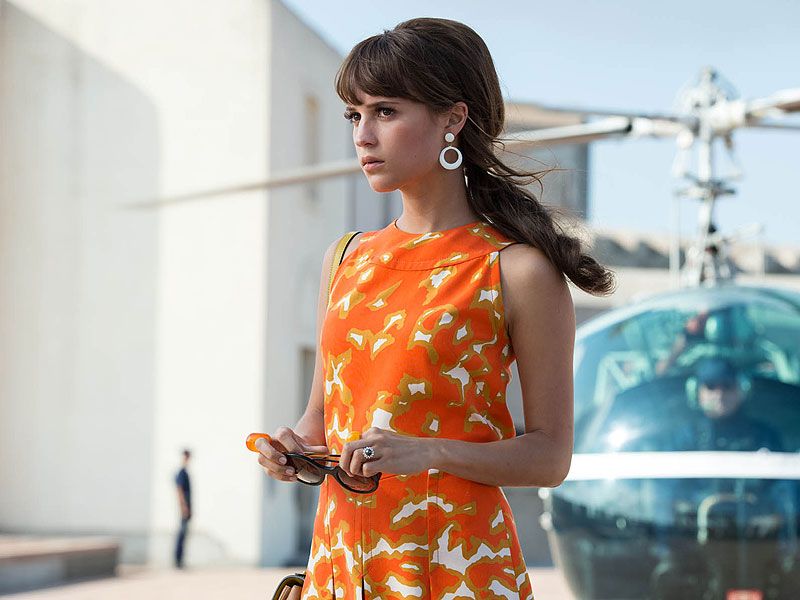
3) Of course, the most 60‘s thing about this movie is Alicia Vikander’s Gaby.  Given her modest figure and impeccable poise, she’s able to rock those Mod fashions something fierce.  Hell, she even makes those overlarge sunglasses work for her.  Granted, I would have preferred they named her April Dancer, but that might have tipped the movie’s hand as to what her role was in the
"Why yes, I know how to rock these Carnaby Street fashion..."
plot.

4) This is another film that suffers from a lackluster set of villains.  Neither Elizabeth Debicki’s Victoria or her husband make much of an impression, and their motivation could use some work.  Even their main henchman is ruined by the way he blabs it up so readily when the tables are turned on him.

5) I wonder if we really needed an origin story for the two leads.  One being a thief and the other having anger issues doesn’t really contribute anything to what is, at its core, a very simple high concept.  We don’t need that level of depth in this context.

6) Boy, Henry Cavill is...earnest in his portrayal of Napoleon Solo.  It’s the kind of performance where I don’t know if he’s being serious or taking the piss out of the spy genre.  Considering that Armie Hammer plays his role straight, it sets up a weird vibe between them.
"No, really...we ARE so villains!"

7) While I think Ritchie’s urge to do a chase scene on three different planes of location was intriguing, I don’t think it quite works.  The fact is, even with the shots showing where the planes were in relation to each other, I found it quite hard to follow.

8) There are a couple of interesting sequences which use two focuses, both for comic effect.  And both seem to benefit from Cavill’s comic timing.

9) Even though an argument could be made that he’s underplaying it, it does seem that Hugh Grant is having fun playing Waverly...and I like how the movie foreshadows his appearance a couple of times before he makes his full debut.

10) While it was nice to see the distinctive UNCLE guns in one sequence, it would have been nice to get a clear shot of them (no pun intended).

Overall...Yes, it’s flawed, but it’s also great eye candy and further proof that Guy Ritchie knows his period pieces.

Tuesday, January 27, 2015

Ten Statements About....WHERE THE BULLETS FLY (1966)

1) While this film is still painfully low budget--like The 2nd Greatest Secret Agent In The Whole Wide World, this Charles Vine adventure confines itself to London and its environs--it’s obvious more money was spent on this film.  There are more elaborate set pieces, including several multi-person gun battles, and a number of sets that seem more spy movie-like.

2) This film also learns from what its predecessor lacked by providing an actual villain in Michael Ripper’s Mr. Angel.  Now granted, Angel is a strange creation with an indeterminate accent and appearance, but at least he’s someone we can focus our animosity on.

3) It amazes me that the film was directed by veteran film and television director Lewis Gilling, because there’s a frequent sense of amateurness to the whole thing.  Particularly alarming is the way the camera is constantly shaking and readjusting itself as if we’re experiencing a very, very slow version of Shaky-cam.

4) I have to wonder if Tim Barrett’s Seraph was meant to be a parody of John Steed in the same way that Charles Vine is supposed to be a mockery of Bond.  It doesn’t quite work, but I will admit that his sudden exit from the film is one of its bigger shocks.

5) While Dawn Addams’ Felicity Moonlight is an upgrade from the previous film’s female lead by, you know, actually being a female lead as well as a spy-movie girl, it’s weird how the film doesn’t introduce her until the third act.  But then....

6) ....there are long stretches where Vine himself doesn’t appear, including a painful ten minute stretch where a ‘comedic’ minister and his secretary visits the air base where the film’s MacGuffin is stored.  It’s a peculiar choice in a peculiar franchise.

7) You know, I don’t think James Bond, even in the Roger Moore era, would stop in the middle of a running gun battle to watch the world’s most awkward stripper.

8) There are moments where Gilling is trying to be too artistic for what, at its core, is a bread and butter spy film.  The sequence where various actors in a room are reflected in a cat’s eyes is particularly jarring.

9)  Boy, you guys got the most out of the cooperation of the Royal Air Force, didn’t you?

10) While the jokes about Tom Adams’ resemblance to Sean Connery is gone, they’re replaced by some forced comedy.  Besides the minister scene, there’s an interminable one with Sidney James as a cranky mortician.

Overall...only a marginal improvement over the original, and still a curiosity that might be of interest to fans of 60's spy culture.

Tuesday, January 20, 2015

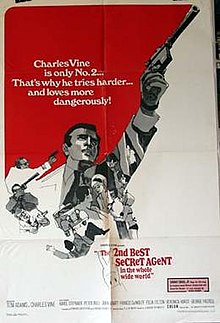
Ten Statements About....THE 2nd BEST SECRET AGENT IN THE WHOLE WIDE WORLD a.k.a. LICENSED TO KILL (1965)

"Why yes, I did get this job because I look vaguely like that
other fellow...."
1) Okay, we get that Tom Adams was hired to play Charles Vine because if you squint in a dark room, he sorta looks like Sean Connery....but do you have to keep reminding us with jokey references to 007?

2) I can’t decide if this film is meant to be taken straight or as a burlesque.  Adams and other actors play their role with a grim earnestness, but then we get villains named ‘HeShe’ and ‘Sadistico’ that seem a touch broad.

3) And since we’re on the subject of villains, the script never gives us a solid one.  We get a group of Soviets, a doppelganger and the aforementioned HeShe and Sadistico--but none of them are vividly enough drawn to qualify as a superspy baddie.

4) As non-sequitorial as the idea of Vine taking a first in Mathematics at Oxford is, it cleverly allows for the exposition about Regrav to be better disguised as a dialogue between peers and not a scientist explaining his work to a blunt object.

5) You know what’s really jarring?  That weird ass guitar based musical score.  It seems too jaunty to belong in a spy movie.

6) While it’s obvious that the film is very low budget, I have to admit I didn’t realize that the big MacGuffin was never seen until after the fact...which is pretty effective screenwriting by Lindsay Shonteff and Howard Griffiths.

7) I guess I should be grateful that Vine barely gives Veronica Hurst’s Julia the time of day save for looking at her legs because she’s....well, a very bad actress and decidedly mannish in appearance.  I almost expected her to be revealed as HeShe at one point.

8) Okay, you make a big deal about the soviet baddies having a doppelganger of Vine they plan to replace him with so he can assassinate Karel Stepanek’s Jacobsen.  Then why don’t you ever even tease that Vine has been replaced, rather showing him being thwarted in his attempts before being uncerimoniously killed at the climax?

9)  You know how you can tell a film’s low budget?  When they use stock footage to represent the hero showing his charge the sights of London.

10) This ending makes. No. Sense.  Even with that seemingly endless scene of Vine’s superior explaining the plot afterwards.

Overall...a peculiar little oddity that may not be the greatest low budget spy movie of the era, but has some charm.  And to think there are two sequels and three sort of rip off Shonteff wrote featuring ‘Charles Bind,’ one of which starred Gareth ‘I was in The New Avengers’ Hunt!

Wednesday, March 21, 2012

A Parting Glance: Robert Fuest (1927-2012)

Robert Fuest might be an unknown name to most people. To others, he might be just a peculiar cult director responsible for a handful of B movies. To me, he was an integral architect of my creative life.

Fuest, who passed away at the age of 84 today, was not only the director of such stylish and demented movies as The Devil's Rain, The Last Program and one of my favorite films of all time, The Abominable Dr. Phibes. He was the Production Designer for my favorite television series of all time, The Avengers. All the wild props, insane sets and vibrant costumes you think of when you think of Steed and Peel kicking ass in their uniquely British style? That's all him. And it was his success at creating a unique and bizarre world that led to Fuest directing several episodes of the sixth and final season of that show, which then led to him directing a well-received adaptation of Wurthering Heights, which led him to creating one of Vincent Price's greatest roles.

I watched The Avengers as a very, very young boy on WWOR-TV here in New York, and it was that show that drew me into the pulpy, fun world of Spy Culture. It was watching Diana Rigg rocking those jumpsuits as she wandered through sets made up of oversized photos of herself that made her my first actual media crush. And later, it was watching Price and the absolutely luscious Virginia North 'And-Then-There-Were-None' the surgery staff that killed the even more luscious Caroline Munro with style and aplomb made me realize that villainy is not just in the deeds themselves. I don't think I am exaggerating when I say that there are things in my writing to this day that have Fuest's vague fingerprints on them, and that he is one of the creators that helped shape my own creative style.

Apparently Fuest never quite recovered from the rather rancid reception of his last theatrical film, The Devil's Rain. Only going behind the camera for two television movies and a number of television episodes--including two for the series revival The New Avengers and a bunch of ABC Afterschool Specials (I can hardly imagine how surreal having him in the director's chair for those bland-as-toast things)--throughout the 80's, Fuest eventually retired to teach filmmaking and paint.

I have to wonder what would have happened if Fuest was able to build on the promise inherent in the Phibes movies; what sort of insane entertainments would I have enjoyed then? Sadly, that's all I'll be able to do...wonder, and honor a Great, Great Man.