Friday, March 1, 2013

Ten Statements About....DOCTOR WHO STORY ONE HUNDRED AND TEN: THE LEISURE HIVE (1980)

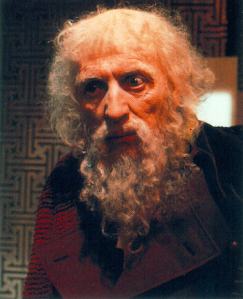
...and after getting super-old, the Doctor will
try to convince people he's an elk...

1) This is the first serial produced by John Nathan-Turner, who will guide the series until the classic version of the show is put on permanent hiatus in 1990....and boy, does he do whatever he can to differentiate it from the Graham Williams episodes.  The new starfield credits, the new music score, the use of 1980's-style  (i.e. clunky and primitive) CGI, the darker outfit for the Doctor...everything amounts to Nathan-Turner shouting 'We t'ain't your father's Who!'.  And to be fair, the new look does serve to convince us that we've come out of the children's pantomine that the Williams/Adams season had become.

2) ...which isn't to say that the show is without flaws.  The serial is so in love with its new CGI-based optical effects department that it devotes big ol' sequences that go on forever to moments that show off their prowess.  One shot of a starcraft docking is shown in its entirety roughly four times, and another shot of a model of the titular building on a CGI generated background (complete with too-bright sun beating down) seems to be repeated every time director Lovett Bickford runs out of ideas.  And this--along with other moments where Bickford indulges in arty shots like the 360 degree pan of Brighton Beach--slows the pacing of the serial down tremendously.

3) I also wonder if the serial wouldn't have benefited from David Haig not chewing his scenery so vigorously as Pangol.  Haig is so sneerily over the top that there's no doubt that he's the villain, and that distracts from the Mafia-manque story that the serial is supposed to be about...and given how Pangol's story arc results in a particularly bad CGI sequence that goes on for so long we can lovingly appreciate the level of crapitude, maybe it's better his story was minimized a bit.
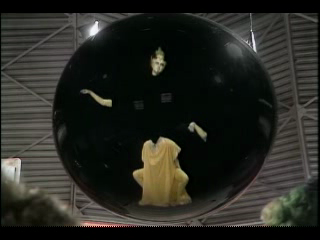
"Look!  CGI!  It's DA FUUUUTUUUURE!"

4) Pangol's craziness also detract from the whole backstory of the Argolins.  There are these weird hints at what they're all about and their biology--apparently they're plant beings (it's never explicitly stated) whose age is measured by the number of berries or seed-pods on the top of their head.  There's a number of interesting things about Argolin society that is sorta kicked aside for Pangol making nasty references to Greeks, ranting around and overall trying to be Better Than You.

5) I can almost buy the Fomasi.  In tight close up they can actually be a bit unnerving.  Even when I see them in full figure and notice the big cinch-sack like collar, I can suspend disbelief juuuust enough to let the serial flow on.  But I cannot buy the way the villainous Fomasi hide from detection for the bulk of the story....they simply cannot slip into those disguises so easily given their generous form.

6) Here's something that made all of us who weathered the panto silliness of the Graham Williams era happy....this story is based on the admittedly fictitious science of 'tacyonics,' but it's a fictitious science that is both plausible and based on a bit of science fact.  Throughout this first season and part of the next, we're going to see some pretty hardcore science fiction concepts--this season ends with a truly amazing story that's tied in to some pretty heady ideas about psychics and mathematics--and it's really refreshing after what we just endured.

"Raahr!  I's a fluffy monsta!"
7) I'm not quite sure, but there's some weird elements in the serial that seems to have been left on the floor.  There's these frequent hints that there's some form of mutual attraction between Adrienne Courri's Mena and Nigel Lambert's Hardin, yet outside of some quotes, there's nothing concrete we can hang this supposition on.  There's the whole concept of the Fomasi criminal underground.  Plus there are other things that are mentioned, allowed to take its bowed, and never brought up again.  It's kind of frustrating.

8)  Thank God that Lalla Ward is wearing something distinct and flattering to her in that Edwardian bathing outfit with the big ol' hat.  But then, the costuming overall is very clever in a minimalist way, allowing us to get a sense of each character with only the way a garment falls on them.

9) I rather liked the way the story sees the Doctor transformed (something we'll see again in the very next serial).  It shows one of the strengths of the early phase of The Nathan-Turner Years--namely, these serials for the first season and change look for ways to actively challenged and hinder the Doctor.  Seeing this doctor struggle with age and his failing brain cells, seeing him express frustration at being slower intellectually is something the viewer hasn't seen before.  We'll see this a lot in these early Nathan-Turner tales until the arrival of Script Editor Eric Seward screws it all up.

10) You'll notice how the serial quickly, and pretty much gleefully, disposes of K-9 and the Randomizer within the story.  This could be looked upon as Nathan-Turner rushing to convince us that This Is Not Your Father's Who....or if could be the very first indications of Nathan-Turner's pettiness, which we'll see in abundance once he and Seward are a team.

Overall...even with its wonky pacing and weak storytelling choices, this is a decent serial that provides something of a 'mission statement' for this first leg of John Nathan-Turner's era--an era that will sour fairly soon, but right now is bright with promise.

Sunday, February 24, 2013

Ten Statements About....AN AMERICAN WEREWOLF IN LONDON (1981)

The scary thing isn't the special effects in this movie...
it's the emotional reality of the performances.

"The undead surround me. Have you ever talked to a corpse? It's boring! I'm lonely! Kill yourself, David, before you kill others."

1) While I know most people think of this as a comedy, it's actually not; it's a full on horror with some strong comedic elements solely for the purpose of relieving the tension.  In almost every way, Landis structures the film like a classic Universal Monster Movie (even namechecking The Wolf Man in a key scene to foreshadow the climax), only with a decidedly 70's sensibility.

2) Landis spends almost twenty minutes with David Naughton's David and Griffin Dunne's Jack before Jack gets et, and David gets lycanthropized.  And almost all of that twenty minutes is a conversation between the two.  This serves a number of purposes--it cements our identification with David, it makes the friendship between the two real so that it makes sense that Jack would try to counsel David from beyond the grave, and established Jack's light-heartedness, which makes his humorous, gruesome appearances later in the film logical.

In the future, Body Mods will get really, really weird....
3) What strikes me the most about Dunne's turn in this film is how, because we got a sense of his personality in the opening act, and because that personality carries over to his three undead appearances, we are nowhere near repelled by his increasingly grotesque appearance.  Landis has been so effective in building up character that Jack's rotting flesh is invisible to us.

4) ...but then, so much of this movie is about the characters.  There's a reason Landis takes almost an hour to get to David transformation into his wolf form; it's so we can get to know David, Jenny Agutter's Alex, even John Woodvine's surgeon.  And it's because we're comfortable with these characters that the horror of what happens is amplified in that last forty minutes.

5) I appreciate how we never get a full back story for East Proctor.  Landis realizes that we don't need to know anything other than there's a werewolf, and everyone knows about it.  And it encourages us to make that back story up....

6) Given that my last exposure to John Woodvine was in his scenery-ingesting performance in the Doctor Who serial 'The Armageddon Factor', I was incredibly struck by his turn as Doctor Hirsch, who ends up playing the Van Helsing role.  Woodvine is incredibly subtle and sympathetic, and watching him slowly put together the pieces of this puzzle and then using that information to try to aid David and Alex.  It's a marvelous little performance.

Quite frankly, Jenny Agutter could turn any man into a
wolf...
7) Another marvelous performance is given by Jenny Agutter.  Alex could easily have become a cliched character based out of a goofy sexual fantasy, but Agutter has genuine chemistry with Naughton that makes the rather accelerated relationship work.  Plus she's thoroughly gorgeous, which can't hurt.

8) I'll say it...the ultimate form of the werewolf is a bit crap, looking decidedly...fluffy with its heavy coat.  But Landis is smart, showing us the monster in very quick cuts or in deep darkness--and those that are relatively clear he shows obscured by the panicked crowd.  It allows the monster to still seem frightening and formidable within the constraints of the budget.

9) That being said, the real highlight of Rick Baker's work is the transformation scene, which is effective due to extremely clever editing to give us the illusion we're watching a single, fluid scene where Naughton distorts into a wolf.  It's a magnificently scary and wonderful scene, made all the more strange by the choice of music.

10) You know, the scene that made me cringe the most isn't one with any of the special effects in it--it was the scene where David is in the phone booth saying goodbye to his family through his little sister moments before he's ready to slit his wrists.  Even though Naughton is a limited actor, he rises to the occasion, making his despair and horror absolutely real.  He also achieves a similar level of magnificence during the scene where he's trying to repel Alex and begs a policeman to lock him up before he kills again.

Overall...a film that, because we tend to focus on the humor, is miscategorized.  This isn't a comedy with horror elements, but a horror film that's emotionally real with comedic elements.  Absolutely essential viewing for horror fans.

Friday, February 15, 2013

Ten Statements About....MONSTER a.k.a MONSTROID, IT CAME FROM THE LAKE, TOXIC HORROR (1980)

"You looking at me?  You LOOKING at me?  I don't see
any other monsters here..."

"You're crazy if you think I'm gonna spend the night outside this stupid lake fighting off mosquitos waiting for you to get a stupid picture of a stupid monster that'll probably turn out to be a stupid log or something."

1) The first sign that this film is going to be glorious awful?  The title card that starts it saying it's based on a true story that took place in 1971....

2) I did a double take when I was looking for the release date for this movie.  It supposedly came out in 1980, but it's got that shot-on-16mm, lack-of-artisty look that makes it feel like a product ten or more years earlier.  The film looks primitive, and the writing (with its whole ecological concern subplot and sexual politics--more on which below), and acting gives it a the feel of one of those 'let's put on a show' exploitation films that would make its rounds on regional drive in circuits circa, well, 1971.

"Okay, I'm going to hang around naked in this lake.
Glad there's no monsters about...."
3) Another reason why this feels so retro is the way women are treated in this film--namely, as things to look pretty and sleep around with.  There's this strange sub-plot where every man who works for the multinational organization that owns the concrete plant this film is based around is apparently sleeping with his secretary.  And when Chris Mitchum (more on him below) shows up in his safari shorts to troubleshoot, he automatically falls in bed with the environmentally conscious reporter gal who is set up to be one of the opposition....well, just because.

4) Now here's a reason I can almost accept that this film was made in 1980....there are a couple of stylistic choices writer/director Kenneth Hartford makes that shows the influence of certain low-budget horror films from around the same time--in particular, the way the exposition is delivered directly to camera, as if the viewer and not Mitchum is Bill the Trouble Shooter.

5) Boy, does John Carradine act as if he's in an entirely different movie.  Granted, this is during the period in his career where he was drunk off his ass and taking any job that would have him, but his performance as the village priest here seems off for a film where everyone seems off.

6) All the women in this film serve almost purely decorative purposes, half of them are here only to sleep with the significantly older male leads, and one is here only to wear a bikini very, very well before being munched by the monster.  Oddly enough, the sexiest of these women is the helicopter pilot, who doesn't sleep with an older male lead or wear a bikini (and, to be fair, has a weird-ass accent that could be Columbian, could be some girl's idea of Columbian).

7) Here's an unintended benefit of this film being so low budget....since the bulk of the monster's scenes are shot in the dead of night, the primitive film stock makes the creature only perceivable in bits and pieces, and those bits and pieces seems pretty scary.
"I'm going to radio for a better script..."

8) ...which is why it's unfortunate that the climax takes place in broad daylight, because the ultimate monster is, ummmm, goofy as all Hell.  This thing, with its Fu Manchu mustache, gnashing jaws that don't join and goggly eyes, is just ridiculous looking.  I can't even decide if this was a full-sized model or a hand-puppet or some combination of both.

9) Chris Mitchum....sigh.  He certainly looks totally out of place in this film, and is the hero only incidentally.  He spends the majority of the film stomping around in some very unfortunate safari shorts (made even more unfortunate since he's the only one stomping around in those things, exposing his too-knobby-knees), and only takes some form of physical action at the very end, when he chases a trigger box in the lake for about five minutes.

10) This film counted in its cast residents of citizens in a town in Columbia, and in New Mexico...and damn, does it show given the number of very lame line readings and endless shots of a Columbia 'fiesta.'

Overall...with all its flaws--and its flaws are legion--this is a welcome and goofy throwback to a 50's monster movie, apparently made in the early 70's in spite of its 1980's origin.  If you're in a certain mood, this film can be entertaining for its faults.

Sunday, February 10, 2013

Ten Statements About....SIDE EFFECTS (2013)

She might look like a wounded bird...but even wounded
birds have beaks that can peck your eyes out...

1) This is a film that could not have been done if Steve Soderbergh hadn't discovered Rooney Mara.  At one point a character refers to Mara's Emily as 'attractive, but with a wounded bird quality,' and that's Mara to the T.  There's something about her eyes that seems perpetually haunted, even as she goes through several transformations and reveals during the course of the film's running time.  Plus, since she's still a relatively unknown face to most viewers (unlike, let's say, Olivia Wilde or Blake Lively, both of whom were cast at one time), which makes the world of the film seem more real.

2) ...but then that's one of the things that makes Soderbergh Soderbergh.  He is not interested in telling a straightforward story, which is why the film morphs several times, changing the tone, the style, and even the P.O.V. of the story whenever it suits him.  Hell, there are moments where the film becomes something of a tone poem (much like one of my favorite films he directed, The Limey), where it appears he's more interested in painting with pictures rather than telling a story.
Of course he's a thoughtful leading man...he's British and stuff....

3) And given that the A-to-B story is not exactly Soderbergh's prime concern, the revelation about Jude Law's Dr. Banks having a situation with a patient early in his career is never fully explored.  We hear his side of the story, but we're never told if he is telling the truth or if he's lying to his wife (played by Vinessa Shaw)....and I rather like that.  Not knowing if he did take advantage of a patient or not both puts him in contrast with Catherine Zeta-Jones' Dr. Seibert, and gives his ultimate choice in how to handle the situation a dark and satisfying shade of ambiguity.

4) That being said, I do feel one of the weaknesses is Dr. Seibert, who is never given the proper depth to make her appear more than a cardboard character from the worst kind of syndicated melodrama.  This isn't Zeta-Jones' fault; the writing when it comes to her is just too stiff for her to be taken seriously, especially in the last act.

5) I love how Soderbergh photographs New York as a place that's recognizable, but also somewhat weird and scary at times.  There are particular moments where he does these transitions that make this city a fairy tale land...which bolsters the whole dreamlike quality of the use of medication that Emily is going though.

6) Given the structure of this film, I have to wonder if this is Soderbergh's tribute to Hitchcock, especially given the way the first act plays out.

7) I certainly appreciate how Soderbergh populates his world with actors we may not have seen before--there are a number of actors in minor roles in this film (particularly Scott Shepherd, Michael Nathanson and Shelia Tapia) who are unfamiliar to the average viewer, but are so good they help build up the veracity of the world these characters move through.

8) I love how Soderbergh trusts in his actors and his story enough to let large stretches of it take place sans a music bed, which also allows us to make the decisions as to what is happening.  More filmmakers, who seem to feel that we need a constant aural assault to guide us emotionally through every single twist and turn, could learn a lesson from this.
"Yeah, they're taking me back to that G.I. Joe movie..
'cause now people think I'm coo'....

9) Boy, Channing Tatum...once more you get a relatively thankless role.  But on the other hand, I guess you're grateful Justin Timberlake turned it down to return to music.

10) This is another movie that seems to delight in giving us multiple endings.  There are easily three points in the film's back end where it could end definitively.  And while I like the ultimate ending, and the film's final tracking shot that makes it seem like everything is not wrapped up as neatly as it seems, I can see how it might aggravate some viewers.

Overall...a cerebral little thriller that works due to the steady hand of Soderbergh, some good performances and a twisting, chimerical tone and plot.  If this is Soderbergh's final bow (I pray it isn't), it's a comfort to know he has gone out with something just as strange and beautiful as his first film.

It was another trip to the Atlas, where I am still trying to get used to the parishoners of the True Faith Church wandering around in the morning.  There was more problems with the digital projector, as we had to deal with some of the eight (eight!) trailers without sound.  Amongst the most interesting of these were The Last Exorcism II (which seems to have abandoned the found footage bullshit and decided to tell a cinematic story...still, it's got Eli Fucking Roth stank on it), the new trailer for G.I. Joe Retribution, and the strangely compelling one for Baz Luhrmann's version of The Great Gatsby, which features Carey Mulligan in flapper mufti (Yes, I am there).  On the other hand, I really wish someone would point out that Oblivion still looks dreadfully boring, and no amount of Sandra Bullock could compel me to see The Heat, which is a prime example of why I hate modern comedies.

Friday, February 8, 2013

Ten Statements About....PLANET TERROR (2007)

Yep...a short Mexican, an Indian and two hot chicks sporting
guns...that's pretty much this film's aesthetic....

"Don't shoot yourself. Don't shoot each other. And especially... don't shoot me."

1) Man, I don't get why Rose MacGowan doesn't have a bigger career--not only because she's gorgeous (the opening go-go dance over the credits should be used as a tutorial for actresses who want to move like a stripper without actually, you know, stripping), but because she's genuinely funny.  Throughout this film, MacGowan's comedic timing is excellent, and many of her lines are laugh-out-loud hilarious.

2) ...although if I had to pick my favorite hot woman in a film stacked with hot women, I'd have to go with Marley Shelton's Dakota Black.  There's something about her eyes that thoroughly sends me, and her story arc (not to mention her strange...aptitude with her hypodermics) makes her a unique character even before Rose MacGowan's Cherry gets, ummmm, 'reloaded.'

(And yes, we will be getting to the Crazy Babysitter Twins...how could we not?)

3) I love the sheer chutzpah of Robert Rodriguez casting as his main bad-ass Carpenter-esque hero short, slight little Freddy Rodriguez as 'El Wray' (which may very well by a reference to legendary surf guitarist Link Wray)....but damn if Rodriguez doesn't live up to the challenge, moving through the film like a laid-back cheetah and handling both his action and his comedy scenes perfectly.  It helps that he has exceptional chemistry with MacGowan; even when he is mocking her, there is no question about the affection Wray has for Cherry.

4) The reason why I feel this movie is a more faithful example of grindhouse cinema even while Tarantino's Death Proof is a better film is how Rodriguez has a very 'anything goes' attitude.  There's a definite sense that he's shoveled in any crazy idea that once popped into his head when putting this film together--wanna see the hero shooting zombies while riding a pocket bike?  Done.  Wanna see a rapist's raping unit fall apart?  Done.  Wanna see the hottest woman on earth with a machine gun, grenade-enabled leg?  You got it!

5) ....and yet, there is a plan in Rodriguez' head, and he makes very deliberate choices to advance that plan, from the way discoloration creeps around a person when he's introduced to indicate his intentions are nefarious to the way the virtuous deaths (i.e. the ones we're supposed to feel bad about) happen off-screen, while the gratuitous deaths (i.e. the ones we're supposed to cheer on or be pleasantly grossed-out by) are seen in full view.  Hell, Rodriguez counts on us to pick up these connections so that he can just go nuts and get back to the crazy ideas.
No, wait...THIS defines this film's aesthetic better than
anything....

6) This is a film that is really, really splattery, with lots of grotesque practical effects.  That being said, the two moments of bodily violence that really made me wince are done with no real special effects.  The death of Dakota's son (played by Rodriguez' son) happens offscreen, with only the sound of a gunshot indicating that it has occured, and is made all the more harrowing due to Shelton's performance in this scene.  But for me, what happens when Dakota slips and falls while trying to open her car door while anesthetized is the single most painful moment of the film to watch.

7) There are moments where I think the film loses its direction during the final act, where the townspeople and the military people finally intersect.  This is the first section of the film where it starts sputtering in fits and starts, particularly in the jail cell and when Dakota and Cherry are appropriated by Quentin Tarantino's Rapist G.I.  It's the first time that we are no longer distracted by the parade of outrageous stuffage and start thinking about those big ol' truck-sized holes in the plot.

Ahhh, the beauty that is the Avellan Twins...and remember,
they're not Sickos...they're just crazy...
8) Even if the film wasn't good--and it is very, very good--I would love this movie if only because it introduced me to Electra and Elise Avellan, a.k.a. The Crazy Babysitter Twins.  These two are just insane in their small role, and they provide some excellent distraction in a moment when things are about to get very, very dark in the film.

9) Supposedly, Rodriguez had asked John Carpenter to do the score, but Carpenter was unable to do so at the last minute...which is fortunate, because I could not imagine anyone but Rodriguez doing the score.  The music's grinding skronk-guitar fits the film's aethetic perfectly.

10) I do wonder if there was a way to keep Josh Brolin's Dr. Black around longer.  Of all the villainous types, he's the one that makes the most impression with his performance and not with his face.  He creates a very spooky, chilling character who has this weirdly uncanny resemblance to Nick Nolte that helps shore up the idea that this is some forgotten New World Picture discovered in some back room in L.A. somewhere.

Overall...a film that properly captures the mix of gruesomeness and fun of low budget genre filmmaking in the 70's shored up by some excellent performances and a sharp, perceptive directorial turn by Rodriguez.

Friday, February 1, 2013

Ten Statements About....PARKER (2013)

Yeah, 'cause a big cowboy hat is the perfect way to disguise
you're a granite-faced, unshaven cockney ass-kicker....

"How do you sleep at night?"
"I don't drink coffee after 7."

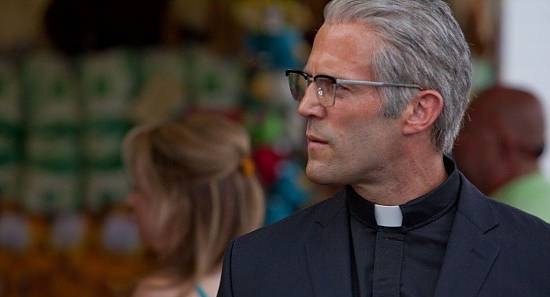
1) While I am relieved that Taylor Hackford didn't try to go the comedy route like the last director did with Westlake's prose, there is a fundamental--albeit not a fatal--flaw in the film, and that's the casting of Jason Statham as Parker.  There are moments where Parker is required to blend in and become more or less invisible amongst the background, and while Statham is able to do so more or less well in the opening heist, his main disguise gig--complete with garish cowboy boots and a white ten gallon hat--fails completely...and having Jennifer Lopez' Leslie call him on it doesn't forgive that everyone else doesn't.

2) On the other hand, the four thieves who Parker has a vendetta against do blend into the background--to the point where they're more or less cyphers.  It doesn't help that most of them go unnamed for long stretches of time; I didn't know the one I referred to as 'Beardy Guy' was called Ross until after his storyline was over.  Even Michael Chiklas' Melander (who I spent the bulk of the film referring to as 'Michael Chiklas' in my head) seems one dimensional and ill-formed.  The one villain who comes off the best is Michael Hauptmann's weasely and incompetent Hardwicke, who not only helps define Parker's code of ethics, but also provides him with the impetuous and motivation to seek revenge.

3) I like the use of Nick Nolte as Parker's former partner and father-in-law...precisely because I could see Nolte back in the 80's being cast as Parker in an adaptation made at that time.
Cross this priest, and you're likely to be damned...

4) And then we have Jennifer Lopez, who apparently remembered she had acting talent on the way to the movie set.  She does the amazing thing of being the comic relief while also being a) integral to the film, and b) being an actual living, breathing human being that we have sympathy for.  Lopez' Leslie actually takes the burden of being the sympathetic character off of Parker, giving him free reign to be the ruthless and relentless protagonist we want to see.

5) I do very much appreciate the fact that Statham's Parker is not invulnerable....he gets hurt.  Hell, he gets hurt very, very badly.  And Hackford is unblinking in showing how grotesque the aftermath of these fights are.  The only problem I have with this is how Parker doesn't seem all that immobilized by his busted ribs and stabbed hand during the fight scenes in the climatic sequence.

6) I also appreciate that Hackford shoots his action scenes by locking down the camera and letting his actors actually fight.  It makes the fights seem more brutal and, more importantly, clearly seen.  I am hoping that this and Skyfall (link!) indicate the end of the 'shakey-cam' school of action filmmaking.

7) You know who else surprised me as a character?  Patti Lupone, who played Leslie's mother, plays it originally like a cartoon monster...but as we go further into the story, Lupone manages to add small, almost infinitesimally tiny touches that moves the character from the one to the three dimension.  And then Lupone surprises us even more by how she reacts to seeing Parker in a serious state of distress, something that makes us admire and respect the character.

8) One very minor thing that bugged me was the script's insistence that Parker is inherently a good guy who loves his girlfriend, does right by people who do right by him, and lives by a code that can be interpreted as virtuous....which is not the Parker Donald Westlake had in his books.  This choice to soften Parker is doubly confusing given that the script provides us with a sympathetic character we can identify with in Leslie.
"Yeah, we're, like, bad guys and stuff because we're...bad.
Plus our boss is Vince from The Shield....

9) On the other hand, I do appreciate how the relationship between Leslie and Parker develops.  I'm pleased that Hackford keeps the attraction pretty much one-sided between the two, thus emphasizing Parker's being committed to his girlfriend and his view of Leslie as part of the job (and since Leslie held up her part of the job and didn't screw up in the way Hardwicke did in the first job, his taking so much time to make sure she's safe in the climax works character-wise).

10) Look, I understand that the house Melander's crew is holed up in is supposed to look run down...but why is it the one house that looks so out of place in the ritzy neighborhood they're operating in--and is the most sinister looking, grey-brown thing with exterior lights that look like malevolent eyes?  What, did the sign shop in the area go out of business so they couldn't hand a 'Thieves At Work' sign over the door, or was that too subtle?

Overall...while there are some good elements, particularly some of the performances, the film's insistence in making Parker into a hero in character instead of incidentally interferes with it being the bad-ass movie it wants to be.  All in all, just another film that comes off more as product than anything else.

Back to The Atlas, which has apparently taken to renting out some of its auditoriums on Sunday to a local church.  The audio track was off during the running of the audiovisual sludge of the Regal Firstlook, allowing me to use my Kindle in peace.  The trailers included the first one for Bullet In The Head that made me want to see the movie, if only because I now know it's a Walter Hill film; Iron Man 3 (no 'I have to see this moment, although I am intrigued by the trailer's stinger); and The Evil Dead remake, which I cannot decide whether there might be enough orginality in the mix to get me curious.

Sunday, January 27, 2013

Ten Statements About....CHOOSE ME (1984)

"Yep....I'm taking naked photos of Rae Dawn
Chong...sucks to be me."

"You can't go around asking every woman you kiss to marry you."
"Why not?  I only kiss women I marry."

1) One of the reasons why I feel this is one of the examples--if not the example--of Alan Rudolph's art is how artificial it looks.  Even though this is supposed to Los Angeles, the streets outside of Eve's Lounge and elsewhere are obviously studio backlots...and it adds into the stylization in the look and the emotional feel of both the setting and the characters herein.  And this artificiality extends to some of the interiors, like the movie-poster laden loft of Rae Dawn Chong's Pearl.  This conscious artifice helps make the unreality of an L.A. that apparently is occupied by only these sextet of people seem more real.

2) I can see why Keith Carradine was something of Rudolph's male muse.  Yes, he's a handsome man, but there's a certain darkness in his eyes (something that Rudolph exploits fully in his next film, Trouble In Mind) that is disquieting.  His face is the perfect avatar of the Rudolph aesthetic.

3) One of the most amazing conceits of the film is how we're told that Carradine's Mickey is incapable of telling the truth...and yet, we get evidence halfway that maybe Mickey's various stories are the truth.  The concept is introduced very carefully, very subtlety, and then never brought up...which leads us to another reason why I love Rudolph as a writer/director--he trusts us enough that he allows us to come to our own conclusions.
"Yep...Genivieve Bujold makes me lunch and
then sleeps with me..my life is soooo bad."

4) Wow...so Carradine gets to kiss in order Lesley Ann Warren, Rae Dawn Chong, and Genevieve Bujold.  He gets to see Chong naked and sleeps with Bujold....

Yeah, Keith.  Tough life.

5) As interesting as Mickey is, Bujold's Nancy is even more so--probably because we know even less about her.  She professes to be incapable of falling in love, insists on talking to her therapist only on the phone...and yet there's that bizarre scene where we see her dressed up to the nines and caressing her very exposed thighs while her therapist tries to stop her from....something.  It's one of the most disquieting scenes because we don't understand how exactly Nancy's mania expresses itself.  And when she does transform in the third act, it's relavatory.

6) ...which leads me to wonder if Nancy and Lesley Ann Warren's Eve aren't meant to represent two aspects of the same person--to be precise, two extremes of the same person.  Eve looks to put her sexual past behind her, whereas Nancy seems to want to use some expression of sexuality as a way to abandon her emotional repression.  There is the sense that one of these two women would gladly become the other.

7) Alan Rudolph should be ranked with Quentin Tarantino as a director who knows how to use music, although he approaches his music use differently.  In this film, he has Teddy Pendegrass do the whole soundtrack, which results in a score that's as sensuous and smoky as the film itself, a score that comments on the action and is more than just background noise.
"Yep...I make out with and marry Lesley Anne Warren...how
I hate my life!"

8) Once you get past the sight of him with a full set of hair, Patrick Bachau's Zack is at turns both the villain and the comic relief, the one hint of true menace in a world of artifice and randomness.  While we get the impression he's a gangster (you can't have an Alan Rudolph film at this point in his career without there being a gangster), he's not an effective one; and since his main purpose in the film is to be frustrated at every turn by Mickey's talent for finding and romancing all his women --leading up to his dead spot perfect, hilarious last line, it works.  It looks so weird seeing him in this film.

(And the same goes for seeing John Laroquette as Eve's bartender...particularly because he seems to tower over everyone else in the film.)

9)  If there's one regret I have about Rudolph's career, it's that he seems to resist giving into the magic realism his world seems tailor made for.  There are some very sparse moments when he indulges in the practice, like when we see Nancy physically appear behind Eve for a second during a phone conversation the two are having, or when the prostitutes who hang out outside Eve's Lounge start doing what appears to be ballroom dances.  I think if Rudolph had embraced this tendency, he may be better remembered today

10) I love the fact that even though this film seems to have a happy ending, Rudolph refuses to go all in--there are brief moments, especially the last shot of the film, that hint at both Eve's and Nancy's stories haven't resolved themselves in a positive way.

Overall...very moody and stylized (I will always contend that Rudolph films aren't romantic comedies so much as romances where strange and funny stuff sometimes happen), this is a prime litmus test for whether you will like his idiosyncratic oeuvre.  I happen to love his work, and consider this one of the crown jewels of his career.