Saturday, January 19, 2013

Ten Statements About....DOCTOR WHO STORY ONE HUNDRED AND SEVEN: NIGHTMARE OF EDEN (1979)

"Raaaahr!  Were's monstas!"

"I shall be charging you with gross neglect of duty. The passengers should be your first concern, yet I find you drunkenly looking on as they are attacked and killed. Well?"
"They're only economy class; what's all the fuss about?"

1) This is the last serial written by Bob Baker, the writing partner of David Martin....and if I wrote this, it'd be my last serial as well because it's thoroughly and absolutely wretched.  Even if we have to assume that the story was, like others in this season, heavily rewritten by Douglas Adams, Baker's tale is so messed up I can't imagine anyone salvaging it.

2) I am absolutely convinced that Lewis Fiander was doing an imitation of Peter Sellers' Dr. Strangelove when assaying the role of Tryst....so much so that between the weird 'vest-with-John-Lennon-specs' outfit and that bizarro accent, Tryst stops the story dead every single time he opens his mouth.

3) What the Hell is Lalla Ward wearing throughout this story--a maternity dress?  That thing is so loose-fitting and so volumous that Romana looks positively lost in that ugly violet thing.

4) You know how I'm convinced that Adams rewrote this script?  There are a whole slew of ideas--the whole crux of the drug running storyline revolves around a matter storage/projection machine--that are given, ummmm, less-than-solid scientific rationalization.  The one quality of the matter projector, namely the way people are able to move back and forth into the projected window, is never explained at all.  We just see The Doctor and Romana jump into the projection of Eden and are asked to accept this.
Monsta Hug!  Monsta Hug!

5) And then there's the monsters....grumblemutter...or should I say 'da monstas.'  The Mandrils are amazingly bad designs, not the least because they sport what looks like big-ass black sausages for a mouth (which, I guess, means they're related in some way to those dorky sea creatures from The Horror Of Party Beach....).  It doesn't help that the cumbersome outfits make moving difficult, and that the zipper and the odd flash of side-flesh when the shirt pulls out from the pants can be clearly seen at points.

6) I will give this one small thing to the serial--there are some tiny moments where the Doctor and Romana actually act like, you know, The Doctor and Romana.  I particularly liked the moment where the Doctor is told he has to traverse a stretch of space liner rife with Mandrils sans K-9 and guns, and Tom Baker grins happily and says, 'I'll have to use my wits.'

7) And while we're on the subject of K-9....David Brierly assays the voice of the little tin dog and as such, this iteration does.  not. work.  The character is actively annoying from the moment it opens its 'mouth.'  And since its co-creator is writing this script, K-9 gets loads to do--most of it embarassing (particularly the moment where K-9 'sniffs' a character when the Doctor introduces him as a friend).

8) Okay, so you want to make this story about the dangers of drugs; I get that.  But do you have to do the Full Reefer Madness to depict how terrible a drug this vraxion is?  I mean, David Daker's Captain Rigg downs just one spiked drink and becomes this lazy, giggling numbnuts instantly.  The choice Daker makes to play this, which all campiness and Adams-esque 'comedy,' detracts from the supposed seriousness of the vraxion threat.
"....and I anticipate a ratio of 10 women for every man...."

9) For a series known for lame and tatty micro-budget designs, this serial hits a new low.  For a supposed luxury liner, the scenes of people in foil jumpsuits in a cardboard corridor manages to break the suspension of disbelief.  There is nothing--not the corridors, not the labs, not the engine rooms--that look like anything other than hastily designed sets.  Usually there's enough interesting things going on we can overlook the cheapness, but given how awful the story is....well.....

10) On the whole, the cliffhangers are subpar.  However, the third episode cliffhanger, where the Doctor seems to evaporate into nothingness when he successfully separates the two ships is pretty good thanks to some really good optical effect.  It doesn't convince us for a second, but at least it's neat.

Overall...One of the worst stories during one of the worst seasons in Classic Who, this serial fails on almost every level.  Avoid at all cost.

Friday, January 11, 2013

Ten Statements About....SERIES 7: THE CONTENDERS (2001)

This woman has just shot a man to death...and she's your hero.

"These cats don't have nine lives."

1) Even though it doesn't fully fit into the purview of 'found footage,' this is one of the most effective examples of that subgenre.  It tells a compelling story, it justifies why we're getting all the footage that we might not otherwise expect to see, and it hints at a larger tapestry that shores up the world the film is set in.

2) ....and that might be the most intriguing thing about the film--the fact that the story, ostensively episodes from the seventh season of this demented reality show, takes place in this weird alternative nightmare universe that implies our society has gone down a very dark, very unpleasant path.  And yet nowhere does writer/director David Minaham spell it all out for you.  We know that the government has a hand in this reality show, we know that they manipulate the results, and we know there's a darker purpose behind all this--but we never learn the truths behind these circumstances.

3) Of course, this film would not work without strong performances, and the strongest performance is by Brooke Smith as our central character Dawn.  We see Dawn do some truly brutal things--there's a brief sequence where Minaham contrasts Dawn's interview with footage of many of her previous kills that is ruthless in its violence--and yet she manages to get a great deal of humanity and sympathy at points, particularly when she takes a moment to comfort the wife of a just-murdered contestant.
Don't pity this woman despite her deer-in-the-headlights
expression...because she won't pity you....

4) ....and on the other end of the spectrum we have Marylouise Burke as Connie, who is a horrific monster of a character--and yet believes one hundred percent that she is not evil, that she is motivated by her Christian values.  And Minaham never presents Connie as anything other than a ruthless killer, right from her first interview where she admits to 'helping' people who suffer pass on to the next world ('This happens more often than you think,' she adds after this confession!).

5) This is a violent film that comes by its R rating thoroughly honestly, and yet the violence onscreen is relatively restrained.  That being said, the brutality and intensity in the way Minaham presents this violence throughout makes some of it rough to watch, particular the film's biggest setpiece set at a suburban mall.

6) The film is hard to categorize.  Even though it doesn't have any gruesome elements, I'd almost categorize it as a horror film for the pitch black view of society it has....but the film is also richly and darkly comic.  Minaham knows he has to give us a release valve and peppers the film with some moment of genuine, twisted humor.  Even the narration--ably provided by Will Arnett, of all people!--gives us some lines that allow us to laugh nervously between the horrific elements.

And what would a reality show be without a car chase?
7) I do like how Minaham does play with our expectations when it comes to the reality show 'script.'  The person we expect to be the first to be picked off is the one who commits the most henious act of violence; the person who we expect to be the mildest is the one who is the most venomous contender.  And since Minaham worked as a story editor for newsmagazine shows prior to directing this film, he's managed to perfectly recreate the way these shows can deceive the public and bend the narrative.

8) ...and that might be why the film didn't do well in its theatrical run.  Minaham is too precise in his recreation of The Contenders TV show, resulting in us not having that slight distance that satire sometimes need.  Even though we're given absurd moments (Dawn being unable to register a kill because a cameraman gets in the way; hostages cheering when a character announces 'people will die'--not realizing that the people that are being referred to are themselves; etc.), they don't feel like commentary; they feel like an example of the thing Minaham is commenting on.  And as such, sometimes the comments don't through to the viewer.

9) ....although I will admit that the 'recreation' of the film's denoument is wonderfully lame, featuring actors who look uncannily like Smith and Glenn Fitzgerald, who plays Jeff....if you looked at them sideways.  As with the rest of the film, the recreation of reality show tropes is uncanny, but unlike elsewhere, Minaham manages to create that little separation so we can appreciate the half-assedness spin control the producers of the show try to achieve.

10) Can I say I love Girls Vs. Boys' soundtrack, which mananges to subsume their noise rock qualities when they need to to recreate cheesy reality show muzak muck, and are able to take a back seat to other composers when they have to (like that hilarious usage of Joy Division's 'Love Will Tear Us Apart' when it comes to delineating Dawn's backstory).

Overall...even though it may fail as a pure satire, this film excels as a really frightening extrapolation of what our present society's obsession with reality TV can result in.  Held together by a magnificent and ruthless performance at its center, it also serves as a great example of how you can use 'found footage' tropes to tell a really great story.

Tuesday, January 1, 2013

Ten Statements About....DOCTOR WHO STORY ONE HUNDRED AND FOUR: DESTINY OF THE DALEKS (1979)

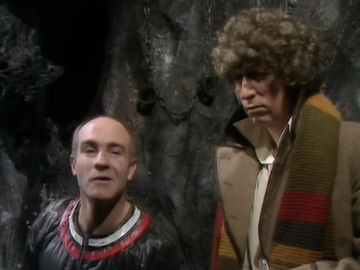
Tom Baker and Lalla Ward try to run away
from a heavily rewritten script....

"Dead?  I do not die.  Mark this moment, Doctor.  In the history of the universe, this moment is unique.  Davros lives!"
"Yes, well I can see your long rest hasn't done anything to cure your meglomania.  Have a jelly baby."

1)  And here we begin Lalla Ward's two and a half season tenure as Romana....and we begin it in typical Graham Williams/Douglas Adams fashion with a comedy sequence which shows Romana being very cavilier in her usage of her regenerations to convince the Doctor she should just mimick Princess Astra's form.  It's a tiresome scene that takes up too much time in the first episode of this serial, and it's a definite harbinger of the the way the Williams era will spiral out of control.

2) That being said, I rather like the visual appearance of Romana in this story.  With the long white scarf and the pink suit, she serves as a sort of female mirror image of the Doctor while also retaining her own identity.

3) This is the first of the Dalek stories that begins the devaluation of the characters as villains, primarily because they are subservient to Davros.  As of this moment, they're pepperpot-shaped henchmen to a man in a bad mask.

4) You know, after the series spends a chunk of the last serial devoted to setting up the new status quo of The Randomizer shifting the Tardis, ummmm, randomly with the Doctor having control of where they will end up....they pretty much crap on that by having them show up on Skaro, a place The Doctor has shown up on several times before.
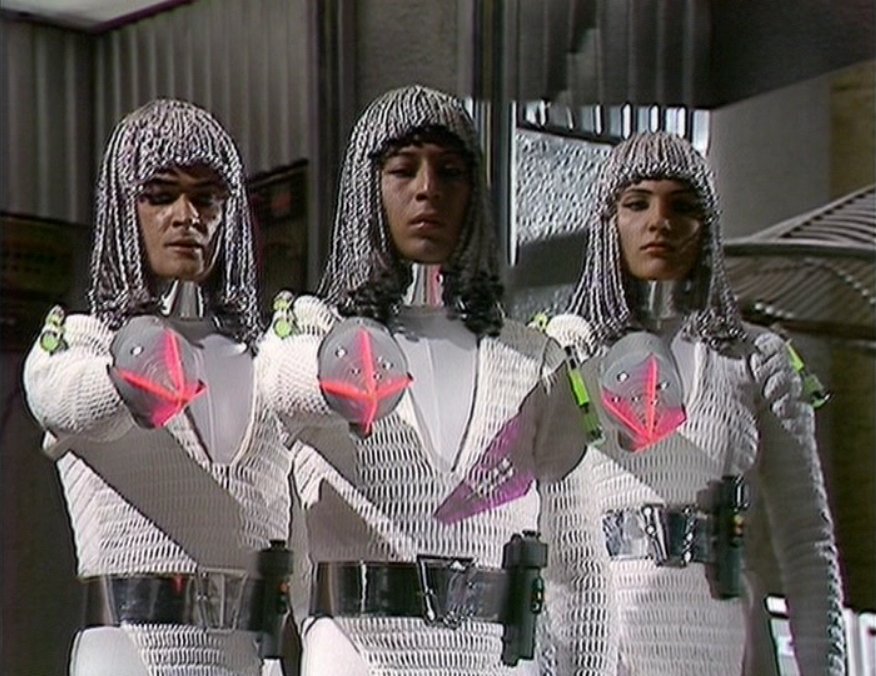
It's the invasion of the cosplaying rasta fashion models!

5) The problem with the Movellans is simply that outside of being another race of robots, they've got nothing going for them.  They're just robots who are pure-d-evil, and that's that.  There's nothing that makes them interesting or scary or even notable, which means the tension the story is counting on never develops.  It doesn't help that those mopheads make them look like a bunch of people going trick-or-treating as a rasta disco band.  

6) This is the beginning of the year where the highly overrated Douglas Adams takes over as script editor (who heavily rewrote the script)...which means that Graham Williams' tendency to treat the show as a comedy runs rampant.  The forced humor begins with that regeneration sequence at the top of the story and continues throughout, the low point being the Doctor mocking a Dalek for not being able to climb up a steep incline--which absolutely invalidates the Daleks (already becoming a bit naff due to their subservience to Davros) as scary threats.

7) You know, while there is a legitimate germ of a good idea as to why the Daleks are seeking Davros out....the moment Davros shows up, that germ is discarded save for some stray mentions in dialogue and that endless 'rock/paper/scissors' scene that is supposed to explain why the Daleks need what Davros is supposed to provide them so much.  For that matter....

"I am ready for my close-up, Mr. DeVille...."
8) Is it just me, or does the whole plot disappear thoroughly around the end of episode three?  The second we get the introduction of that atmosphere-burning bomb, the whole thing just degenerates into a lot of silliness with Daleks running around with bombs strapped to their bodies and these two dull alien races getting caught in the crossfire.

9) I think I understand the decision to raid the BBC Wardrobe of all the old Who costumes to kit out the Dalek slave force....but seeing all these recognizable and obviously tatty outfits--some of which are very ill-fitting--only emphasizes the cheapness of this production.  I really have to wonder if the slave force would have been better served by showing up in simple, nondescript outfits because....

10) ...when all is said and done, the slave force and Tim Barlow's Tysson are just there to muddy the waters.  There's so little done with them that they come off as a whole big bunch o' filler....which is sad, because Barlow is generally really good, and plays off of The Doctor well.

Overall...the beginning of one of the darkest era of the series, where canonical elements are treated with contempt by Adams and Williams.  While it may not be the worst Dalek story ever (Russell T. Davies saw to that), it is amongst the worst.  Avoid.

(And speaking of avoid...wait until we get to the next story...)

Saturday, December 29, 2012

Ten Statements About....DJANGO UNCHAINED! (2012)

Yes, he is a free man and yes, he meant to dress like that....

"How do you like the bounty-hunting business?"
"Kill white people and get paid for it? What's not to like?."

1) Since this is a Quentin Tarantino movie, I appreciated the way he incorporates elements from the original Franco Nero films into the story.  Hell, I practically stood up in my seat when the Morricone theme (arguably the greatest movie theme of all time) came out of the speakers at the beginning, and pumped the air when Nero shows up for a brief cameo that passes the torch onto Jamie Foxx.

2) Even though Tarantino has had flirtations with other actors before, I have come to believe that he's found his muse in Christoph Waltz.  Just like with his portrayal of Landa in Inglorious Basterds, Waltz' Dr. King Schultz is a vivid character who seems to have his own weird code of honor.  And given how well he plays off of Foxx, he's a great characters who brightens the film as long as he's onscreen.

3) I think the real charm of Leonardo diCaprio's Candie is that while he does villainous things, an argument can be made that he may not exactly be the villain.  Yes, he does some hideously awful things, he has that subtle but gross incestuous relationship with his sister...but nothing he does is outside the law or mores of the culture he exists in.  It's only when Samuel L. Jackson's Stephen outs Schultz and Django that Candie becomes a monstrous individual.  Taken in this context, it makes sense that his role is relatively small.  And speaking of Stephen....

"You are supposed to be me? Funny...I do not look black...."
4) I have to wonder if Stephen is, in Tarantino's mind, the true villain of the piece.  Jackson's performance is extremely clever.  Judging by the way Stephen seems to shift in intelligence depending on who he's addressing, this seems to be a man who gives off an inferior facade to hide the fact that he's always angling to be in a superior position.  And give it to Tarantino that he doesn't give the character the redemption moment we are led to expect him getting at some point simply because of who is playing him and what his character is in the context of the world.

5) God bless Tarantino for continuing to use practical effects.  These wounds are splattery and messy, and doesn't have the sameness of CGI wounds in other films.  This carnage is so gross that you sort of understand why Django hesitates to kill one man in front of his son.

6) I know that some people have some problems with the humorous way Tarantino handles Don Johnson's Big Daddy and his proto-Klan buddies, especially the scene featuring Jonah Hill complaining about the hoods.  But that humorous element was vital.  There's so much grimness on either side of that sequence, especially when we start moving toward the Candie sequence, that those moments (and I'll fess up to laughing out loud at the whole discussion of whether to wear the hoods or not) are necessary to allow the audience to relieve the tension.

7) One thing that sort of niggles at me is how we never see the logical extension of what Django does at both Big Daddy's and the Candie plantations.  There is so much gravitas to the way Django dispatches the overseers at Big Daddy's that I expected the slaves watching him to rise up.  I can understand why the slaves wouldn't rise up at the Candie's initially--they do have Stephen manipulating them into thinking they should be good lil' slaves--but the ones at Big Daddy should be running around kicking all sort of white ass after seeing Django beat and kill their masters.
Look, Don Stroud...I know you were hot shit in the 70's, but
you don't mess with Christoph Waltz....

8) It puzzles me why Tarantino chose Kerri Washington to play Hildy.  Don't get me wrong; Washington is an excellent actress....but given how little play Hildy has in the film itself, it seems like a waste of her talents.

9) And speaking of talented actors...I am totally cool with Foxx as Django for about 95% of the film's running time.  But there's about 5% where Jamie Foxx The Personality steps out of Jamie Foxx The Actor and totally subverts all the work the latter has put into making his version of Django into a living, breathing character.  There are some moments where I can forgive it, like in the coda at the end, but some of the other moments in Act Two and the early parts of Act Three end up being discordant.

10) I was somewhat floored by the amount of celebrity cameos in this film; if it was made in the 70's, I could easily see it being marketed with one of those headshot lines showing all the big names in small roles in the film.  But without a doubt, the most pleasurable of these cameos for me was seeing John Jarrett of Wolf Creek as an Australian mining guy who is tricked into arranging for his own death.

Overall...an excellent western in the Tarantino mode that only makes me sadder that this may be the beginning of the end of his career.

I was at the Atlas again--they've now raised the price to ten dollars for a matinee, which is almost as expensive as the regular price--and managed to avoid the sludge that is the Firstlook.  What I did not avoid is the family behind me who brought both their infant child and their young son, who thought nothing of deciding to play a little Angry Birds about midway through the film; I really think there should be a parenting license in this country, don't you?   Not a lot of interesting trailers, perhaps the most intriguing being the one for Scary Movie 5--not because I wanted to see it, but because I was surprised the producers took this long to tackle the found footage genre.

Tuesday, December 25, 2012

Ten Statements About....TIME BANDITS (1981)

"I think the reason I've gotten top billing over you is called...
oh, I don't know, celebrity?"
"Who was that man?"
"That was no man. That was the Supreme Being."
"You mean God?"
"Well, we don't know Him that well. We only work for Him."

1) At the core, this is a children's fantasy, and one of its strengths is how Terry Gilliam makes it a children's fantasy as a child would imagine it, not how an adult would.  Thus it's messy, it's gross at times, it's illogical....and it is sophisticated only to the lengths a particularly bright child can achieve.

2) And let's be honest here; the other strength is Gilliam's incredible attention to detail both visually and story-wise.  I was particularly struck by how the Castle Of Evil in certain shots seems to be made out of Lego Bricks...thus making it something a child can build itself.

3) However, it's not perfect.  It's obvious that Gilliam's script (written in collaboration with Michael Palin) hasn't shaken off his Monty Python sketch structure.  There are moments--like the frequent visits with Palin and Shelly Duvall's lovers--where the film stops so we can get a sketch.  Hell, the whole first half plays out like an extended, star-studded Python episode.  And speaking of that first half....

4) It really could have used some trimming.  I understand that we needed to establish the idea of the time holes and all, but did we really need to spend as much time as we do with Napoleon and Robin Hood?  The Napoleon sequence in particular seems very drawn out.  So does the King Agamemnon sequence, but that one serves the secondary purpose of showing us what Kevin's ideal father would be like before we get the diametrically opposite father figures of Evil and The Supreme Creator....
"What do you mean this is supposed to be a comedy?"

5) While we're on the subject, I like how both David Warner's Evil and Ralph Richardson's Supreme Being are designed as reflections on Kevin's thoughts on what fathers are like.  Warner's is capricious and cruel and prone to punishing for the sake of punishing, while Richardson's is condescending and lecturing to his assistants, making his punishments seem like kindness.  These are both valid ways a child like Kevin might see his own father as being.

6) I find it fascinating that Warner's Evil is obsessed with recreating the world with technology, as opposed to humanity, coming first.  But then, there's a definite luddite-ness to the whole film; it's technology that seems to obsess Kevin's parents to the point of neglecting him, it's technology that tempts the Bandits to their capture by Evil, it's technology that backfires on the Bandits when they're fighting Evil, and it's ultimately technology that ends up delivering Kevin's parents to their fate.

7) As much as I liked Sean Connery's Agamemnon--and I liked him alike--he seems to be in an entirely different movie.  Whereas John Cleese's Robin Hood and Ian Holm's Napoleon are aware they're in some form of a comedy, Connery plays his role absolutely straight.  Even the one moment that could appear comedic, where he does a magic trick for Kevin, is done very seriously.
In its last days, some of the members of Menudo were...
Questionable Choices.

8) I appreciate how everything that Kevin experiences on his adventure can be ascribed to a dream he has inspired by his toys and surrounding and exacerbated by what we learn in the very last sequence has been happening to his house....but attention is never drawn to this fact.  We see the items that might inspire his fantasy in very tiny glimspes so that if we catch it, that's good but if we don't we still get a strange adventure.

9) I totally adore the way Warner has this weird sort of dynamic with his three minions.  There's an active....affection Evil seems to have for these three misshapen lackey, and yet he is incapable of showing that affection except through cruelty and torment.  And the even weirder thing is how much the minions seem to delight in this, to the point that they cheer when they're about to be destroyed.

10) You know, that ending leaves a strange taste in my mouth, especially given what The Supreme Beings says about Kevin's future.  It seems maybe too dark a note to end the film on, even for a film like this that has some really, really dark notes.

Overall...a good children's fantasy that marks a particular moment of development in an excellent director, this film is glorious for its flaws and a compelling watch.

Sunday, December 16, 2012

Ten Statements About....DOCTOR WHO STORY ONE HUNDRED AND THREE: THE ARMAGEDDON FACTOR (1979)

Oh, oobee do/I wanna be like you/I walk like you/talk like
you, too....

""We have the power to do anything we like, absolute power over every particle in the universe, everything that has ever existed or ever will exist as from this moment. Are you listening to me, Romana?"
"Yes, of course, I'm listening."
"Cause if you're not listening I can make you listen, because I can do anything. As from this moment there's no such thing as free will in the entire universe. There's only my will because I possess the Key to Time."

1)  ...and so the final story of the Key To Time Saga ends with this bloated, epically awful story which serves as an argument against the six-part format, primarily because so much of it is taken up by the equivalent of water-treading.  There is barely enough in this mess for a four-part story; making it a six parter makes for an unbearably slow watching experience.

2) This serial is rife with some wretched performances--and none are as bad as John Woodvine's scenery-devouring turn as The Marshall.  Woodvine pitches his performance at such a melodramatic level where he seems to be shouting every single line--even the ones where he's supposed to be whispering--and comes off as strident and bullying.  Hell, when your performance is so bad you can't even convincing sell the single word 'Fire!' (a word you have to repeat over and over again for an episode and a half because you're stuck in a time loop), well...it's time to go act in another story.  Or show.

3) I'm still scratching my head trying to figure out what the deal was with William Squire's Shadow.  We're literally given no back story whatsoever when it comes to this goof save that he likes to laugh a lot and is an agent of The Black Guardian.  Much like Woodvine, Squire is chewing up the scenery while actually doing very, very little.  And when we learn of The Shadow's ultimate fate--and that the Guardian actually planned for it to happen--you have to wonder why he was sitting there on Xeos doing all this pointless scheming and running around in the first place.
Nooooooo!  Drax!  Go away!  Stupid Drax....

4) This is Lalla Ward's first appearance on Who, and her turn as Princess Astra (coupled with Baker's interest in her) inspired Williams to cast her as Romana when Mary Tamm gets pregnant.  However, even though Astra is integral to the plot and Ward is fairly decent in her performance in comparison to Woodvine, Squire and others, the reason she's so integral is literally forgotten about for about three episodes until someone realizes they need to get back to the Key To Time aspect of the story.

5) ..but then, the scattershot nature of the plot is indicative of the script by Bob Baker and Dave Martin.  Plot developments are dropped suddenly, perils are introduced only to be waved away a few minutes later, whole characters seem forgotten for long stretches, and there are gigantic stretches of plot that seem riveted on just to eat up time.  Add in a shockingly shoddy grasp of science even for this era of classic Who, and you have a monstrous mess.  

6) And then there's...grumblemutter...Barry Jackson's Drax.  An awfully conceived character to begin with given tiresome life by Jackson, Drax is given far too much time to introduce himself as a comedy element the story really didn't need, then seems to complicate the plot solely for the sake of complicating it.  And the biggest problem with him?  He's introduced in the fifth episode, long after the last significant character (the computer Mentalis) was introduced in the second episode.  I have to think that Baker and Martin had so written themselves in a corner that they created Drax solely as a deus ex machina to get the story to wrap up neatly.

7) Look, I know that the science in classic Who can get really wonky....but The Shadow uses a mechanical device designed to control and communicate with living beings to control and communicate with K-9.  Really, Bob Baker and Dave Martin?  Really?

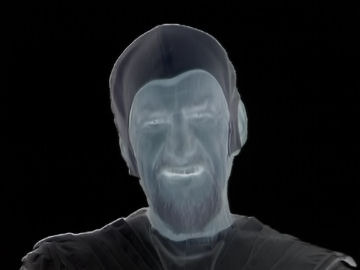
"Of course I am evil...I am able to turn myself into a
negative image, see?  See?
8) Given what she's endured this season, Mary Tamm ends up in this serial being one of the better things in it.  She ends up actually functioning the way she was set up to function in The Ribos Operation, and figures out some of the plot angles before Baker does.  Plus she ends up wearing a modified version of the outfit she wore in Ribos, with the skirt shortened slightly and rather kicky boots, that is extremely flattering to Tamm.  Pity she steps down to become a mother after this serial, because she seems to have found Romana's character again.

9) And while we're on the subject of characters I actually like, I rather enjoyed how Davyd Harries' Shapp is originally presented as The Marshal's lackey who does nothing but follow orders...and ends up transforming over the course of the serial into someone who is opposing his superior's insanity in his own way.  Plus Harries manages to infuse Shapp with a strange sardonic humor of his own that actually serves as a subtle form of comedy relief.  Sadly, he degenerates into a slapstick buffoon (get used to this), but for a while he's a refreshing presence.

10) Of course, all this five-pounds-o'-story-stuffed-into-twenty-pounds-of-television leads to a rather good finale to this ambitious season-long story arc.  The moment where Baker figures out the implications of what having the Key to Time truly are works wonderfully until it's blunted by some of the patented Williams era forced humor.  And the status quo the series ends up with, where the Doctor slaps a 'Randomizer' onto the control console so he and Romana can evade The Black Guardian (well realized by Valentine Dyall) is promising at this point.  Granted, it all goes to Hell starting with the very next serial (and guess what we're covering next time?), but for the time being it leaves the series in a potentially excellent place.

Overall...a boring and aggravating serial that's marred by some horrendous acting and poor plotting.  The final sequence, which is good, does little to alleviate the overwhelming ennui that infuses this pointless tale.

And just a warning...it gets worse.

Saturday, December 1, 2012

Ten Statements About....GOLDFINGER (1964)

Yep...Shirley Eaton covered in gold paint...why does this do
it for me?

"Do you expect me to talk?"
"No, Mr. Bond!  I expect you to die.  There is nothing you can talk to me about that I don't already know."

1) This is pretty unique in the Connery cycle in that it's the only film where Spectre doesn't have any role.  As such, this film is not so much an exemplar of The Connery Era as the blueprint for the Roger Moore era that is to follow.  There's a decidedly different feel to this film that sets it apart from the other Connerys--which might be why it's used as the reflex choice for most people when asked to name their favorite Bond film.

2) Gert Frobe is essential to this film even working to the extent that it does.  He's so...grotesque in his behavior, a true glutton who is nonetheless supremely satisfied with himself.  Frobe's physical acting (his voice was dubbed) is wonderfully operatic, and he drives home the monstrousness and arrogance of Goldfinger well.

3) However, as much as I respect her for being a major part of my favorite television show, and for being the woman who forged the symbiotic connection between The Avengers and the James Bond series, I cannot endorse Honor Blackman's Pussy Galore.  The character is fairly mangled in the film as the script tries to acknowledge her lesbianism without out and out saying it, and her motivation seems thoroughly messed up in the process.  Plus the sudden face turn after Bond hits the hay with her--literally--makes no sense whatsoever.  And...I'm being honest here...she does very little for me, ending up arguably in my bottom tier of Bond girls.
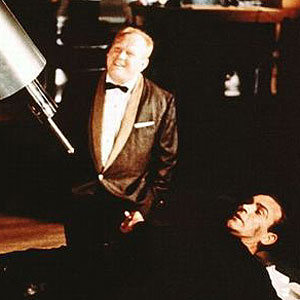
The first laser on film...and it's used to threaten
Sean Connery's nuts.....

4) Is it just me, or does all the argle barge Goldfinger does leading up to Operation Grand Slam seem excessively showy?  Granted, part of Goldfinger's nature is his desire to be thought of as the cleverest guy in the room (notice how he decides to keep Bond alive a little longer only when he acknowledges how brilliant Operation Grand Slam is), but the whole 'let me bring you all together so I can brag, then kill you' thing seems a bit...pointless, doesn't it?

5) The thing that strikes me about Howard Sakata's Oddjob is how, solely through body language and facial expressions, he creates a fully realized character with menace and, most importantly, a sense of humor.  We never once doubt that Oddjob is anything but a scary individual--partially because Connery treats him thusly--but those little smirks reveal something in his inner life that's extremely vivid.  It's not for nothing that he remains one of the greatest Bond henchmen in the series' history.

6) I have this theory that the films where an American city is the central site of the adventure tend to be lackluster...and this may be the best, but not by much.  Kentucky is so....unphotogenic until we get to Fort Knox, and then the film is almost over.  There's little to engage the eye, so much so that the only thing I was concerned with in one scene involving Felix Leiter was the big ol' Kentucky Fried Chicken sign in the background.
"I'm so glad we had this time together....."

7) I like Shirley Eaton.  Really like.  She's got far more life and fun than either of the other Bond girls, and it's a shame she has to exit so quickly.  It's not for nothing that she is the center of one of the most iconic images in the series' history.

8) I don't know why it bugs me so, but I really wish they hadn't hired such a dowdy, obviously older Felix Leiter.  It makes the whole friendship between the two seem less than close.  Hell, Cec Linder looks and acts more like Connery's uncle and not his friend.

9) Boy, Ken Adams' sets are still amazingly tasty....particularly the one for Fort Knox, which Adams made up whole from his imagination.  These few sets--the Fort, Goldfinger's weird lounge room/planning area, the laser laboratory--just jump out at you amidst all the rather ordinary landscapes, reminding you that yes, this is supposed to be a Bond film.

10) Is it just me, or does Connery just stumble around annoying the crap out of Goldfinger until the goof drags him by the ear into his plan?  For a spy film, Bond doesn't do much in the way of spying...which is why it's so odd how so many of the tropes of the series seem to solidify here.

Overall...I know this is heretical, given how this is usually the default choice people have for Best Bond Film, but this is a film that drags at times, detracting from the generally good acting from its principles.  Not my favorite, although far from the worst of the Connery cycle (that's for the next time we look in on 007....)