Saturday, December 31, 2011

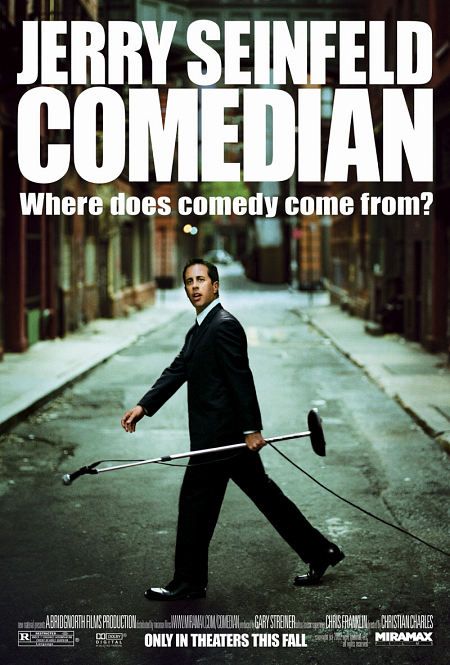
Ten Statements About.... COMEDIAN (2002)

"I love walking downstairs, go in there. It's all crowded, everyone's perched and you just go on and grab the mic and bust it out here and there. The bare essentials. It's like Tyson fighting with no socks, just shorts and his shoes."

1) One of the key scenes in this film is early on, when we are privy to a conversation between Jerry Seinfeld and Orny Adams. There's a real sense that both men want to be at the other's position, which sets up one of the themes of the film--namely, that no matter where these comedians are on the ladder to success, they still think they're Not Quite There Yet.

2) ...which is furthermore driven home by the scene toward the end when Seinfeld pays a visit to Bill Cosby...seeing Seinfeld acting totally like a newbie fan, practically genuflecting before Cosby and taking in all the advice the elder man gives him, is fascinating.

3) There have been a number of documentaries that have been accused of making characters out to be heroes and villains through judicious cutting and strategic scene choice. I get the impression director Christian Charles tries to make Orny out to be a villain, but he ends up coming off as more pathetic and desperate other than monstrous. Even when he is badmouthing the comedian who just gave him decent advice, you feel that the person Adams hates the most is himself.

4) I respect that Charles makes the choice not to show us the bulk of key appearances both Seinfeld and Orny make during the course of the film--he ends up showing us Seinfeld's performance in a Washington DC night club representing his first hour long set only in the pauses, and the opening moments of Adams' debut on Letterman in long shot, on a monitor in an empty dressing room. It's as if Charles knows that the actual acts aren't as important as the journeys that are being taken.

5) That being said...one of the weaknesses of the film is the way Adams sort of disappears a little more than halfway through the film's running time. It's as if Charles loses interest in him as a compare and contrast to Seinfeld.

6) Oddly enough, the second weakness is the sudden appearance at roughly the same time of Seinfeld's family. Charles has been successful for the film's running time focusing solely on Seinfeld as a professional being; suddenly having his wife and child showing up (especially when we see them hanging out in his dressing room at Letterman) smacks of artifice.

7) But without a doubt the biggest piece of artifice, and the one moment where the film just collapses totally for a bit, is when Seinfeld takes a trip to the Museum of Television and watches old tapes of The Ed Sullivan Show and 'laughing' at the comedians showcased therein. This is the one moment that feels thoroughly and absolutely made up and calculated to make us go 'awwwww.'

8) I really love how we get a better sense of a number of comedians--including, biggest shock of all, Jay Leno--and appreciate them more as human beings. Colin Quinn in particular comes off as smarter than he ever has.

9) If I was Charles, I would have not brought up the handful of pop songs in the last third of the film. Up until then, the music has been very subtle, usually confined to ambient use...but in that last leg, where 'Deacon's Blues' by Steely Dan blares out of the speakers while Jerry enters into a theater before a full show, it comes off as manipulative.

10) Charles does ultimately give us bits of both Seinfeld's and Adam's acts, but juuuuust enough. If there were any more, it might interfere with the approach of the documentary, taking away from its treatment of comedy as a business and not as an artform.

Overall...an interesting documentary more for the insights into the business and culture of comedy than as a portrait of a major comedian. There are a number of missteps, but it is more than made up for with the real peek into the real community of the comedians depicted within.

Friday, December 30, 2011

Ten Statements About DOCTOR WHO CHRISTMAS SPECIAL 2011: THE DOCTOR, THE WIDOW AND THE WARDROBE (2011)

"It's a glowing, pulsating package...what's to be afraid of in
a glowing, pulsating package?"
"Are you the new caretaker?"
"Usually called The Doctor, or The Caretaker, or Get Off This Planet...though, strictly speaking, that probably isn't a name."

1) Wow....no mincing around with this special, is there? Let's just chase Matt Smith around a disintegrating starship then toss him off it, why don't we?

2) Right off the top, I appreciate that Moffat has chosen to make this special a showcase for Smith's talent for physical comedy. Whether stumbling about in a spacesuit with its helmet on backwards or bounding around the superhouse he's created for the Family Arwell, Smith excells--and looks like he's having a ball doing every single stunt.

3) As opposed to Russell T. Davies, who just created episodes writ large that just happened to have a Christmas Tree in the background, Moffat seems to be using the Christmas Specials to both illuminate other aspects of this Doctor's personality by giving him problems he can't just speechify away and explore actual perceptions about the holiday season. Setting this at a very particular time in England's history gives him the chance to deal with the darker side of the Christmas Season (It does play host to the highest suicide rate of the year, after all) which gives some of the broader comedy bits a bittersweet patina.

I also respect that giving the Doctor de facto new companions who wouldn't work on a weekly basis like Madge Arwell allows us to see a different Doctor than we do in the regular series.

4) At the center of this episode is Claire Skinner's performance as Madge, and she is able to add a great deal of nuance and subtley to a character that could've been all string-pull-y and manipulative of the audiences' emotions. There's a definite sense of a before-and-after life for her and her children with helps build the veracity of the story.

Yep...it seems Britian can't forget A Christmas Story either...
5) Okay, Stephen Moffat, be honest--you cast Maurice Cole because he looks so damn much like that kid from A Christmas Story, right? Right?

6) I don't know why, but I love the interplay between our three soldiers. Bill Bailey, Arabella Weir and Paul Bazely have wonderful comic timing--and you understand what each of these characters is about just from their initial exchange.

7) I love how the Moffat Christmas Specials show the Doctor affecting positive change both personal and universal--Hell, here we get him helping Madge save an entire race while also getting her to cope with the death of her husband....

8) ...or so we think. And the genius of Moffat is that we suspect that's where we going very, very early on (pretty much from the first moment that the Arwell father's death is mentioned)--but when it happens, it happens in a thoroughly logical way...and it's not The Doctor's hand, but Madge's that creates this Christmas miracle.

Put all your Doctor/Woodie jokes in here...
9) Claire Skinner scolding the Doctor into going and visiting Rory and Amy? Brilliant. Utterly brilliant.

10) Is it just me, or has Karen Gillen gained a bit of weight? If so....damn, it looks good on her, and we all know what I thought of her before...

Overall...I have to agree with the common feeling that this is a lesser entry than last year, but I'll still take this over any of Davies' specials

Wednesday, December 28, 2011

Ten Statements About....JOURNEY TO THE SEVENTH PLANET (1962)

"Raaahr!  Eye's a monsta!  Get it?  EYE!  I'VE GOT ONE EYE!"
"Our minds are being probed like mice--lab specimens."

1) I always find the perceptions of the future from the past fascinating--this film supposedly takes place in 2001, and it's nice to know we achieved world peace and turned over control of the planet to the United Nations some eleven years ago.

2) Ahhhhh, John Agar...towards the end of your matinee idol career and still playing the hot-to-trot American stud trying to make out with the...questionably attractive Greta Thyssen. But hey, you're an American actor giving us some recognition factor amongst all these Danes....

3) Even though this is a Danish-American co-production (the notorious Sid Pink was coming from the absolutely peculiar Danish kaiju Reptilicus when he made this), it's hilarious how these Danish actors interpret the racial stereotypes who make up the crew.  Check out the one guy who's playing the Irishman, who among other things believes in leprechauns!

4) Wow...nothing like a Jim Danforth-animated one eyed, pot bellied rat monster to convince you you're experiencing the height of terror. But at least it's original, and not heavily-tinted special effects scenes from Earth Versus The Spider. And dig that roar that is used for both monsters--it's supposedly a repurposed scream from Rodan, but I suspect it's just a guy going 'Rahr! I's A Monster!'

"Hello--Hello--Hello!....Hello."
5) Keeping in mind that this is an ultra-low-budget movie from a producer with a reputation for being ultra-cheap, I admit I liked the spacesuit designs they came up with. Yeah, they're obviously jury-rigged, but the person who assembled them took a lot of care to make them seem both striking and utilitarian.

6) So the crew are going to put together a super-acetylene torch to destroy the one-eyed (again with the cyclopean creatures!) Jello-Mold Monster that is the enemy of the film....and they do so by cannibalizing parts and siphoning off liquid oxygen from the fuel tanks? Wouldn't that, like, prevent them from making the trip home, especially given how the script implies that this space trip is seriously micro-managed?

7) I find it hilarious that the creature can apparently manifest desires, and all those desires incarnate as women of questionable hotness dressed more often than not like early 50's pin-up girls, who are then made to be sinister as the film goes on. The problem is that these women are not very good actresses, and seeing them try to act all evil on a dime is silly as all hell--especially when Pink decides to change the lighting on the girls' face to reflect their eeeeevilness.

"Rahr!  I's a monsta...and I come in so many flavors!"
8) Okay...so the script by Ib Melchoir and Pink establishes early on that the icicles that populate the Uranian surface are so sharp they can tear open the spacesuit, leading to instant suffocation and/or decompression....but when one of the spacemen does rip open his suit, it's okay because it's so cold that the blood spilled would freeze over the tear, re-sealing it....wouldn't there by a dire frostbite problem to be dealt with, what with the temperature being 200 degrees below zero and all?

9) Look, I may rag on this film for some of its questionable special effects--believe it or not, the Danforth rat-thing is arguably a high point of the film--but there's something quaint and charming in a movie that believes it can get away with pin-scratching the film negative to represent laser fire and obvious stop-motion photography to represent the Jello-Mold Monster's terraforming of the spaceship's environment. This sort of poverty-row creativity has gone the way of the dodo in the wake of increasingly inexpensive computer graphics suites, and I almost miss it.

10) Oh, Lord....that theme song. I don't know what element makes it so bad--the pathetic lyrics or the fact that it sounds like it was recorded in the Grand Central Station bathroom.

Overall...a pretty bad film which manages to generate some modicum of a 'so bad it's good' quality...maybe not enough to make it bearable, but enough to maybe sample a bit to see if it's for you...

Monday, December 26, 2011

Ten Statements About....COLLATERAL (2004)

In this movie, Jason Statham is not the baddest mofo in the
room...
"Tens of thousands killed before sundown. Nobody's killed people that fast since Nagasaki and Hiroshima. Did you bat an eyelash, Max? Did you join Amnesty International, Oxfam, Save The Whales, Greenpeace or something? No. I off one fat Angelino and you throw a hissy fit."

1) You know why I truly like this movie? Michael Mann takes three actors I honestly don't care for, two of which I think are truly lazy in their choice of films and their performances...and wrings performances out of them that thoroughly blow me away.

2) And it's not just the performances. Notice how Mann chooses to use a dark, deep color palette for the majority of the film--not because it looks cool (which it does), but because it makes Tom Cruise's Vincent, with his grey hair and suit, stand out from everything else, an unwelcome interloper in Max's world.

3) Of course, before Vincent makes the scene, Mann takes his time not only setting up Max's world but letting the scene between him and Annie unfurl at a leisurely pace. This opening conversation does two things--it actually establishes a chemistry and a selfish reason for Max to want to save Annie later, and also ties into the whole theme of coincidence that seems to run as an undercurrent in this film. That Jada Pinkett Smith and Jamie Foxx are able to dial themselves down so that we get a sense of these two people as people, and understand why Annie might have an attraction to Max, gives that aspect of the film a veracity so many other thrillers don't bother to establish.

4) Perhaps the most intriguing thing about Tom Cruise's performance here is the way you get a sense that Vincent has some strange form of feeling (respect? like?) toward Max. It's not exactly conveyed in a conventional way, but see how he encourages Max to stand up to boss or builds Max up in his mother's eye--this is one professional recognizing another and endeavoring to help him out. Hell, even that sneering monologue where Vincent mocks Max for never really intending to get his limo company off the ground can be construed as a pep talk to motivate him to move forward with his life.  Even after Max tries to sabotage his agenda, Vincent seems somewhat protective of him (he doesn't carry through on his promise to kill his mother even hen Max actively hinders him).

Two professionals in a taxi cab...but it's not confessions
that are fueling this trip....
5) Of course, would this film have worked if Cruise wasn't willing to let go of his own vanity and let his real self show up on screen...and such a simple thing as showing up unshaven with grey hair severs the man on the screen to our perception of Cruise as a star. And similar de-glamorization happens with our other leads.

He may look like an ally...but this film
isn't about wrapping things up into
neat little packages...
6) Another thing I love about Mann--he loves actors who look like real people, not actors. Who else has used Bruce McGill as often as he has? Even the smallest roles--Javier Bardem showing up as a crime boss for a single extended scene, or Debbie Mazur and Bodhi Elfman popping up to argue in the back of Max's cab seem like real people, which adds to the realism of this world Mann is presenting.

7) And speaking of McGill's Pedrosa--I appreciate how the script by Stuart Beattie builds up both his and Mark Ruffalo's Detective Fanning's role...only to have them unceremoniously killed off during the sequence at Fever. This just emphasizes the whole coincidence theme, and makes Vincent come off not as the cool, collected pro he passes himself off as, but as a chaotic force of nature.

8) I have to say--while I can accept the use of many of the songs in the film since they're ambient noise tied into specific locations, the sudden appearance on the soundtrack of that one ballad after the coyotes cross the street in front of Max's cab briefly shocked me out of the film. It's not just because it's so out of character with James Newton Howard's bluesy film noir score, but because it's the one note of artifice in a film that up until then has tried to keep its feet somewhat in the realistic.

9) I had always heard that Peter Berg started his career as an actor--but I never recognized him as such until seeing him here...and ironically it's his character's inability to accept Fanning's insistence that there's a pattern to the events of this night that saves him.

10) And one of the great things that Beattie's script does is makes Max's motives selfish on some level. Yes, he is doing something heroic when he throws Vincent's briefcase containing his agenda onto the highway--but only after he feels ashamed by Vincent's lying on his account. Yes, he tries to stop Vincent by causing a car wreck--but only after Vincent mocks him. Yes, he works hard to save Annie--but there's always the nagging feeling that he does so because he knows and is attracted to her, as opposed to the previous victims.

Overall...a magnificent little thriller with echos of noir fueled by the exceptional performances by Cruise and Foxx (and to a lesser extent Pinkett Smith), a clever, smart and philosophical script by Beattie, and Mann's excellent muted direction.

Wednesday, December 21, 2011

Ten Statements About....LETHAL WEAPON (1987)

You know what's more depressing than the holidays?  A
chistmas tree holdup....
"Do you wanna hear that sometimes I think about eatin' a bullet? Huh? Well, I do! I even got a special bullet for the occasion with a hollow point, look! Make sure it blows the back of my goddamned head out and do the job right! Every single day I wake up and I think of a reason not to do it! Every single day! You know why I don't do it? This is gonna make you laugh! You know why I don't do it? The job! Doin' the job! Now that's the reason!"

1) The thing that will always floor me about this film is how the script by Shane Black spends close to an hour focused entirely on Murtaugh and Riggs with minimal lip service to the actual plot. We get so deep into so many aspects of these two men's lives that we are thoroughly and absolutely invested in them and their partnership even before the second half puts them through Hell.

2) Of course, the film wouldn't work without the chemistry between Gibson and Glover, and the way these two men make the pairing work not only convinces us of the veracity of their characters, but makes definitive character choices that makes their growing trust in each other thoroughly believable.

3) ..and it's very fortunate that Gibson and Glover are capable of doing this, because the actual plot is...well, it's not exactly very good. The villains are for the lion's share ciphers, as if Black felt their presence intruded on what he really wanted to write about, namely the relationship between the two leads.

To think we used to believe he was only acting crazy...
4) Thankfully, one of the villains is Mr. Joshua, given vivid life by Gary Busey. He's pretty much the sidekick to Mitchell Ryan's General...but so distinctive is Joshua that he becomes the de facto main bad guy--and ends up getting into the climatic fight scene with Riggs.

5) While this film is usually noted for helping put Gibson over into the top tier of stardom, it should be acknowledged that for every moment he nails, there's a moment where he loses control of his accent or fails to sell some of the nuances Black's script demands of him.

6) I find it fascinating how much of the film's running time takes place during rain; even the final fight takes place while a broken fire hydrant is stimulating a torrential rain storm. It really does give the film a distinctive feel from other L.A. set action films, although I'm not sure if the rain is a jokey commentary on the film's Christmas setting (it being so warm that L.A. can't provide us with snow), or a reference to Riggs being some sort of inheritor of the hardboiled detective.

7) I've never been able to accept the whole 'kidnapping Rianne Murtaugh' aspect, and not just because Traci Wolf is a thoroughly awful actress...the kidnapping never shakes the impression that it's there to just occupy a slice of time to jumpstart the crime plot that Black and director Richard Donner has spent so much time ignoring.

To think we used to believe he was only acting crazy...
8) It also doesn't help that said crime plot is sort of rushed through over the course of the film's last forty minutes or so--and about seven minutes of so are devoted to that final confrontation with Joshua on Murtaugh's lawn. I suspect that if the script sprinkled a little more screentime to the General and his plot, the film would have flowed so much better.

9) I absolutely love the fact that the Murtaugh family actually looks and feels like a family. Even down to the fact that the two younger kids seems to share a resemblance to Glover and Darlene Love.

10) And speaking of things I love...I love the fact that the final fight between Riggs and Joshua is choreographed as what is for all extent and purposes a mixed martial arts fight...and Donner is perfectly happy to let both the beauty and the brutality of the fight play out. Hell, Donner even stages it so that the key development in Riggs' character arc fully expresses itself in how he resolves the fight.

Overall...a wonderfully cool film--although I love it more as a story about two police detectives learning to trust and respect each other and not as an action film. The Shane Black script is smart, smartly interpreted by smart actors. Plus, it counts as a Christmas movie, only with bullets.

Tuesday, December 20, 2011

Ten Statements About....THE MALTESE FALCON (1941)

One of the greatest movie P.I.'s of all time...
"When a man's partner is killed, he's supposed to do something about it. It doesn't make any difference what you thought of him. He was your partner and you're supposed to do something about it. And it happens we're in the detective business. Well, when one of your organization gets killed, it's-it's bad business to let the killer get away with it, bad all around, bad for every detective everywhere."
 
1) Humphrey Bogart could not have done this film with anywhere near the effectiveness that he shows here without climbing his way up through Warner Brothers' ranks as a heavy. Since John Huston's script maintains Sam Spade's rather fluid attitude towards morality, Bogart needed to be able to show a shadier side to make his manipulation of events believable.

2) I really enjoy how Mary Astor's Brigid never, ever says she kind and good and pure--hell, even when she's 'playing schoolgirl,' she is always telling Sam that she's Very Bad News. And you know what? She's Very Right.

3) You know one little touch that I thought was genius? The working relationship between Lee Patrick's Effie and Sam. Huston's script makes it rather clear that Effie is one Damn Smart Customer, and Sam relies on her intelligence and intuition--Hell, it's almost as if Effie is an unofficial partner in the firm.

Two of these people are supposed to be dangerous...
the other one is.
4) Another brilliant touch--when you come down to it, Sydney Greenstreet's Caspar Guttman and Peter Lorre's Joel Cairo are children in men's bodies; if we didn't know it by the third act, the way their interactions disintegrate into schoolyard accusations when they realize they've been had makes it clear. But the fact that they're distinctive and 'scary' individuals, it further obscures the fact that we met real villain in the very first scene.

5) Of all the 'villains,' the one I was taken the most by in this viewing was Peter Lorre. Remember, this was Lorre before he became a parody of himself, and he's actually pretty scary for all his feigned civility. There's something unnerving about how reasonably he orders Sam around while waving his gun, and his body language is strange and off-putting in all the right ways.

6) One of the reasons I bemoan the death of black and white is how being deprived of a color pallete allowed good directors to find other ways to convey emotion and characterization. Some of Huston's choices, like showing Sam and his partner separated by their name plate, or choosing to only show the phone when Sam receives news of Archer's death, are more engaging because they're unusual.

7) You know, I don't think this film could have been made now simply because we never, ever get a sense of whether Sam is on the up and up or not. If made now, the script would make Sam much more heroic and wouldn't mince words on how virtuous he is. Huston is able to get away with a moral ambiguity--Hell, the reason Sam gives up Brigid is because, if we're to believe him, it's bad for business to let Archer's death go unpunished--because the audience is willing to accept shades of grey.

"Look, Guttman...I'll bet you the Falcon isn't filled
with peanut butter creme!"
8) But what we do get is that Sam, whether heroic or villainous, is very good at his job. Simple things like sending Brigid into the next room to get him money long enough for him to check the labels on her clothes and try to confirm her story makes it clear how clever he is.

9) Compare Sam's instincts to Archer, who comes off in his one brief scene as, well, a bit of a goof. It's clear that Sam's partner is motivated for taking the case because he likes Brigid's look (and her money). It's his behavior that makes me wonder if Sam lets him take on the case on purpose--not because he wanted him dead, but because Sam doesn't trust her even at this early point in the story.

10) And The Falcon of the title is the ultimate MacGuffin. Even though we're told this is the item around which the story revolves, it's nothing but a feint. The story is about Archer's murder, not a hunt for a statue. And the only statue we do find is a replica; we never learn if the original even exists except in the mind of these two children in adult's bodies.

Overall...a key, essential film that drives home what a movie star is thanks to Bogart's performance. It may not be the first film noir, but it certainly is one of the movies that laid down much of the blueprint for this wonderful genre.

Monday, December 19, 2011

Ten Statements About....MAD MAX (1979)

Mad Max owes more to The Man With No Name
than any science fiction hero....
"They say people don't believe in heroes anymore. Well, DAMN THEM! You and me, Max...we're going to give them back their heroes."

1) At its core, this film represents the logical evolution of the western from the work of Peckinpah and Leone. Even though the film is set 'a few years from now,' and the characters ride cars and motorcycles instead of horses, this is 100% a refitted spaghetti western--a 'carghetti western,' if you will.

2) The thing that fascinates me the most is how, unlike the many, many post-apocalyptic films that followed in the Mad Max franchise' footsteps, no one explains what exactly happened that turned the world of this film into wide stretches of desolate wasteland where most people live in their cars. It's as if there wasn't a catastrophe of some sort, but just a general breakdown in society that happened so gradually no one noticed until it was already too late.

3) There's no doubt in my mind that this film would not work as well as it does without the physicality of Mel Gibson. Hell, director George Miller pretty much lets Gibson's reactions move the story...

"I could either cut you or suck your blood...what
do you think?"
4) ...which allows Miller to avoid actually showing much in the way in violence. We see the before, we get brief flashes of the after, but Miller has enough trust in his actors and his audience to allow us to fill in the actual carnage ourselves. And the film becomes more gruesome that it could have been if Miller relied on special effects, as the images in our head are far worse than what a make-up man could come up with.

5) I love Brian May's score, which actually has a sense of humor--whenever the film looks in on the ramshackle building that is Max's police station, I laughed out loud at the upbeat super-heroic march May assays.

6) The marvelous thing about the film's opening car chase is how, in the ten minutes before we even meet up with Max, Miller gives us a real sense of all his co-workers. By the time the whole sequence is done, we know enough about the other policemen that Miller can just bull on through with his plot.

7) Boy, I really wish there was more of Roger Ward's Fifi, who is just such an odd character, but absolutely compelling. I have to wonder, given Fifi's taste for horticulture, if he was the inspiration for Cowboy BeBop's Jet Black.

"So...you ever hear of 'bears,' Max?"
8) If there is a problem, it's that sequence that bridges the second and third act. And it's not because the scenes of Max and Joanne Samuel's Jessie getting all intimate with each other or horsing around are dull or slow; it's because Miller has been so effective in utilizing a sort of filmic short hand to convey character that using these longer scenes to go over characterization we've already sussed out makes this bit of the film seem redundant and unnecessary.

9) The thing that makes Hugh Keays-Bryne's Toecutter so fascinating is that the actor takes his cues not from biker flicks, or even from westerns--but apparently from horror films. The way he moves and acts, down to his hissing like a vampire when he sees Max on the field of their last confrontation makes him seem otherworldly--which contributes to the concept of this taking place in the future.

10) I think it says a whole lot about Australian culture at that time that Miller makes more out of the destruction of vehicles than of people.

Overall...while most people would point to this film's sequel, The Road Warrior, as being the essential movie in the franchise, it doesn't mean that this one isn't important. As an example of the way the western never went away, just disguised itself for a few years, it's actually pretty damn good.