Showing posts with label horror films. Show all posts

Wednesday, October 8, 2014

Ten Statements About....FRAILTY (2001)

This may not look like a weapon of divine retribution...
“You're my son, and I love you more than my own life. But you know what's funny about all of this, Fenton? I'm afraid of you."

1) One of the brilliant things in a film filled with brilliant things is Bill Paxton’s performance as the unnamed patriarch of the Meiks clan....because he is able to convey that he’s a good father even as he becomes obsessed with his new calling in life.  This makes his decision midway through the film thoroughly logical (even as that decision may have led to both his fate and the fate of his sons).

2) I have to wonder if writer Brent Hanley is a fan of writer Jim Thompson; not only does the film have a narrative feel similar to Thompson’s work, part of the film’s resolution seems to quote an aspect of one of his most famous (and twice filmed) novels, The Killer Inside Me.

3) I am so grateful that Paxton knew that the violence in the film needed to be implied.  If we actually saw the ax murders on screen it might distract from the fact that this film is purportedly a psychological character piece about how one person copes with the rest of his family being, in his mind, thoroughly and utterly insane.
...but this man would disagree....

4) One thing I did not care for is how Hanley cements the bulk of the film as happening in 1979.  Given the universalities of the themes this film explores, the way the film stops so Adam and Fenton Meiks can debate about whether they should go see Meatballs or The Warriors or who’s the funniest character on The Dukes of Hazard distracts from the story while adding nothing.  The script would have been better served to keep the time frame ambiguous, to give the past segments more of a ‘fairy tale’ feel.

5) God bless Powers Boothe.  He’s one of those rare actors who can look like he’s working both sides of the fence in the same damn flick and never look like he’s faking one or the other.

6) You know why Matthew McConaughey is so perfect as our narrator?  His eyes have such a haunted look to them throughout the film.  Even though Paxton makes it pretty clear early on that this is an unreliable narrator film, McConaughey manages to make us forget it every time we look into his eyes.  After all, there’s so much pain in them, how can we not believe that he went through the horrific moral quandary depicted in his tale?
Sometimes family advice is not good advice...

7) This film would not work without the effective performances by Luke Askew and Jeremy Sumpter.  The twist that fuels the third act would not have worked without one of them creating enough of a resonance with McConaughey’s performance that we take something said in the present day as gospel.

8) I guess one of the reasons I found the twist so effective is how Paxton makes sure to make the trappings of Pa’s obsession seem so ordinary. When these three divine weapons turn out to be an axe, a pair of workman’s gloves and a lead pipe, we tend to downgrade the grandiosity of his delusions.  And by downgrading him, we are taken off guard when we realize the nature of what is really happening.

9)  I’m sure a lot of people balked at the supernatural element that’s introduced in Act Three...but even though Paxton gives us reasons not to believe there is the supernatural in this world, at no point does he ever definitively say there is no supernatural.  When the presence of the superatural is revealed, the moments where it presents itself in the first two acts do not contradict this new information.

10) I don’t know which is goofier--the dream that results from moonlight shining on a trophy, or the dream that shows a fully armored angel emerging from the undercarriage of an auto....but maybe that goofiness is intentional, and plays into the impact Paxton wants the big reveal to have.

Overall...a very nuanced horror film that addresses the concept of morality emphasizing atmosphere over gore, cleverly directed and well written.

Wednesday, November 6, 2013

Ten Statements About...CEMETERY MAN a.k.a. DELLAMORTE DELLAMORE (1994)

Love means never having to say 'you've got bits of
my cemetery stuck in you.'
“I'm the watchman of the Buffalora Cemetery. I don't know how the epidemic started. All I know is that some people, on the seventh night after their death, come back to life. I call them Returners, but frankly I can't understand why they're so anxious to return. The only way to get rid of them once and for all is to split their heads open. A spade'll do it, but a dum-dum bullet is best. Is this the beginning of an invasion? Does it happen in all cemeteries? Or is Buffalora just an exception? Who knows? And in the end, who cares? I'm just doing my job."
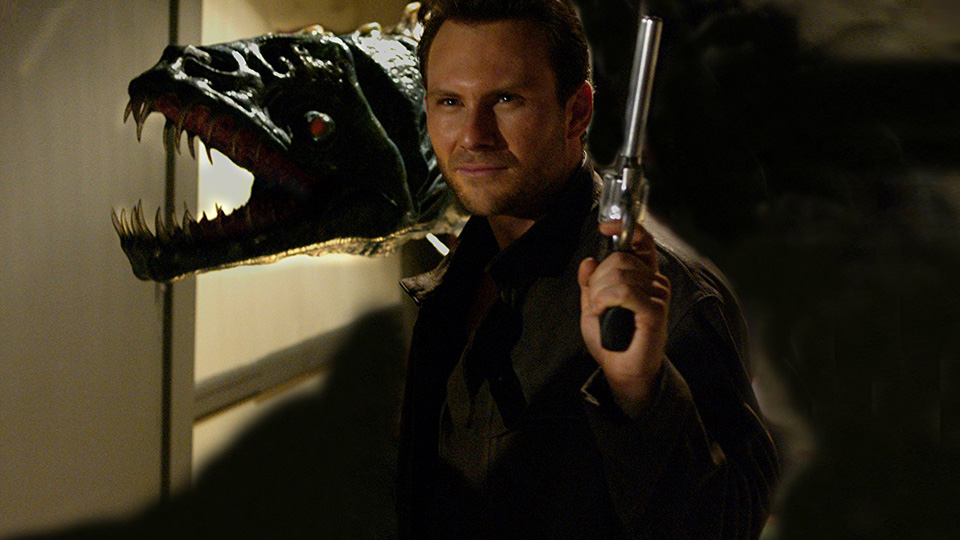
1) This film is built firmly on the back of Rupert Everett, who was born to play Francesco Dellamorte.  All the laughlines, the tone and the exposition is carried by Everett, and his presence is what moves the film forward even as it becomes--consciously or not--more disjointed narratively.  And speaking of the film’s disjointed narrative--

2) A strong argument (one I agree with) can be made that everything supernatural happens in Francesco’s head.  All the zombies, the strangeness, the angel of death, even the metafictional ending are not acknowledged by any of the other characters save Gnaghi, and given how no one understands Gnaghi save for Francesco, there’s a strong chance that he’s reading meaning into the man-child’s grunts.  This could very well be a film about a mentally ill man and not a weird cemetery where the dead rise after a week.

3) I love how Michele Soavi is unafraid to indulge in his humorous side--and not only in the obvious ways (like how the Mayor tries to fire Francesco even after dying).  My favorite bit is how the photo of The Widow’s statements and, ultimately, her lovemaking with Francesco.   It’s an indication from Soavi that this film should not be taken on its face value.
And the scary thing?  This is the closest thing we have to
a normal relationship in this movie.

4) I love Francois Hadji-Lazaro’s performance as Gnaghi.  A mime by profession, Hadji-Lazaro has to use his physicality to carry his performance, and he does so magnificently.  And while he is used primarily as comic relief, he is able to give Gnaghi a level of pathos and joy at time that is infectious.

5) Anna Falchi....hmmmm.  I appreciate that she is capable of giving us three different characters (she’s referred to simply as ‘she’ in the credits,’ but I refer to the three as The Widow, The Secretary and The Student), but more often than not she isn’t very good, and I keep being distracted by the strangely impossible shape of her body.  She’s at her best as The Widow in the first act, playing off Everett extremely well and managing to get off a few darkly funny lines...plus she has the greatest reaction to the weirdest pick-up line in the world.

6) What does it say about this film that the sweetest and healthiest relationship is between Gnaghi and the decapitated undead head of the mayor’s daughter?  Just saying.
He runs a cemetery, she's turned on by old bones...it's a
match made in...well, somewhere.

7) The thing that’s kinda weird about the Buffalora Cemetery that serves as this film’s backdrop is that it seems to go on forever.  It appears far bigger than Buffalora itself is, which seems to be little more than a town square and some side streets.  Granted, this discrepancy allows Soavi to create some beautiful shots, especially the brief tracking shot pulling away from Francesco’s home so we can see the parade of undead making their way to him as the flash from his frequent gunshots illuminate the night.

8) Having seen all of Soavi’s films, I’m willing to bet that the frequent parallels that he evokes throughout the film--the young girl evoking her lover, whose body is now fused with the motorcycle he loved mirrors The Widow emerging from her grave fused with bits of the grounds of the cemetery Francesco tends to; the ignus fatu that surround Francesco and The Widow when they first make love reflect the fate of The Student after Francesco realizes her true nature--are intentional and meant to be noticed, just as the way his composition of Francesco and The Widow’s first kiss evokes Magritte’s ‘The Lovers.’
All this and..BREASTS!

9) I really like Anton Alexander’s Franco, who truly does provide the only touchpoint Francesco has to the real world...although I continue to be puzzled by how he’s handled in the narrative itself.  He takes this strange turn in the third act that doesn’t quite jibe with his portrayal in the first two acts.  Even if we accept that the actions happen in Francesco’s head, there’s a definite disconnect in Fraco’s narrative arc.

10) I don’t know about you, but I don’t think that I would ever go to a doctor’s office like the one of Clive Riche’s Doctor Verseci.  Even if we take into account my ‘this happens in Francesco’s mind’ theory, that place is a dirty, grotesque horror show of a place.

Overall...a strange and peculiar film that is unlike any other zombie film, this is recommended viewing not only for Rupert Everett’s amazing performance but for the sheer oddness of the narrative and the beauty of the compositions.  One of my favorite, if not my favorite, zombie films.

Wednesday, July 24, 2013

Ten Statements About....THE BLOOD ON SATAN’S CLAW (1971)

Ladies and gentleman...the Hot Face Of Evil!
"You must have patience, even while people die. Only thus can the whole evil be destroyed. You must let it grow."

1) The thing I find the most fascinating about this picture is how it’s dominated by Patrick Wymark’s Judge and Linda Hayden’s Angel Blake--and yet both actors only appear sporadically, especially Wymark.  It’s to the credit of these two actors that they manage to cast a shadow over the story even when they’re nowhere to be seen.

2) The film also greatly benefits from being shot on location using mostly natural lighting.  There is a definite sense of veracity to this small town, which makes the strange and disturbing things that happen all the more creepy.

3) God is Linda Hayden gorgeous.  And while I still think she is while she’s wearing that ridiculous sheet and the black crepe-ish eyebrows in the third act, her Angel Blake is a tutorial in how to be seductively evil.  There are moments when director Piers Haggard just focuses ever-so-briefly on Angel, and the way she’s staring, or the way her lips just curls gently into a smile, speaks volumes about the darkness in her heart.
"Verily, this cookie has gone bad..."

4) Apparently, this script was written as three shorter films set in three different time periods before Haggard insisted on them being integrated into one story...and you know, that integration works to heighten the sense of this small rural town in Jacobean England falling into utter chaos.

5) One of the reasons I love films from this period of British cinema is how they’re populated by these amazing character actors that bring life even to their briefest scenes.  I was particularly taken with Howard Goorney’s unnamed Doctor and Anthony Ainley’s naturalist Reverend Fallowfield, who bring a little nuance to their every moment on screen.

6) Perhaps the thing that I find so disturbing about the events in the film is how it’s almost entirely caused by a group of kids who seem to think they’re playing.  And to make things even worse, Haggard adds these two old people in amongst the kids, laughing and smiling in encouragement that adds a whole layer of unsettlement to the proceedings.

7) According to Haggard, the centerpiece of this film--the ritual (incestuous, necrophiliac) rape and murder of Wendy Padbury’s Cathy, was improvised on the day.  If that’s the case, it’s a magnificent piece of on-the-spot filmmaking. It’s truly scary for the way Haggard seems to play with our expectations, leading us to imagine all sorts of fates for Cathy...until we see what Angel has in store for the hapless young girl and we realize it’s much, much worse.

8) The greatest unsung hero in making this film so great is composer Mark Wilkinson, whose weird, woodwinds-intensive score that tweets and twitters like the crows that serve as one of the movie’s motifs.  The way it seems to insinuate itself quietly, commenting on the events as they grow more and more out of control, contributes to the overall sense of unease in the story.
"Collect All My Parts And I Will Be....A MONSTA!!!"

9) Okay...that freakin’ paper mache’ devil.  What the.....?  In a film that so skillfully creates mood and atmosphere and maintains such a creepy feel, the goofy looking demon hoping around just kills a lot of said atmosphere.

10) And while we’re on the subject, while I don’t think it has the buzz-kill aspect of paper mache’ devil, I find it amusing that The Judge warns people he will use unimaginable methods to kill the evil, and ‘unimaginable methods’ apparently equals a big honking sword, two mean dogs, and that deaf mute guy who got thrown off the roof in The Spy Who Loved Me.

Overall...a really amazing little horror film that manages to create a disturbing atmosphere throughout.  One of the great jewels in the crown of Tigon’s career, and a shame that it’s not available on DVD or Blu-Ray in the United States.

Sunday, February 24, 2013

Ten Statements About....AN AMERICAN WEREWOLF IN LONDON (1981)

The scary thing isn't the special effects in this movie...
it's the emotional reality of the performances.

"The undead surround me. Have you ever talked to a corpse? It's boring! I'm lonely! Kill yourself, David, before you kill others."

1) While I know most people think of this as a comedy, it's actually not; it's a full on horror with some strong comedic elements solely for the purpose of relieving the tension.  In almost every way, Landis structures the film like a classic Universal Monster Movie (even namechecking The Wolf Man in a key scene to foreshadow the climax), only with a decidedly 70's sensibility.

2) Landis spends almost twenty minutes with David Naughton's David and Griffin Dunne's Jack before Jack gets et, and David gets lycanthropized.  And almost all of that twenty minutes is a conversation between the two.  This serves a number of purposes--it cements our identification with David, it makes the friendship between the two real so that it makes sense that Jack would try to counsel David from beyond the grave, and established Jack's light-heartedness, which makes his humorous, gruesome appearances later in the film logical.

In the future, Body Mods will get really, really weird....
3) What strikes me the most about Dunne's turn in this film is how, because we got a sense of his personality in the opening act, and because that personality carries over to his three undead appearances, we are nowhere near repelled by his increasingly grotesque appearance.  Landis has been so effective in building up character that Jack's rotting flesh is invisible to us.

4) ...but then, so much of this movie is about the characters.  There's a reason Landis takes almost an hour to get to David transformation into his wolf form; it's so we can get to know David, Jenny Agutter's Alex, even John Woodvine's surgeon.  And it's because we're comfortable with these characters that the horror of what happens is amplified in that last forty minutes.

5) I appreciate how we never get a full back story for East Proctor.  Landis realizes that we don't need to know anything other than there's a werewolf, and everyone knows about it.  And it encourages us to make that back story up....

6) Given that my last exposure to John Woodvine was in his scenery-ingesting performance in the Doctor Who serial 'The Armageddon Factor', I was incredibly struck by his turn as Doctor Hirsch, who ends up playing the Van Helsing role.  Woodvine is incredibly subtle and sympathetic, and watching him slowly put together the pieces of this puzzle and then using that information to try to aid David and Alex.  It's a marvelous little performance.

Quite frankly, Jenny Agutter could turn any man into a
wolf...
7) Another marvelous performance is given by Jenny Agutter.  Alex could easily have become a cliched character based out of a goofy sexual fantasy, but Agutter has genuine chemistry with Naughton that makes the rather accelerated relationship work.  Plus she's thoroughly gorgeous, which can't hurt.

8) I'll say it...the ultimate form of the werewolf is a bit crap, looking decidedly...fluffy with its heavy coat.  But Landis is smart, showing us the monster in very quick cuts or in deep darkness--and those that are relatively clear he shows obscured by the panicked crowd.  It allows the monster to still seem frightening and formidable within the constraints of the budget.

9) That being said, the real highlight of Rick Baker's work is the transformation scene, which is effective due to extremely clever editing to give us the illusion we're watching a single, fluid scene where Naughton distorts into a wolf.  It's a magnificently scary and wonderful scene, made all the more strange by the choice of music.

10) You know, the scene that made me cringe the most isn't one with any of the special effects in it--it was the scene where David is in the phone booth saying goodbye to his family through his little sister moments before he's ready to slit his wrists.  Even though Naughton is a limited actor, he rises to the occasion, making his despair and horror absolutely real.  He also achieves a similar level of magnificence during the scene where he's trying to repel Alex and begs a policeman to lock him up before he kills again.

Overall...a film that, because we tend to focus on the humor, is miscategorized.  This isn't a comedy with horror elements, but a horror film that's emotionally real with comedic elements.  Absolutely essential viewing for horror fans.

Sunday, November 4, 2012

Ten Statements About....WOLF CREEK (2005)

This may not be  some caricature of a bushman....
"I'm going to do something now they used to do in Vietnam. It's called making a head on a stick."


1) This is a beautiful, beautiful film--director Greg McLean has a real eye for great compositions and in the first third of the film frequently cuts away to catch moments of amazing loveliness. And because so much of this first part of the film is steeped in beauty and wonder, it makes the rest of the film all the more frightening.

2) And there's also the fact that while McLean never makes any bones about this being a narrative film, there are long stretches that seem to ape a 'found footage' feel, especially in regards to the party in the pre-credit sequence and the actual visit to the titular Wolf Creek. It gives the film a weird and strange sense of veracity to it, drawing us closer to our trio of protagonists, and making what they're going to go through all the more harrowing.

3) I find it interesting how McLean's script seems to gleefully take horror movie conventions and just screws with them something fierce. And each of these genre-busting moments are so well spaced that you forget that all bets are off, making each of these moments truly shocking.

4) The last two thirds is an extremely intense experience...and it's all the more notable for how very little overt gore there is in the film. We see rather graphic after-effects of what our villain does, allowing us to run horrific scenarios concerning what he's going to do to Kesti Morassi's Kristy in the shed we find them in that are all the more horrifying.
This is may not be your final girl..

5) And speaking of the villain, this film is made by the performance of John Jarrett as Mick Taylor. The thing that makes Jarrett so terrifying is that his actual performance almost never changes. He is still the same goofy, caricature of a bushman he appears to be when he first shows up; only the context changes for his behavior. And that somehow makes him downright demonic. Granted, it doesn't help that McLean creates this coda that seems to imply that Mick is something akin to a supernatural force (the playing around in the first act with stories of UFOs and magnetic interference don't help much, either)....but Jarrett owns this movie.

6) And since we're on the subject, the one big weakness of the film is McLean's continuing to play around with the idea that our trio of travelers slip into another reality when they encounter Mick. There are specific moments like the ones cited above, and another one involving a shed full of cars, that just don't work unless you accept that Mick is more than human. And sadly, it detracts from the film's power, as Mick Taylor is far more frightening as a plain ol' evil human being and not a preternatural killer.

7) While I know most people would cite the 'head on a stick' as the most disturbing moment of violence--probably due to it being the most graphic and gory moment--my feeling is that the last kill is the hardest to take. Portrayed in long shot, with no musical accompaniment, the thing that makes it so horrifying is how detached it...and if that isn't enough, the close-up that follows of Mick, his expression so blank it invites you to figure out what's going on behind his head, just chills you to the bone.
This may not be an escape...

8) This is one of these films--and this may be more thanks to Jarrett than McLean--where a second viewing changes the experience. Watching it with the knowledge of Mick's true nature changes your attitude towards his interaction with our heroes, and makes you see them in a new light.

9) There is one moment in this film, where someone comes across a pile of video cameras and watches one of those videos that still chills me to the bone. There's no violence, no threats, but the sheer implications of what we see, the conclusions we draw, may very well be the most horrifying thing in the movie.

10) The ending is so bitter--it manages to thoroughly break the back of the hope that it might otherwise give. Part of it is the seemingly random nature of why the character survives, and part of it is what the character goes through after escaping his fate.

Overall...even though it's an extremely intense and ugly film morally, this movie is gorgeous visually and has enough going on under the surface that it achieves a certain haunting quality.

Sunday, October 28, 2012

Ten Statements About....THE NIGHT STALKER (1972)

This film takes place in a time when people were scared
of vampires!
"This will be the last time I will ever discuss these events with anyone. So when you have finished this bizarre account, judge for yourself its believability...and then try to tell yourself whenever you may be it couldn't happen here."


1) With the casting of Darren McGavin in this role, we witness the perfect fusion of character and actor. Even though the role was not written with him in mind, Carl Kolchak seems tailor made for McGavin's hardboiled sensibilities, resulting in a reporter who seems to harken back to an earlier time, a man who believes in breaking past the truth....resulting in him knowing the secrets of the universe and, Cassandra-like, being shunned for it.

2) And it's fortunate McGavin--whose prior claim to fame was playing Mike Hammer on television--fit the role so well, because so much of Richard Matheson's excellent script is structured like a hardboiled crime film in its pacing, its language and its visual look. And because the first act of the film plays like a straight detective story about a serial killer stalking Las Vegas, the ultimate revelation about who and what Janos Skozeny is becomes all the more shocking.

3) You know, Gail is pretty much a thankless task assayed by a mediocre actress in Carol Lynley...but it has to be admitted that she has a real chemistry with McGavin, and gives us a very rare aspect of the character we don't get in either the sequel or the television series that resulted from this film's success. Seeing her interact with Carl softens him slightly and grounds him as a human being--thus giving those moments where he's desperate and scared have more impact.

4) Another thing that makes this film so unique is the way director John Llewellyn Moxey goes with a cinema verite style. The way the scenes play out in the first twenty minutes of the film seems so naturalistic....and yet there are these weird, strange elements in these very same scenes. It's another reason why the film feels real to us, making the surreal elements feel all the more shocking when they emerge.
Down these mean Las Vegas Streets one of the greatest
characters in televsion history drives.....

5) ...and another thing that helps create the veracity of this film? We don't see Barry Atwater's Janos Skorzeny until over twenty minutes of the movie's seventy-five minutes running time, and don't see him clearly until thirty minutes. That's an eternity when you take into account this was designed to run with commercial breaks. It makes us almost accept that this might be a legitimate crime thriller about a killer he thinks he's a vampire...until we see Atwater's shadowy over-the-shoulder form strangling a german shepherd while its owner looks on frozen in fear.

6) One of the genius touches of Matheson's script is something that becomes a hallmark of the character--namely, the little character sketch of each victim we get before she makes her disappearance. It further re-enforces the film noir atmosphere of the movie and gives us a degree of sympathy for what amounts to cannon fodder. And given each mini-essay is being recited in McGavin's wonderfully world-weary and cynical voice...well, it works.
 
7) You know, even though the film has that wonderful score by Robert Cobert that's this combination of jazz and electronic howls and screams, I love how so much of the movie happens quietly. There are long stretches where the only sound is the dialogue and ambient background noise. Moxey trust the script so much he allows it to stand out unsweetened by music--something that would never happen in the modern day.
Anyone wh knows their film noir knows this triumph
will end up leaving a bitter taste in Kolchak's mouth...

8) This film also benefits one hundred percent from being shot recognizably on location in Las Vegas. The shots of Kolchak driving down the Strip, or of these people wandering through the casinos once more add to the reality of the story and makes it feel realer than other comtemporary horror films.

9) As much as I love McGavin's portrayal of Kolchak, I suspect I wouldn't love it so much if he wasn't paired up with Simon Oakland's Vincenzo. It's not just that McGavin and Oakland's chemistry is palatable, or that they both play up to and subvert the cliche of their roles...it's that the tension between them makes the ultimate resolution of their relationship as reporter and editor all the more impactful. Oakland's entire role plays up to that single line...'You're a Hell of a reporter,' and when we hear that line, delivered in that way, we know what's about to happen is Not Going To Be Good.

10) ...which brings us to the ending, and I love how dark it is. Kolchak saves the city, and is thanked with the threat of prison, his story being suppressed, being forcibly separated from his fiance' and run out of town. This is absolutely in keeping with the film noir world view that Curtis, Moxey and Matheson has maintained since the first moment of the story. And it leads to the exquisite last moment, where Kolchak makes a decision about what to do with what he knows, which is at turns funny and appropriate.

Overall...one of my favorite television films, a film noir crime story with a strong supernatural element that has at its core one of the greatest television characters in history. Essential viewing.

Friday, July 27, 2012

Ten Statements About....THE REFLECTING SKIN (1991)

Yes, that's a boy having intimate pillow talk with a dead fetus.
And yes, that's indicative of how twisted and depressing this
film is.
"Why don't you go play with your friends?"
"They're all dead."

1) I'm warning you right now--this is a brutally unpleasant film that is made all the more unpleasant for its thorough lack of hope. This is a movie that just hammers you with the desperation, guilt and doomed nature of its characters until you are just as devastated as Jeremy Cooper's Seth, screaming for some form of release in a world where none is ever forthcoming. Be prepared.

2) Director Philip Ridley takes full advantage of the stark landscapes of Canada that stand in for Idaho in this film. There are frequent scenes of Seth, sometimes with his friends, running through these seemingly endless wheat fields, their dark clothing popping off the screen. The perpetual brightness of these sequences act in stark contrast to the evil acts that occur in these landscapes.

3) Ridley's script is so tight and well-thought out that while we are horrified by Seth's growing delusion--and later madness--we never doubt for a second why he's believing these things. Ridley makes sure there's a logical explanation for every aspect of Seth's belief system, and the fact that everyone surrounding him is several degrees of insane only allows that system to grow.

4) ....and it's fortunate that Ridley's script is so tightly plotted, because Jeremy Cooper....well, Jeremy Cooper isn't that great an actor. We are horrified by Seth's descent in spite of Cooper, not because of him. That being said, there is a severe disquieting element to the way Cooper's line readings get more and more gleeful as the evidence that supports his theory that his brother's new girlfriend is a vampire grows and grows....which in turn makes Seth's decision at roughly the one hour and twenty minute mark all the more frightening.

You think this is a sweet scene between two people in
love...but then you don't know this film.
5) Even though most people would look toward the very early performance by Viggo Mortensen, the person I think may be the one whose performance holds the film together is Lindsey Duncan. Duncan's Dolphin Blue is as weird as her name implies, and she rises to the task of bringing her to life multiple times. There's a definite sense of her being too far gone to save (and the implication is that her madness, and her husband's death, is connected to the mummified child Seth and his friends find in the barn), but she is at turns pitiful and--in a very odd way--sympathetic and playful with Seth. And while she may think she's bonding with Seth by sharing her memory box filled with her husband's remains, all she's doing is leading him further into insanity.

6) And I guess we need to mention The Black Cadillac. Cruising through the wheat fields, its blackness making it stand out for miles, it's the literal harbinger of death. I almost wish, however, that what Ridley implies pretty much from the first time Jason Wolfe's Driver talks to Seth wasn't made obvious in a later scene. Wolfe is so confident in his predatory friendliness that we didn't need to see his friend jump out of the Cadillac and abduct someone.

In the context of this film, this might as well be a shark...
7) You know what else horrifies me about this film? The abject sense of isolation throughout the film. There seems to be maybe ten people in this area, all living with great spaces between them...and their numbers dwindle so rapidly I wonder if it's some sort of black joke.

8) In a film that seems to dare you to evoke the phrase 'Lynchian,' Robert Koons' Sheriff Ticker is the most Lynchian element. With his metal eyepatch, ruined ear and artificial hand, speaking in a theatrical grit, Ticker seems to come from much further away than 'the town.' And like Dolphin, Ticker has this unfortunate habit of trying to bond with Seth by telling him the most horrific things. And speaking of Sheriff Ticker...

9) ...it is indicative of this film that the only real moment of comic relief, when Seth can't comprehend what Ticker means when he asks if his father touched him, becomes seriously dark and disturbing when the Sheriff demonstrates what he means. It's almost as if Ridley is gleeful in the way he smashes the few rays of hope, twisting them from something light into something repellant.

10) However, I do respect that Ridley gives us a touch of ambiguity to Seth's action that leads to his final breaking point. While there's no doubt that he does what he does out of pure malice for Dolphin, it's unclear if it is an impulsive move or a calculated attempt to destroy what he perceives to be a monster. It doesn't redeem Seth Dove, but it does give us a way of nuancing his terrible nature.

Overall...while it is a relentlessly nasty film with a pitch black view of humanity, the startlingly beautiful compositions and tight plotting make it a eminently watchable movie. It may very well be one of those movies, like Henry: Portrait of A Serial Killer, The Bad Lieutenant, and others, that you should experience once but never revisit. It has certainly made me want to view Ridley's other two films.

Wednesday, June 27, 2012

Ten Statements About....RED LIGHTS (2012)

She may have experience ghostbusting, but this time the
laughs are few and far between....
"There are two kinds of people out there with a special gift. The ones who really think they have some kind of power. And the other guys, who think we can't figure them out."

1) This is a film where there is a 'shocking end twist'; but unlike certain other horror films with twists in them, the twist isn't the end all and be all of the film. The revelation in the film's final moments actually dovetails directly into what director Roderigo Cortes wants to say about belief, faith and the need for physical proof.

2) ....and one of the things I respect about this film is that Cortes pretty much tells us within the first ten minutes what is going on--Hell, he has the key person spell it out for another one--and frequently clues us in on the mystical element of this story, yet does so in such a subtle way we either don't notice or are unwilling to notice until the trap is sprung.

3) The thing about Robert DeNiro's performance is how we almost never see his Simon Silver in a private moment. We see Silver through other eyes--on television shows, in experiment footage, during his stage show. Thus, the two moments where Silver is not performing, where we see what could very well be the real Silver, have even more impact than they might otherwise have.
Those dark sunglasses may be the least bit of misdirection
in this movie....

4) I find it fascinating how in some way all three of our principles are missing something--in the case of our heroes, it's something spiritual (although the twist throws one of these two people's claims into doubt), and in the case of Silver it's his physical sight (although there are the very subtle implication that Silver is sighted and playing at being blind to emphasize the power of his gift). This gives them echoes of the people who are being victimized by the psychics Sigourney Weaver's Matheson and Cillian Murphy's Buckley chase after.

5) Even thought it's undeniable that Murphy and Elizabeth Olsen have powerful chemistry (it doesn't surprise me in the least that we find out about halfway through that Buckley and Olsen's Owen are now living together), her characters seems...superfluous. I suspect she's there primarily to give Buckley and Matheson someone to explain their psychic-busting operations to in the first half, and to 'ground' the scares in the second half. I welcome her presence because she works so well with the actors around her, but she's the most out of place of the elements in this film.

6) I love how the scares are done without any sort of obvious CGI trickery--the only possible CGI work I can detect happens near the very end, in the experimentation montage, and is very quiet. None of them are of the 'jump out of your seat' variety, although almost all of them are creepy in their own way....and my favorite, involving the rearrangement of a room in the matter of seconds, seems to have echoes of the chairs rearranging in Poltergeist.
Yeah, Buckley may have that UFO poster Mulder had in
his office...but this guy may not be looking for truth at all.

7) It's interesting how Cortes goes out of his way to avoid nailing down where this film takes place. Even though the script references real world cities, once we get to this city, places and landmarks become nebulous. Of course, this is a subtle way for Cortes to make the experiences in the story 'universal,' but it also gives the film itself an eerie, strangely dream-like quality.

(For what it's worth, I assumed the city was St. Louis, although there are moments when it looks like Seattle, Portland and Houston)

8) If there is a problem with the film's script, it's how in Matheson Cortes once more resorts to the old cliche of The Learned Person Who Becomes A Skeptic When They Lose A Child. Granted, Weaver is such a good actress that she's able to give that knee-jerk character trait nuance--and she manages to take that and use it to the benefit of her relationship with Buckley, as we get the impression she's transfered the feelings she would have had toward her son if he grew up normally to Buckley. But this is a clever enough script that I find resorting to this lazy bit of characterization a sore spot.

9) I will watch Toby Jones in pretty much anything--and it's great seeing his Shackleton set up as the comic foil for Matheson, only to have him take on a different role in the story once Matheson is written out of the film itself.

10) Much like the mood of the film, the color palette on this film is very muted, almost washed out and unsaturated in the way John Frankenheimer used to to simulate black and white cinematography. The only time we do get bright colors is when we see red--either blood, or the little notebooks one of the false psychic's crew uses to write notes in. This serves to create the sense that, even with all the high tech we see, the film itself is set in some other time.

Overall...a subdued little horror film that will probably unnerve rather than out and out scare, but gets a lot of credit for its strong acting, effective misdirection and deliberate pace. It may be more M.R. James than Stephen King....but in a cinematic world where everything's about spurting wounds, it's rather refreshing.

Thursday, June 7, 2012

Ten Statements About....THE SHINING (1980)

"I'm not going to be a movie star?  NOOOOOOOOO!!!!"
I think we should discuss Danny. I think we should discuss what should be done with him."

1) I know this is a bizarre way to start this 10 Statements...but the soundtrack that Kurbrick puts together piecemeal from various sources is one of the most disturbing soundtracks I've ever heard. The weird atonal pieces from classical performer Bela Bartok are particularly upsetting.

2) One of the reasons I suspect Kubrick cast this film the way he did is because he wanted to tell as much of this film with the character's faces. So much of this movie is moved forward by the reaction shots of these people--hell, a major plot point rests on watching Scatman Crothers' eyes widen and mouth drop open--that he needed these particular actors, even if some of them are much older than the characters are portrayed in the book.

3) That being said, one of the weakest links (not the weakest link, as we'll get to later) is Shelly Duvall's Wendy. She seems to spend the entire film whining, crying and screaming to the extent that it rejiggers the relationship in the book into something much more overtly abusive and parasitic than it was in the book. While that's a definite choice, and one that was successful in the context of this film (people still talk about this version while the Garris telemovie remains mostly forgotten), it also blunts Wendy's 'resourcefulness' to the point where I wondered where Jack's talk of her being so came from in Act Three.

4) I have to assume, given how Kubrick always approached everything with a extreme attention to detail, that the weird fairy tale echoes were intentional, especially in regards to the hedge maze. I realize it was created because special effects at the time made recreating the hedge animals of the book impossible, but having this maze be 'the dark woods' Danny has to enter to avoid the monster his father becomes is actually more appropriate in the context of the movie.
wait a minute...those are real girls...THOSE AREN'T
MIDGETS!!!!!

5) Of course, the sad thing is that Danny Lloyd is not an actor. Yes, there are moments where he works--the whole sequence where he retreats and leaves Tony in charge is pretty good--but the bulk of his performance is lackluster and obviously artificial. We're not even going to talk about the ludicrousness of his facial expressions whenever he starts to 'shine.'

6) I respect what Kurbrick is doing with the whole sequence where Scatman Crothers' Hallorann comes to Danny's rescue only to have said rescue dashed almost immediately (although ironically, said 'rescue' ends up successful). However, I do think that all the time we spend watching him realize the danger, fly out to Colorado, arrange for the Snocat, etc. ends up building up the expectations to the point where his sudden dispatch is a disappointment rather than a shock.

7) Everyone mentions Joe Turkel's Lloyd, probably because his exchanges with Jack are quotable...but to me the scariest character overall is Philip Stone's Delbert Grady. Part of it is the subtle way Kubrick introduces him, allowing us to slowly realize who he is, but mainly it's because in this film full of quiet horror Grady is the most quietly monstrous--telling Jack the most horrific things in the most reasonable of ways.
With Kubrick, it's not this point that's scary...it's what happens
getting up to this point.

8) You know, at first I thought some of those shots of Jack Nicholson sitting there looking like a comedy goof were ludicrous...until I noticed how Kubrick changes the color palette whenever Jack 'enters' the world of the Overlook. When he's in the 'real' world, the palette is stark and harsh, but when he's lost in the Overlook, the colors become warm and comfortable. Of course, the world where he's the most at home is the world he should never, ever be in....

9) I find it riveting how, the deeper we get into Jack's psychosis, the more the camera begins to 'identify' with him, to the point where it follows the line of his axe whenever he swings it. This is how you use a moving camera--to emphasize the fact that Jack's no longer stable, but is absolutely unstable.
Furries...this is what you look like to us.

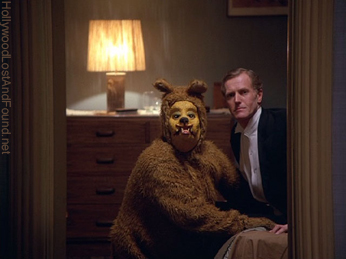
10) To me, the effectiveness of the scare scenes is because they're so sparse on the ground and rely on us to put together what's going on. If a lesser director (like, Jan de Bont or you know...oh, Mick Garris) had handled this, we would have gotten an avalanche of special effects full of goopy, gooey ghosts instead of a couple of carefully placed apparitions with only minimal grotesqueness. Hell, the most disturbing stuff isn't the decaying old lady but the two girls--who I swore were adult actors made up until I saw them in the documentary short on the DVD being introduced to Nicholson--or the strange tableau with the figure in the animal costume. Kubrick trusts us to make stronger scenarios in our head than he can provide himself.

Overall...a truly amazing horror film notable for how deliberate and subtle it is...so subtle that all the overtly hammy elements serve as the breathers, and not the moments of silence in between.

Friday, April 13, 2012

Ten Statements About....CABIN THE THE WOODS (2012)

"Hello?  Spam delivery here!"
"They're zombified, pain-worshipping, backwoods idiots."
"But they're our zombified, pain-worshipping, backwoods idiots."

1) Hope you like monsters!

No, seriously...you'll have to stick around for a bit, but if you're patient, this film becomes Crazy Monster Heaven.

2) I'm beginning to wonder if Joss Whedon, who co-wrote and produced this film, is one of those so-called 'geniuses' like Douglas Adams who has a limited amount of ideas and just recycles them under different trade dresses throughout his career. There are elements in this film that are either direct lifts or minor alterations from such previous Whedon works as Buffy the Vampire Slayer (especially Season Four) and Dollhouse. This in no way interferes with my enjoyment of the show, but it's hard to ignore that this is a story that has a prosthetic limb or two of previous Whedon entries.

3) Similarly, it's hard to escape the presence of The Whedon Day Players in this flick. Hell, one of the main characters--a character that you could argue is the hero--is played by Fran Krantz, who was the mastermind behind The Dollhouse in Dollhouse, and is actually playing a character who is something of a variation on that one. The only Whedon Regulars who seems to be playing a character who's actually a character is Amy Acker's Chem Tech Lin.

4) Since this film was shot two years and change ago (its release was delayed due to original producer MGM's financial problems), it's kind of a shock to see Chris Hemsworth in a decidedly slimmer form....doubly so given he's playing The Jock in this Archetype parade.
Ladies and gentlemen....here are the real monsters of this
film.

5) Of course, one of the strengths of this film is how gleefully the film embraces our expectations and laughs at them, twisting and turning things until we literally don't know what's going to happen next--and that includes that last twist, where Whedon and director/co-writer Drew Goddard pull the trigger on something we literally assume they never will.

6) And another strength is that the script plays fair. Every shock and twist is set up--even the one that leads to Hemsworth's fate is set up so early in the film I actually forgot about what he's about to run into until it's too late. And credit to the two for working out a rationale for the whole scenario and why it plays out the way it does.

7) You know, I haven't mentioned Bradley Whitford's Hadley at all. This is the best performance of all, primarily because at the core Whitford is a white collar drone just doing his job, taking what little joy in a horrifying job where he can find it....which makes what was, for me, the single scariest moment in the film work.

8) Here's an example of shakey cam working for the film, and not against it--the reason for the switch to that style of shooting, that everything has suddenly been thrown into chaos by the actions of our heroes and so many things are happening at once, makes it acceptable. Of course, the fact that Goddard still manages to make the important developments (including a hilarious payoff to Hadley's story) very clear to us allows us to tolerate this choice toward shakiness even more.
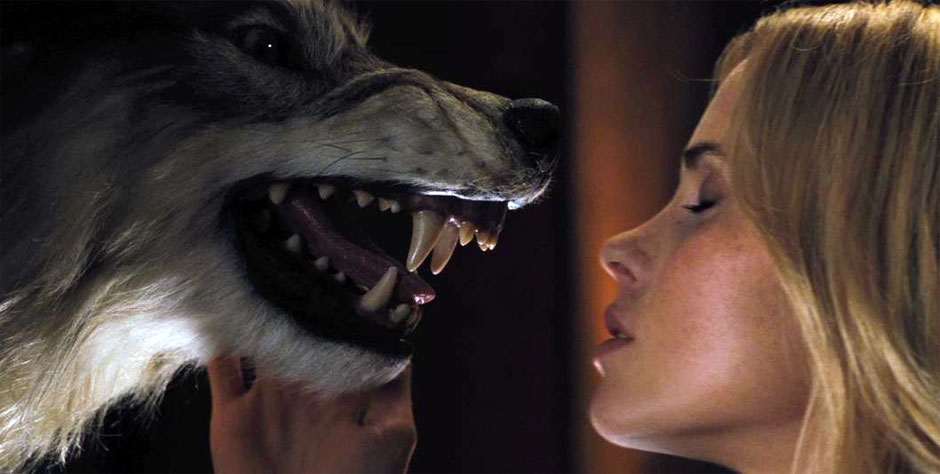
If you ever wanted to know what it would look like for a cute
blonde to make out with a stuffed wolf head...here's your chance.

9) I also like how sometimes the script allows Hadley and his partner, Richard Jenkins' Sitterson, to stand in for us....like when they mock Tim deZarn's Mordecai, the Gatekeeper for the scenario.

10) Given the absolutely insane little glimpses we get of Japan's arm of this operation (prompting Hadley at one point to quip, "How difficult is it to kill nine-year olds?"), I almost regret not seeing more of the scenarios around the world. Hell, we've got something like eight different nations referred to....aren't they each worth a minute or two?

Overall...even with my Whedon-wariness, I love this fucked up, clever movie. This is a fun rollercoaster of a movie--and even if you may not be on board during the first half's stalk-n-slash satire, I guantee you that the last half hour will have you grinning like a ghoul. Easily one of the better horror films I've seen in the last few months, if not a year.

I went to the Loews Village 7 to see this. The trailers were a strange mix of comedy and horror films, including Looking For A Friend For The End of The World (which actually seems like it might be fun, although I kept wondering what is in the air this year that's prompting so many 'End of The World' films); Chernobyl Diaries (...dear Oren Peli...stop that found footage crap. Please...) and Abraham Lincoln, Vampire Hunter (another reason that my blood now runs cold every time I see Tim Burton's name on a trailer).

Thursday, April 5, 2012

Ten Statements About....SWEENEY TODD: THE DEMON BARBER OF FLEET STREET (2007)

Even with the wacky hair and the razor, Johnny Depp manages
not to overact....
"At last...my arm is complete again."

1) I'm convinced there is an exceptional Broadway musical director fighting to get out of Tim Burton's body. One of the absolute brilliant things about this film is how easily the story flows, carried forward on the strength of its songs and the way he directs the film so it feels like a stage play when it needs to, and opens up when it doesn't....

2) ....and another brilliant thing is how this group of actors you think wouldn't be able to carry musical numbers succeed because Burton is able to recast much of Sondheim's songs (many of which utilize complex time changes, harmonies and dissonant lyrics) so that they're talk-singing their way through it. And because so much is talk-singing, it gives certain actors--especially Johnny Depp--the confidence to try full on singing.

3) You'll notice that this film utilizes a muted color pallete throughout its running time unlike many later Burton features where said muted pallete gives way to a much brighter one...and I think Burton could benefit from abandoning those damn eccentric candy color swirls and doing something more subdued like this more often....because those bright colors distract from Burton's storytelling abilities in other films, but here the moments where the bright colors appear (i.e. every time there is a throat slitting) empasizes the horror and shock of those moments.
Look!  Sasha Baron Cohen is using a funny accent...and
is actually good!

4) Why is it I love Sascha Baron Cohen except when his dialogue is written by Sascha Baron Cohen? I ask this because, quite frankly, he's brilliant as Pirelli.

5) Another performance I love is Timothy Spall's as Beadle Bamford. Not just because it is successful in its all-out oiliness...but because somehow with his body language and his appearance, Spall seems to have walked straight out of the illustrations for the Penny Dreadfuls from which this story originally came from.

6) As much as I dislike CGI...okay, loathe CGI...this is what it should be used for--enhancing the look of a film, making London look like a sinister picture book of the London of old. I can even respect the somewhat clumsy use of CGI blood in a few key moments at the film's climax, as using the slower flowing blood in those kills seem to be a subliminal cue that these are the murders Sweeney will learn to regret.

7) I didn't notice until this viewing how 'By The Sea' has a darkly funny staging thanks to the way Depp seems thoroughly out of it as Bonham Carter's Mrs. Lovett is planning their upcoming fantasy life. And speaking of which...

8) I'm really of two minds when it comes to Helena Bonham Carter's Lovett. She's very much underplaying it, which seems to make her more monstrous than Sweeney--after all, Sweeney's horrors are spurred forward by what Judge Turpin did to him, while Lovitt's is done out of practical capitalism--but there's a ring of falseness to the way she continues to go along with 'Mr. T' even when it becomes overwhelmingly obvious that he is working at his own purposes to the exclusion of hers.
"Didn't you once rob Nakatoni Plaza?"

9) While it is a delight to see Alan Rickman being Mean Ol' Rickman...I can't help but think that he's not exactly stretching himself here, that this is just a bit of lazy casting facilitating some lazy acting.

10) While it's obvious from almost the introduction of the romantic subplot that it's only there because it was there in the stage play, the way Burton literally forgets to pay off on it, satisfied with leaving Joanna in the chair and forgetting about Anthony almost entirely once the climax is in high gear makes his disinterest clear.

Overall...arguably the best of Burton's later films thanks to his eschewing of what has become his stylistic crutches, this succeeds both as a musical and as a full-on, grand guignol horror film.

Wednesday, January 4, 2012

Ten Statements About.... TORTURE GARDEN (1967)

"I's DA DEBBIL--SQWAK!!!!"
"What you have seen are imaginary horrors. But now I can let you experience real ones. Yes, ladies and gentlemen, I do have a private exhibit."

1) The thing that's distinctive about this film is it's arguably the most American of the Amicus Anthologies. It's got several American actors in it, it's the first of three anthology films written by grandmaster Robert Bloch, and the framing sequence is based wholely on a classic American carney trick....and yet it still is very, very English...

2) And the lion's share of why the portions of the film that works works is due to Bloch's script. I was particularly struck by how he took his story 'Enoch,' a Southern Gothic psychological horror story about a man who is convinced a demon lives inside his head that compels him to kill, and seamlessly reset it in a typical English setting....

3) ...which would have worked even more if it wasn't for the fact that Michael Bryant's Colin, who is obviously written as a young man who's been drifting around after leaving University, is middle aged and, ummmm, noticeably balding. Bryant does play the character very effectively, but it's hard to get away from how out of place he seems in the scenario as presented.

4) Perhaps the biggest flaw in the film is in its placing the two weakest stories, 'Terror Over Hollywood' and 'Mr. Steinway' back to back right in the middle. Since the former is kinda out of place in a horror film and the later is just too. damn. ludicrous. to be scary (we'll get to that later), it throws off the film's pacing to the point where the viewer can become distracted...or worse, thoroughly disengaged from the film proper.

"So everytime Samuel L. Jackson curses, we take a shot,
agreed?"
5) Thankfully, Burgess Meredith and the framing sequence's bizarre device for introducing the stories (there's this statue of Atropos, one of Fates, and Meredith hypnotizes each victim into hallucinating their futures) manages to snatch us out of the bad stories. Meredith seems to be having a lot of fun teasing and jeering at his guests while ruminating on what they're actually seeing in the reflection of the shears. Sure, the ultimate payoff of who Dr. Diablo is is botched, but the journey getting there is wicked cool.

6) Not surprisingly, Beverly Adams--the risible 'Lovey Kravitz' of the even more risible Dean Martin Matt Helm movies--is incapable of carrying off the rather tired premise of 'Terror Over Hollywood.' She's a pretty enough girl but very wooden (which is ironic, considering her fate in the story)....

7) ...but then, at least she's not Barbara Ewing, who may be not a very good actress, but at least has her lack of talent obscured by being tormented and murdered by a piano in 'Mr. Steinway.' This story is easily the stupidest of all the Amicus anthology stories--and may even be in the running for worst horror anthology segment ever.

"I's da demon cat--not Get Me My Tenda Vittles!"
8) If you've ever wondered why Jack Palance always got cast as the heavy, wonder no more. The co-star of the last segment, 'The Man Who Collected Poe,' Palance tries to pass himself off as English and fails miserably. Hell, I didn't realize his fey, affected voice was supposed to be a British accent until Peter Cushing's Lacelot Canning points it out in the dialogue. It's one of those moments of miscasting that's almost divine in its wrong-headedness. A pity, as the story is one of the most unique of all the Amicus features.

9) As successful as Bloch is at adapting 'Enoch,' he fails with 'Terror Over Hollywood.' As it is, it's not one of his better horror stories about the entertainment industry....and the story isn't even altered enough to make it plausible in the English setting. It doesn't even scan with Adams' backstory as presented in the framing sequence itself....

10) and the rather sad make-up effects in both 'Terror Over Hollywood' and the framing sequence doesn't work to sell us on the horror of the film. The robotic effects in 'Terror' are particularly clumsy, and--given how 'Enoch' was effective solely through the acting of Bryant--I wonder if they really needed the 'I's da Debbil' make-up on Meredith for the film's last shot.

Overall...this might be the weakest of the six (seven if you count producer Milton Subotsky's anthology film he made after Amicus went under, The Monster Club) Amicus anthologies. The good-to-bad ratio is higher, with one of the stories being the absolute worst the studio ever produced. One for the completists.

Which, sadly, I am.

Sunday, November 27, 2011

Ten Statements About....ALONE IN THE DARK (2005)

"Bullet-Cam...do you thing!"
"My mommy says that there is nothing to be afraid of in the dark."
"Your mother's wrong, kid. Being afraid of the dark is what keeps most of us alive."

1) Not even five minutes in, and there's a definite sense of this world being populated entirely by wooden puppets in the guise of actors--oh, and Christian Slater and Tara Reid, which might not mean much difference, come to think of it.

2) Boy, is this film score's action music, with its bongos and disco beats, really, really goofy.

She's a gifted archeologist, and he's a paranormal
investigator.  No really....
3) Movie, if one of your major plot points revolves around a box made of gold...you shouldn't kill a tiny bit of genuine atmosphere later on when a character discovers the after effects of that box being opened by shooting the inside, where we can clearly see that it's a wooden crate spray painted gold.

4) As bad as Slater's psuedo-Chandler posturing is as paranormal investigator Edward, his energy levels just high enough to justify his getting a paycheck for this film, he's thoroughly eclipsed in awfulness by Reid's Aline. With her herky-jerky physical acting, flat line reading and perpetually unbuttoned or belly-baring wardrobe, she's pretty much laughable. She's the most inappropriate archeologist/museum curator ever.

5) I'd be more freaked out by the Xenos, the Alien-like creatures that make up the main threat of the film, if they weren't animated to have this hunched-over with hands together stance that makes me think of them as armored squirrels.

6) One of the fundamental flaws in this film is how it's so intent on trying to share with us this deep mythology of the game that it's based on--you know, the whole Native American Who Discovered A Gateway Into Another World thing, the whole Bureau 713 thing, the whole backstory of Edward--that even the big ol' action sequences of soldiers versus the armored squirrels get bogged down in expository sludge.

One's a cop that doesn't play by the rules.  One's an armored
monster squirrel...they're partners....
(I've just written a better premise than this one)
7) I would really love to know how Uwe Boll justified the frequent cutaways to Catherine Lough Hagquist's Krash, whose whole purpose in the plot is to sit in Bureau 713's HQ in a skullie complaining about how they can't get a signal. Was she doing something for Boll to prompt him to give her so much screentime?

8) Look, I get that the nineteen orphans were experimented on by Bureau 713, and that Edward was the twentieth orphan who escaped...but did we ever get a resolution to what happened to the grown up orphans after they answered the summons of the gold-painted-wood box? Was that whole storyline even necessary, given that the film degenerated in the last twenty five minutes into incoherent punchy-punchy run run?

9) Granted, this makes a little sense now that I know of Boll's proclivity for shooting first drafts...but when you have a character hand another a file saying there is info on three people in it, and the second character proceeds to flip through updates on five people....don't you think it's time to fire your continuity person?

10) Do you think Stephen Dorff curls up in a ball late at night and silently cries himself to sleep in mourning for his career? I mean, at least Slater and Reid had brief windows of success in their career, when Dorff was once touted as the next big thing and can't get work in anything other than direct-to-video films, Tarsem Singh work-for-hire projects...and this, apparently.

Overall...All over the place and messy to the point of incoherence, this does get punctuated by moments of brief hilarity thanks to its gallery of awful performances, awful performers, unbelievable characters (do you think Reid's Aline and Denise Richards' Doctor Christmas Jones meet regularly for Inappropriately Attired Scientist Lunches?) and gobstoppingly bad dialogue. If only that last twenty minutes didn't tip the whole thing into loud nonsense, it might be in the 'unintentionally funny' category.

Saturday, November 5, 2011

Ten Statements About....SEE NO EVIL (2006)

Yeah, I'd be pissed if my director was
ripping off Jim Van Bebber...
"What if you get us caught, asshole?"
"By who, Captain Hook?""

1) This is a horror movie written and directed by people whose understanding of horror movies was derived solely by watching horror movies circa the mid-00's. It's all there--the video ramping, the wobbly-cam, the quick cuts, the whole derelict esthetic, the industrial hum every time we get a smash cut scare, the transposition of an innocent song with scenes of extreme carnage...I could go on, but I don't want to.

2) Actually, I could go on, but this film is shot so darkly that, quite frankly, it's hard to even figure out what's going on. Oh, sure, you can glean that all the eye-plucking and hook slinging and forcing people to choke on their own cell phones or feeding people to a pack of wild dogs (obviously all designed to appeal to the torture porn audience), but only if you squint and fiddle with the brightness control of your television...and even then you might only figure out what's going on in the abstract.

3) Hmmm...did director Gregory 'New Wave Hookers' Dark think that those video-name-tags on the kids when they're exiting their prison would allow us to understand their characters more quickly? Because, you know, I still couldn't figure out who was who, even with everyone yelling everyone else's name all the time.

4) Honestly, Mr. Dark, couldn't you have concealed that revelation about the kindly old woman from the Historical Society really being the mother of Jacob Goodnight who tortured him into becoming an eye-plucking serial murderer just a little bit more? Because anyone who didn't figure that out at, oh, roughly the ten minute mark when she's introduced really doesn't have a clue.

"I like cheese.....heh...."
5) And while we're on the subject of Jacob Goodnight, Mr. Dark...don't you think that if you're trying to create a new horror movie character ripe for a franchise--for that's what WWE Films was originally intended for, right? To create movie franchises for wrestlers so they wouldn't leave the promotion?--you should mention the character's name once? Seems counterproductive to never tell us what to call your boogeyman when you're hoping we'll want to see his further adventures.

6) Okay, I get that Christina Vidal's Christine is meant to be a Final Girl because her mentor Williams tells us how she got arrested for protecting her sister from their abusive stepfather. And I can accept that Samantha Noble's Kira can survive, even after being Jim Van Bebber'd in a cage and threatened with eye-plucking and torture by Joshua, since Dark takes pains to establish that Christine is protective of Kira. But when you spend so much time establishing how Luke Pegler's Michael beat the shit out of Kira and was out for revenge on her for sending him to prison, and show him throughout the film acting like a horny, destructive asshole....don't expect me to accept him as the film's hero in the last act.

7) The sad thing? Glen Jacobs, billed here under his wrestling name of Kane, is a real physical presence. Not only does he endeavor to show some nuance in his portrayal of Goodnight--he fails, but I respect he tried--he obviously is able to translate his physical ability as a wrestler into some decent physical acting. However, this character is so badly underwritten, and ultimately results in a downright embarrassing scene which requires Jacobs to mime masturbating while watching Noble squirm around in a cage that any credit he earns in the first two acts is pissed away in the third.

"Awwww, man...she's a hot chick, he's got a pipe, and I'm
black...I'm SO gonna die here!"
8) Considering that, at its core, this is an 'old dark house' film, there's no real sense of how this hotel that's serving as the old dark house is laid out. Hell, I didn't realize there were two sets of elevators in this place until a key point in Act Three. Similarly, there are plot seeds dropped about the history of the hotel that never blossoms or even explored beyond their being mentioned in passing. But then....

9) This film--and I have to give Dark and writer Dan Madigan some grudging respect for convincing Vince MacMahon and his then-new start-up company to finance this--doesn't have a plot. And by that I don't mean it's one of these meandering string of set-pieces I usually refer to as plotless...I mean that there's not enough story to fill an average paragraph. It's not a plot, it's not an outline...it's a pitch sentence in movie form.

10) And I can think of no more perfect metaphor as to what watching this movie felt like other than the post-credit stinger after the cast credits rolled...namely, the scene where a stray dog trots up to Jacob Goodnight's cooling corpse and--in close-up, not less!--pisses in his empty eye socket.

Overall...unless you want to watch this as a curiousity...don't. Just dont'. And for that matter, don't let porn directors direct horror movies.