Showing posts with label Mary Tamm. Show all posts

Sunday, December 16, 2012

Ten Statements About....DOCTOR WHO STORY ONE HUNDRED AND THREE: THE ARMAGEDDON FACTOR (1979)

Oh, oobee do/I wanna be like you/I walk like you/talk like
you, too....

""We have the power to do anything we like, absolute power over every particle in the universe, everything that has ever existed or ever will exist as from this moment. Are you listening to me, Romana?"
"Yes, of course, I'm listening."
"Cause if you're not listening I can make you listen, because I can do anything. As from this moment there's no such thing as free will in the entire universe. There's only my will because I possess the Key to Time."

1)  ...and so the final story of the Key To Time Saga ends with this bloated, epically awful story which serves as an argument against the six-part format, primarily because so much of it is taken up by the equivalent of water-treading.  There is barely enough in this mess for a four-part story; making it a six parter makes for an unbearably slow watching experience.

2) This serial is rife with some wretched performances--and none are as bad as John Woodvine's scenery-devouring turn as The Marshall.  Woodvine pitches his performance at such a melodramatic level where he seems to be shouting every single line--even the ones where he's supposed to be whispering--and comes off as strident and bullying.  Hell, when your performance is so bad you can't even convincing sell the single word 'Fire!' (a word you have to repeat over and over again for an episode and a half because you're stuck in a time loop), well...it's time to go act in another story.  Or show.

3) I'm still scratching my head trying to figure out what the deal was with William Squire's Shadow.  We're literally given no back story whatsoever when it comes to this goof save that he likes to laugh a lot and is an agent of The Black Guardian.  Much like Woodvine, Squire is chewing up the scenery while actually doing very, very little.  And when we learn of The Shadow's ultimate fate--and that the Guardian actually planned for it to happen--you have to wonder why he was sitting there on Xeos doing all this pointless scheming and running around in the first place.
Nooooooo!  Drax!  Go away!  Stupid Drax....

4) This is Lalla Ward's first appearance on Who, and her turn as Princess Astra (coupled with Baker's interest in her) inspired Williams to cast her as Romana when Mary Tamm gets pregnant.  However, even though Astra is integral to the plot and Ward is fairly decent in her performance in comparison to Woodvine, Squire and others, the reason she's so integral is literally forgotten about for about three episodes until someone realizes they need to get back to the Key To Time aspect of the story.

5) ..but then, the scattershot nature of the plot is indicative of the script by Bob Baker and Dave Martin.  Plot developments are dropped suddenly, perils are introduced only to be waved away a few minutes later, whole characters seem forgotten for long stretches, and there are gigantic stretches of plot that seem riveted on just to eat up time.  Add in a shockingly shoddy grasp of science even for this era of classic Who, and you have a monstrous mess.  

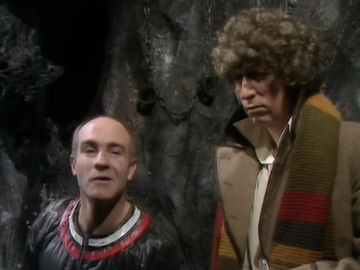
6) And then there's...grumblemutter...Barry Jackson's Drax.  An awfully conceived character to begin with given tiresome life by Jackson, Drax is given far too much time to introduce himself as a comedy element the story really didn't need, then seems to complicate the plot solely for the sake of complicating it.  And the biggest problem with him?  He's introduced in the fifth episode, long after the last significant character (the computer Mentalis) was introduced in the second episode.  I have to think that Baker and Martin had so written themselves in a corner that they created Drax solely as a deus ex machina to get the story to wrap up neatly.

7) Look, I know that the science in classic Who can get really wonky....but The Shadow uses a mechanical device designed to control and communicate with living beings to control and communicate with K-9.  Really, Bob Baker and Dave Martin?  Really?
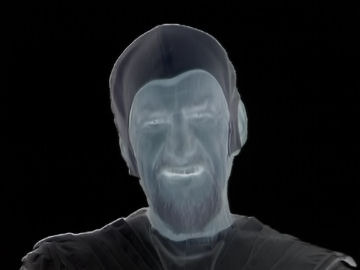
"Of course I am evil...I am able to turn myself into a
negative image, see?  See?
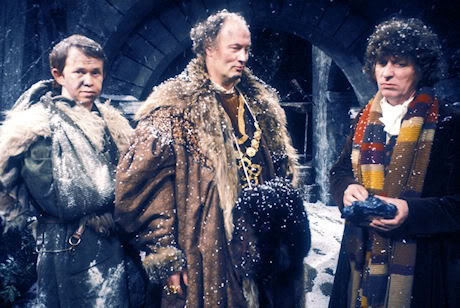
8) Given what she's endured this season, Mary Tamm ends up in this serial being one of the better things in it.  She ends up actually functioning the way she was set up to function in The Ribos Operation, and figures out some of the plot angles before Baker does.  Plus she ends up wearing a modified version of the outfit she wore in Ribos, with the skirt shortened slightly and rather kicky boots, that is extremely flattering to Tamm.  Pity she steps down to become a mother after this serial, because she seems to have found Romana's character again.

9) And while we're on the subject of characters I actually like, I rather enjoyed how Davyd Harries' Shapp is originally presented as The Marshal's lackey who does nothing but follow orders...and ends up transforming over the course of the serial into someone who is opposing his superior's insanity in his own way.  Plus Harries manages to infuse Shapp with a strange sardonic humor of his own that actually serves as a subtle form of comedy relief.  Sadly, he degenerates into a slapstick buffoon (get used to this), but for a while he's a refreshing presence.

10) Of course, all this five-pounds-o'-story-stuffed-into-twenty-pounds-of-television leads to a rather good finale to this ambitious season-long story arc.  The moment where Baker figures out the implications of what having the Key to Time truly are works wonderfully until it's blunted by some of the patented Williams era forced humor.  And the status quo the series ends up with, where the Doctor slaps a 'Randomizer' onto the control console so he and Romana can evade The Black Guardian (well realized by Valentine Dyall) is promising at this point.  Granted, it all goes to Hell starting with the very next serial (and guess what we're covering next time?), but for the time being it leaves the series in a potentially excellent place.

Overall...a boring and aggravating serial that's marred by some horrendous acting and poor plotting.  The final sequence, which is good, does little to alleviate the overwhelming ennui that infuses this pointless tale.

And just a warning...it gets worse.

Sunday, November 18, 2012

Ten Statements About....DOCTOR WHO STORY ONE HUNDRED AND ONE: THE ANDROIDS OF TARA (1978)

When I Googled images for 'Androids Of Tara', this is the
first thing that came up...Sigh...
"You can't trust androids, you know."
"That's funny, you know. That's what some androids say about people."


1) I think it's indicative of the Graham Williams era that one of its greatest serials is one which pretty much slavishly follows The Prisoner of Zenda, only with science fiction trappings like androids interposed within it. Hell, when one of your major actors seems to have been cast solely because of his resemblance to Ronald Coleman is uncanny and The Doctor tells another character that their plan has been done before...well, they're not even bothering to hide it.

2) But one of the reasons this story works so well is the way writer David Fisher finds a way to make the android tech critical to the story. There are certain ways that the plot would not work in this iteration without the presence of androids. And because we accept the use of android tech, the other weird tech aspects--like the electronic crossbows and swords--make a lot more sense

3) A large portion of why this serial is so much fun lies in the performance of Peter Jeffreys as Count Grendel. Especially given the pastiche nature of this episode, there was a need for a larger than life villain, and Jeffreys takes the opportunity to breathe life into a charming cad like the Count. And more importantly, Grendel is smart. He's never made to look the fool by the Doctor--something that will become a problem as we get deeper into Williams' reign--and bases his strategies on logic and a love of cunning. He's so fun that when he's allowed to escape, you almost wish they found a way to bring the Count back.

4) I find it really refreshing that Fischer gets rid of the whole Key To Time aspect of the story within the first ten minutes so he can then dive into the silliness and craziness of the actual tale. Yes, there are moment when the Key fragment becomes the focus of the scene, but usually it's there only to tell us more about the character who's bringing it up, as in the moment where we learn just how intelligent Lois Baxter's Madame Lamia really is.
"I am going to ask you to take your hand off my ass politely..."

5) I think I've mentioned how much I enjoyed it whenever Tom Baker took up a sword and got all Erroll Flynn, right? Well, this is manna for me, as Baker gets to ride a horse, and engages in a climatic sword fight with Jeffreys that is really cool.

6) Since I mentioned her before, I rather liked the way Lois Baxter found a way to infuse Madame Lamia with more nuance than she really needed. One gets the sense that Lamia is clever, maybe even more clever than Grendel, but allows herself to be used due to a combination of Tara's caste system and her own feelings for the Count. It's a pity that she's written out about halfway through the tale, because some of her interactions with the Count and Romana are pretty cool.

7) This is arguably the last time we'll see the Mary Tamm version of Romana being, well, a useful and willful counterpoint to the Baker Doctor. She's the one who sticks to the mission of finding the Key fragment, after all. But there's this tendency to the 'wailing frail' archetype, as she gets kidnapped not once, but twice, and struggles to ride a horse that's a sign of things to come. Hell, when we finally meet her in her dual role as The Princess Strella, we're rather struck by how much more proactive she's in.
"The pellet with the poison is in the vessel with
the pestle--the Hell you say!"

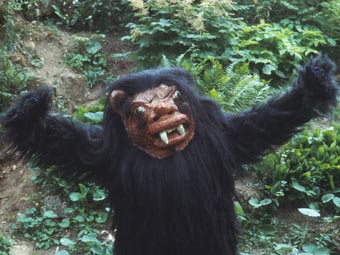
8) God, that freaking pig-midget monster thing. Thankfully, unlike the Shrivenzale of the first Key To Time story,it's only used once and glimpsed very briefly...but it still is an embarassment that points out the chintziness of the show's production at this time.

9) I do wonder if the story wouldn't have been more effective if the serial at the very least moved away from the very Zenda-esque trappings we see here. Because the costuming and sets are all reminiscent of that Ronald Coleman classic, we're constantly reminded of the source material. It's made even more peculiar given the rather fetching outfit Romana produces as 'what all the fashionable Tarans are wearing this year,' which looks nothing like the very Edwardian fashions we see on display here.

10) Even though Williams is very much enamored of K-9--hell, the little monster originated under his reign--it's interesting how they're already finding way to write it out for key scenes. While we do get a lot of K-9 making things easy for Baker, the climax literally dumps him in a boat in the middle of the moat...and it's just an echo of things to come once John Nathan-Turner takes over.

Overall...one of the better stories in the Graham Williams era in spite of its slavishly following the playbook of a classic film.

Friday, September 28, 2012

Ten Statements About....DOCTOR WHO STORY NINETY-NINE: THE PIRATE PLANET (1978)

"You're complaining about your scarf?  Look at me, sah.
LOOK.  AT. ME."
"You commit mass destruction and murder on a scale that's inconceivable and you ask me to appreciate it just because you happen to have made a brilliantly concieved toy out of the mummified remains of planets?"
"Have some care, Doctor. It is not a toy!"
"THEN WHAT'S IT FOR?"

1) This, the second serial for the 'Key To Time' season, is the first of two (three if you count 'Shada,' the story that was meant for Season 17 but never finished due to a strike) written by Douglas Adams. And as such, it is all over the place, and features gags being set up just for the sake of gags. I have grown to not appreciate Mr. Adams' brand of humor, although I will admit that it is less intrusive in its cleverness than some of his other works.

2) Like the previous story, this serial features an over-the-top bad guy in Bruce Purchase's Captain. Unlike that previous story, Purchase's over-the-topedness is marginally more entertaining...and when we learn that his bluster is a conscious choice to conceal a deeper motivation, it adds a level of depth that Paul Seed's Graff Vynda K lacked. That being said...

3) ...there are story elements in this story, especially involving The Captain and his assistant, Andrew Robertson's Mr. Fibuli, that mirrors the previous story so closely there's a fierce sense of deja vu. It makes me wonder if both stories would have benefitted from being separated by another, less similar stories.

4) This is the second story featuring Romana, and we're still at the point where Romana is a Very Good Idea Indeed. This is the first time where the character separates from The Doctor for some scenes, and Mary Tamm's mixture of slight innocence and haughtiness plays well when contrasted with The Captain.

5) And of course we continue to see the kiddification of the series under Graham Williams. For every element that seems kinda horrific and adult (the ultimate fate of these planets that The Captain mines to obsolescence is particularly terrifying, especially given The Captain's intention of using Earth next), there's stuff obviously put in to amuse the children like the electronic parrot that engages in a battle with K-9.
"Tell us more about your affair with Churchill, grammy!"

6) Okay, I know that the big reveal involves who really is the big bad of this serial is supposed to be the main shock....but it's telegraphed . There are so many prominent shots of this person that we know there's something wrong. Plus when that person's true nature is reveal, the actor's performance is pretty, well, bad. It's almost as if you wish The Captain remained the villain of the piece.

7) I truly wonder if David Warwick's Kimus and Primi Townsend's Mula are necessary to the plot. When all is said and done, they don't really do much, as The Doctor and Romana is the one who does the heavy lifting. Kimus in particular seems useless save to spout some anti-Captain rhetoric and provide some mild exposition about Queen Xanxia...but there's no reason not to collapse his character into Mula, who at least has the excuse of being the sister of one of the Mentiads.

8) And speaking of the Mentiads, while I will agree they do have a purpose in the story, they are indicative of one of the many problems I have with Adams as a scriptwriter...namely that he doesn't know when to stop throwing new ideas into the mix. As with pretty much everything he wrote, this serial at times come off as an sausage so overstuffed that it's exploded. There's so many ideas thrown into this pot, a number of these things leak out and just sit there messily.
"Ahhhh, this is boring...let's go watch TWILIGHT:
BREAKING DAWN PART II."

9) While this story has not aged well in my eyes, there is one magnificent moment that almost redeems it all. The scene where The Doctor confronts The Captain over the display case of destroyed planets, debating whether it is a marvel of science or an abomination, stands out. The way Baker tries to rationally explain why he won't applaud the Captain's efforts, then explodes in righteous, overpowering anger when the Captain rebukes him shows us a Doctor we won't be getting much for the bulk of the Williams era.

10) Reasons why I am no longer endeared by the vaunted Douglas Adams humor #42: after three and a half episodes of carefully constructed plotting, or building up the mystery and getting all our ducks in the row, we get this torturous set up so that Adams can spring a play on the phrase 'throwing a spanner in the works.' That the climax is a joke blunts the impact of said threat, and makes the entire story up to that point several gradients of irrelevant.

Overall...a well-constructed story for the most part that frequently gets derailed by Adams' tendency to reach for a laugh. Some good performances redeem it somewhat, but the fact that this is one of the better stories of this season says more about the season and not the story itself.

Wednesday, August 29, 2012

Ten Statements About....DOCTOR WHO STORY NINETY-EIGHT: THE RIBOS OPERATION (1978)

Much like Sarah Jane, this Scottish brunette is not just a
pretty face...
"You want me to volunteer, is that it? And if I don't?"
"Nothing."
"You mean nothing'll happen to me?"

"Nothing. Ever."


1) And here we are at 'The Key To Time,' the 16th Season. And, as with most of the serials for this season, this is a story where moments of brilliance float in the middle of great seas of dullness. We're at the point where Williams seems to treat the show solely as a kid's show, coupled with his constant dancing about in an effort to keep Tom Baker engaged in the show--an action that will lead to one of the worst seasons of the classic series. Luckily, this is not that season.

2) The biggest new development is the introduction of the companion Romana, played by the stunning Scottish actress Mary Tamm. And even though Tamm proved to be...limited as an actress, she does manage to give Baker someone to work off of in a new way. Romana, because she is a Time Lady, is able to be confrontational with this Doctor about his shortcomings and lack of education, creating an interesting 'practical knowledge vs. learned knowledge' tension that isn't played off of enough.

3) The actual set-up for this season, written by Anthony Read and Graham Williams, features the Baker Doctor literally humbled in the presence of Cyril Lucking's White Guardian. It's really very well done, both as a change of pace and as a piece of exposition. We get to see Baker trying to exert himself in resisting the Guardian's wishes, but the very subtle threat (see the quote above) seems to put him back in line. Lucking plays the character well, and the scene is expertly done.
As Tom Baker's tenure went longer and longer, he began to
forget things...like turning off the lights in the refrigerator...

4) ...and then we're plunged into the story itself and it's...well, it's not very good. There's a definite sense that writer Robert Holmes really wanted to write a pilot for a show about a pair of intergalactic con-men and forced it into a Who serial. That whiff of back-door pilot never leaves the series even when it's focusing on The Doctor and Romana.

5) That being said, the con-men are responsible for one truly brilliant moment. When Nigel Plaskett's Unstoff reveals to Timothy Bateson's shunned and broken Binro that yes, his theories about the stars are absolutely true is what this show should be about--a great little nugget of wonder in the middle of this sad, plodding little serial.

6) I know there may be people who love Paul Seed's rather, ummm, vigorous performance as the Graff Vinda K, but I'm not one of them. He's so over-the-top, and seems to be proclaiming every line as if he just ate a particularly bitter lime. Plus--he does that weird Holmes trick (we'll see it again in The Caves of The Androzoni) of addressing the camera directly for one of the cliffhangers!

7) Even though they really don't do much with the setting, I do appreciate how the visual designers chose to give the setting a very Russian feel. It's the sort of thing we don't see often in science fictional settings, and it does give the serial a somewhat unique feel.

8) This may be the first serial where The Doctor--who, not three seasons ago, actively refused to kill The Daleks, the greatest source of evil in the galaxy--actively kills someone. I'm not sure if the reason I find this so distasteful is that it's the beginning of a long slippery slope that will end with Peter Davison waving a gun about and Sylvester McCoy, ummm, blowing up Skaro. It's a sign of some very, very bad things to come.

9) ....and then there's the Shrivenzale. This is an example of a creature that maybe--maybe--if it was kept in the shadows might've been effective, but every time we see it straight on looks ridiculous. I particularly like the one shot at the top of episode two where we see the Shrivenzale scrabbling to gain purchase against the stone floor to eat some Romana butt....and we see the rubber claws literally bending back in on itself. Thankfully we see only a little bit of these dopey monsters, but since they're the only real monstrous thing in this story their crapitude sticks out.
"Hello, we're the backdoor pilot people...can you spare a serial
to let us tell the audience our premise?

10) I think when you come down to it, the thing that bugs me the most about this story is how dismissive Holmes is of large chunks of the story he's created. He's obvious way more interested in Garron and Unstoffe than in anything else that's going on that the parts that don't directly involve those two (like, let's say, stuff involving The Seeker and her psychic abilities) are written in a grey, plodding way. Maybe this is because of Williams' interference and forcing the Key To Time framework on it, but it's very, very minor Holmes....and in this case, minor Holmes is not good Holmes.

Overall...there are some good moments in this story, particularly involving the set up for The Key To Time. But ultimately, this is a weird and bland tale that reads like a backdoor pilot that justifiably wasn't picked up.