Showing posts with label Janet Fielding. Show all posts

Monday, January 19, 2015

Ten Statements About....DOCTOR WHO STORY ONE HUNDRED THIRTY-ONE: WARRIORS OF THE DEEP (1984)

"Yep...all fall down go boom I guess."
“The Myrka is a creature of the inkiest depths - or was until the Silurians tinkered with its biology. Anyway, it has little tolerance to light and hopefully none at all to ultraviolet rays.”
“Can you be sure?"
“No, Tegan. Perhaps you should ask it nicely to go away?”

1) There is a certain elegance to connecting the Silurians and the Sea Devils, making them akin to distant cousins.  Granted, it doesn’t make a whole lot of sense when you think about it in the context of the series for any length of time, but for the story it does.

2) Oh, God...go away, stupid pantomime horse Myrka.  Just...go away.

3) ...and you know, the Myrka would just be another crappy monster design if it wasn’t proving how ‘indestructible’ it is by stomping around on literal styrofoam sets.  There are moments where we actually see the rubble caused by this stupidity wobbling and curling under its foot.  It undercuts the veracity of a serial whose quality is already shuddering like a top.
"RAAAR--I's a Monstah!"

4) It’s nice to see that in 2094 all military personnel worship Michael Jackson and wear vinyl outfits with piping ala’ the video for ‘Thriller’.  No wait...no it isn’t!

5) I see that John Nathan-Turner's obsession with name stars has prompted him to ressurect Ingrid Pitt.  As if seeing this legendary Scream Queen all chunky and slathered in make-up wasn’t enough, we have to see her kung-fuing the Myrka.  And that moment may encapsulate everything that was wrong in the JNT era.

6) And speaking of Ingrid Pitt’s Dr, Solow, the whole subplot involving this conspiracy to turn Martin Neil’s Maddox into a pawn for ‘the opposition’ designed to sabotage the whole operation seems decidedly out of place.  Hell, it seems there primarily to add to the morbidity that Eric Saward confuses for being adult.

7) We get that ‘adult’ means gruesomeness and death to this era of Doctor Who....but don’t you think every. single. cast member dying save for our heroes a bit much?

"I figured I'd act all cowardly and resist
your every suggestion...sound good?"
"8) On one hand, I like the samurai-like armor of the Sea Devils--even if the necks list to one side.  On the other, giving the Silurians what amounts to a wrestler’s singlet and a perpetually surprised expression does not work a’tall.

9) You can kind of see how Turlough is not going to be the greatest of companions.  He’s not one for action and tends to contradict everyone around him.  To be honest, I see no advantage to having him tagging along.

10) What was the point of the ‘what have you been eating?’ gag?  Because it’s not, like, funny or anything.

Overall...a pretty low point for the series, and arguably the lowest point in the Peter Davison era.

Friday, August 1, 2014

Ten Statements About....DOCTOR WHO STORY ONE HUNDRED TWENTY-THREE: TIME-FLIGHT (1982)

"And later I will go to ComicCon in this outfit and
fool everyone!"
“What's happened to the Xeraphin?” 
“Transferred to the center of the Master's Tardis.” 
“What does that mean?” 
“It means the Master has finally defeated me."

1) This story was written by long time Who director Peter Grimwade.  As a writer, Grimwade...makes an exceptional director.  This is just a sad and confusing story that has a strong whiff of Grimwade making it up as he goes along.

2) Nothing dates a story quite like having it revolve around a then ‘cutting edge’ technological wonder.  The way this serial fetishizes the Concorde makes it seem awful quaint in retrospective.

3) That being said, I’m almost willing to forgive the dated Concorde love for the inclusion of Richard Easton’s Captain Stapley.  The latest of this season’s Temporary Companions, Stapley is a lot of fun, and even has a pair of ‘companions’ of his own.  I particularly like how he unwittingly helps the Doctor plot The Master’s downfall.  And speaking of The Master...
Somehow I don't think the 'Possessed Sway'
will catch on as a dance craze....

4) ...what.  the.  Hell is the Master doing cosplaying as a fat-ass Persian sorcerer?  It’s not as if he expected The Doctor to pop up in this continuum.  He seems to wearing that uncomfortable looking fat suit solely because he can.  It’s ridiculous, and I was relieved when he rid himself of the Khalid identity at the end of the second part.

5) So are the Plasmatons a lesser version of the Xeraphin, a sort of creation pulled out of the Master’s mind by his leeching off of the Xeraphin’s psychic energy, freeform psychokinetic servants or....

Why am I ruminating on this?  They’re crap, right up there with Omega’s Jelly Bean Men from The Three Doctors in terms of silly looking.

6) Here’s one of my main problems with the Anthony Ainley version of The Master--he always seems to be doing stuff to fix things that went wrong with either a) himself or b) his TARDIS.  All this complicated bull is set up by him just so he can jump start his ionic column.
"It's not a crap matte...it's part of the story!"

7) Here’s where the benefit of having only two companions work--both Nyssa and Tegan have something to do, and for a change, Nyssa actually gets to do a little more than Tegan (which is odd, given that you would think the stewardess would have more to do in a serial where a commercial airplane has a prominent role).  Okay, granted, most of it is Sarah Sutton getting all stiff and channel-y as the Xeraphin try to communicate through her, but still...

8) So when it comes to the Xeraphin’s psychic defenses, they throw illusions up of Adric (makes sense, given that the mental pain caused by his death is still fresh), the Melkur (makes sense given the Xeaphin have tapped into Nyssa’s mind) and...a Terraleptil?  Even admitting how much I like the Terraleptils, that’s a pretty sad admission that so far, the Davison era has seriously poor monsters.  Why didn’t the Xeraphin throw the Master at them, given the pain he's caused both of the companions?  It’s not like Ainley’s appearance would blunt the ‘surprise’ of him being Khalid.

9) Not only is the Heathrow shooting way gratuitous, with long sequences taking in parts one and four, it draws too much attention to itself, as if Nathan-Turner is screaming, ‘Hey Look!  We’ve got enough of a budget to do location shooting!’  Much like the use of the Concorde having no purpose in the story, all this Heathrow love is pointless.

Well, at least they get rid of Teg--wait, what?

10) I give the serial credit for not only accepting the limitations of its low budget, but using it as an advantage when it comes to the scenes of the characters under the delusions caused by The Master.  The obvious matte shots of the background seems out of place until you realize those shots are psychic fabrications!

Overall...a terrible, terrible end to the nineteenth season of Who.  The nonsensical story, the too-long Heathrow elements, the dumb behavior of the Master....all these elements combine to provide a story that eminently missable.

Wednesday, July 23, 2014

Ten Statements About....DOCTOR WHO STORY ONE HUNDRED TWENTY-TWO: EARTHSHOCK (1982)

"Is he looking at me--don't look--is he?"
“Emotions have their uses.” 
“They restrict and curtail the intellect and logic of the mind.” 
“They also enhance life! When did you last have the pleasure of smelling a flower, watching a sunset, eating a well-prepared meal?"
“These things are irrelevant.” 
“For some people, small, beautiful events is what life is all about!"

1) While this serial is supposedly script edited by Anthony Root, it’s actually the first script edited by Eric Saward, and it pretty much sets the tone for his tenure as a whole.  In writing this script, Saward creates a template for what he’s looking to do with the series--the shocking violence, the high body count, the way the story seems to split into two unrelated mini-stories, the obsession with the Doctor and/or companions shooting guns, the unhealthy Tegan love, the sometimes bizarre snatches of dialogue (a sample of which is quoted above), etc.

2) I think this version of the Cybermen is one of the better, if not the best version.  The use of flight suits, the strange plexiglass chin guard that reminds us that there is something human in these creatures, the hints of circuitry underneath that chest respirator...all contribute to give these Cybermen a visually engaging appeal.

3) Given that this is Adric’s swan song, it’s not surprising that Matthew Waterhouse is given the most chances to act and, you know, do something other than throw in with the enemy and eat.  And sometimes it kinda, sorta works in rare moments. Granted....
"I'm afraid one of us has to die in a needlessly
pointless way....and it won't be me."

4) ...given Adric is very front and center and Saward’s love of Tegan results in her going all Signourney-Weaver-In-Aliens cosplay, Nyssa is once again reduced to effectively sitting in the TARDIS and worrying over everyone else alongside Clare Clifford’s Professor Kyle.  And sadly, even after the TARDIS crew is reduced to two companions, this is frequently Nyssa’s only contribution.

5) Beryl Reid being cast, highly inappropriately, as the hard-nosed ship captain Briggs, is the beginning of John Nathan-Turner’s obsession with casting big name stars (for England) in Doctor Who.  And in this case it thoroughly fails, as Briggs is about as hard nosed as a kitten on a catnip overdose.

6) The efforts to create a tighter continuity from episode to episode is in overdrive here.  Not only do we get a reminder of last serial, there are direct references to the E Space trilogy as well as a montage in Episode Two that tries to put the various Cybermen appearances in some sort of historical timeline.

7) Wow....yet another serial this season with a cliffhanger where the Doctor gets threatened with execution.  Who would have guessed?
No, we're not using triple exposure to deceive you
into thinking there are hundreds of us...why?" 

8) This is the second time in three serials that the villain uses androids to disguise their true intentions--and ironically these androids are way more effective than the stupid playing card android that served the Terrileptils in 'The Visitation', and fit easily into what The Doctor said about beauty in that previous tale.

9) Hope you liked the abrupt, fairly pointless and gratuitous death of Professor Kyle, because there’s more--loads more--of the same in the coming seasons.

10) While the death of Adric was shocking in its way, the silent ending of the credits running over his broken Badge For Mathematical Excellence is a tad over the top.

Overall...a portent of things to come, this is a messy and ill-conceived serial best remembered for its last few moments and not the ‘just go with it’ nature of the segments preceding it.

Wednesday, July 9, 2014

Ten Statements About....DOCTOR WHO STORY ONE HUNDRED TWENTY-ONE: BLACK ORCHID (1982)

"Doctor, don't you think your new outfit is a little...weird?"
“Why do I always let my curiosity get the better of me?"

1) This is the last of the pure historicals, which is kind of sad given that it is both very good and the last vestige of the series’ original intent as a vehicle for teaching history.

2) You know one of the major reasons I like this series?  This is the first time since the Davison era began where the companions seem to be having fun.  Even Tegan, who I usually loathe, comes off as charming...and maybe a tiny bit sexy.  Because they’re enjoying themselves instead of arguing and bitching, the serial comes off as a lot less dour than the stories before and after them.

3) This is a story that benefits from being only two episodes.  It fairly zips along.

4) And this is another, very rare episode where Sarah Sutton gets to prove that yes, she can act.  By playing dual roles, Sutton may not get to show she can play two distinct characters (but then, the similarities between Nyssa and Anne are part of the plot), but that she can do more than lecture Adric and be the teacher’s pet.
Hope you like cricket!

5) I appreciate how, when all is said and done, the entropic element is treated with sympathy.  Even its demise is borne of tragedy rather than vengeance.

6) Okay, I get that everybody in this time period is familiar with time travel thanks to H.G. Wells...but did all the police officers have to be all blase’ about the nature of the TARDIS?

7) Once more we continue with the speculation that the production staff had made the decision early in the season that Adric was Not Long For This World.  After all, Nyssa has a main plot purpose, Tegan is providing color commentary, and Adric...Adric eats.
"Mainly the just make me sit around, Other/Me."

8) I sometimes think that John Nathan Turner and company overcompensates when it came to making this Doctor vulnerable.  There’s a major part of this serial that’s devoted to Davison accidently stumbling into a secret passage and feeling his way around ala’ Scooby Doo.  I don’t mind making a Doctor who isn’t all-knowing, but this is ridiculous.

9) Do we really need to see an extended sequence of The Doctor playing cricket, one of the most incomprehensible and boring sports in the world?

10) I understand why we have our entropic element being cared for by an Amazonian Indian...but is the lip thing absolutely necessary?

Overall...a surprisingly charming and fun episode that serves as a breather between much darker stories.

Wednesday, July 2, 2014

Ten Statements About....DOCTOR WHO STORY ONE HUNDRED TWENTY: THE VISITATION (1982)

"You don't see me making fun of your haircut, do you?"
“The android's armed. If it wanted, it could destroy us ten times over.” 
“Once would be enough."

1) There are many reasons why this is one of my favorite--if not my all-time favorite--Davison serial, and the prime reason is the presence of Michael Robbins’ Richard Mace.  Mace, who was originally created for a series of radio plays, is a magnificent creation that plays off of Davison expertly.  I’d be a truly happy man if he had joined the TARDIS crew permanently (maybe kicking out Tegan in the process, one could hope).

2) The rather intriguing attempts John Nathan-Turner makes to create a tighter continuity continues here.  Having taken place literally minutes after the events of Kinda, we see Tegan trying to explain what happened.  That is effective; the dismayed Doctor going ‘not again’ when he’s about to be decapitated (a callback to Four To Doomsday) not so much.

3) While everyone participates, it’s obvious the strain of having three companions is wearing on the production crew.  Tegan gets mind controlled for an episode, after all, and Nyssa is left in her bedroom working on a sonic amplifier (which sadly, makes this one of the serials where Nyssa actually has anything to do).  It’s no wonder that Adric is given his walking papers in two serials.
"Yes, yes, Doctor...I know I'm awesome.  Let
us not spread it around."

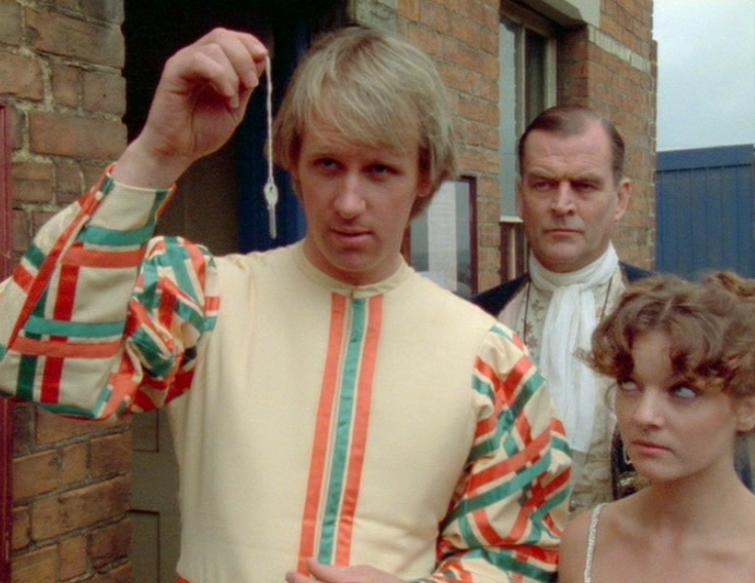
4) There’s definitely something to be said about a serial with location shooting.  No generic rock quarries or stark landscapes here; the lush forests and seemingly authentic architecture contribute to the veracity of this story, making it work all the more.

5) Wow....for a so-called ‘beautiful’ android, that playing-card looking thing is seriously goofy.  It’s much more effective when it’s wearing the Grim Reaper disguise, and even then the hints of its soccer goalie gloves takes the drama out of it.

6) I always felt the Terrileptils should’ve been used more.  In this serial (their only appearance) they prove to be a compelling and scary opponent for the Doctor.  I’ve always wondered if the cumbersome suit with its limited animatronics hurt the creature in their popularity.

7) This was Saward’s first script for the show, a script he sold before he became script editor.  And even in this early script we can see a lot of the weaknesses in Saward as a writer, especially his bloodthirstiness.  The scenes of the Terrileptil’s bodies being consumed by the fire (including what I presume to be their eyes blowing up and bursting) is a gruesome sign of things to come.
"Raaawr!  I's a crap android monsta!"

8) I wonder if everyone--save Matthew Waterhouse--knew Adric’s time was up.  There are some lines in a conversation with Nyssa that sounds an awful lot like foreshadowing.

9) Is it just me, or are these some of the lamer cliffhangers in a long while?  I mean, Nyssa gets upset because the Doctor walks through a holographic wall?

10) So let me get this straight--the Terrileptils are all refugees from a prison planet where the environment is so nasty that they are horribly scarred....and yet the other two Terrileptils seem rather pristine.  Okay, granted the budget couldn’t afford three animatronic suits, but couldn’t special effects guys mess up their face, or lose them a thumb or something?

Overall...even with some of the silly bits (Go away, playing card android), this is a well-done basic Who episode that triumphs thanks to atmosphere, effective enemies and one of the stand out temp companions of all time.

Saturday, June 14, 2014

Ten Statements About....DOCTOR WHO STORY ONE HUNDRED NINETEEN: KINDA (1982)

Sleeping Tegan....the best Tegan of all.
“Are you an idiot?"
“Well, I suppose I must be."

1) If this story seems atypical of this first season supervised by new script editor Eric Saward, you’re right; it was originally commissioned by Christopher H. Bidmead during his short tenure as Script Editor.  Bidmead encouraged writers to do deep, complex stories and Saward....didn’t.  This results in a muddled serial that seems at odds with the themes it wants to explore.

2) Go away, stupid paper mache’ snake.  Just...go away.

3) I get that John Nathan Turner intended for the Davison Doctor to be somewhat vulnerable...but ye gods, Davison frequently looks ridiculous.  When the first glimpse of him in this serial depicts him clutching two cables in his teeth as if he just found a fish in the river, it makes it hard to take this Doctor seriously.
"Rahhhr!  I's a scaaary Paper Mache Snake!"

4) You know, when you’re so burdened with companions that you let two of them literally sleep the bulk of the story away, assigning the Doctor another companion specific to the story seems silly....

5) ...although this is in no way a critique of either Nerys Hughes or her character.  Hughes’ character works very well with Davison’s Doctor (Hell, I’d take her over Tegan any day), and provides a vital, subtle contrast to the rather vigorous acting of the other supporting players.

6) You can see one of the reasons why Adric ended up the sacrificial lamb this season.  This marks the second time in a row where the little snot somehow throws himself in with the enemy, and as such Adric comes off as an unreliable companion at best (something Nathan Turner will try even more ovetly when he introduces Turlough later).  Hell, we’ve got a moment where Adric turns, and The Doctor literally sighs and rolls his eyes!

7)  Is it just me, or is that subplot about the missing three crew members forgotten about halfway through?

8) One of the things I like about Richard Todd’s performance as Saunders is how the man we meet at the start is a bit of a perjudiced jerk...but the person he becomes after exposure to the Kinda is very much there.  Saunders is consistently the same person throughout this serial; it’s just he sees things from different perspectives in different points in the serial.
This is what real evil looks like...

9) I will never understand why we need Stupid Paper Mache Snake when there’s a much more effective manifestation of The Mara in Jeffrey Stewart’s Dukkha.  Dressed as some sort of courtly gentleman from a Shakespeare play, charismatic but malevolent, Stewart drives the scenes where the Mara communicates with Tegan resulting in her possession.

10) Christopher Bailey’s script features a lot of fascinating concepts in regards to the titular Kinda (At least until Saward muddies Bailey's Bhuddist leanings with a slew of Christian stuff)--their belief that speech is a sign of wisdom, their telepathy, their cultural mores, their use of humor as a negotiation tool--but it’s very difficult to take them seriously when they’re all played by British actors with a slight spray on tan and some hawkish features.

Overall...potentially an intriguing multilayered story that’s hindered by some script meddling and a thoroughly stupid set of special effects (not to mention that paper mache snake.  Go away, paper mache snake).

Saturday, September 7, 2013

Ten Statements About....DOCTOR WHO STORY ONE HUNDRED AND EIGHTEEN: FOUR TO DOOMSDAY (1982)

Yes, it is the Doctor about to pitch a cricket ball in space...
and that moment is one of the least stupid in this serial.
“We’ve got to get to Earth and warn them!”
“Or what?  Who’ll believe us?  We’ll be laughed at!”

1) This was the first serial Davison and crew shot for the 19th Season and It.  Is.  Horrifically Bad.  And I don’t think its horrific nature can be attributed to the four principals (well, three of the four; Matthew Waterhouse’s been doing this for long enough that there’s no excuse for him to be awful) trying to get into their characters.

2) I suppose I should be grateful that Nyssa gets a couple of things to do--to the point where you can almost see why Davison wanted it to be just her as companion--and that’s she’s the least risible of the quartet.  But even Sarah Sutton has her moments of overacting badness, which only contributes to the heavy fog of terribleness that just pervades the entire story.

3) Boy, when the crew starts to refer to the Urbankins as ‘frogs,’you never again can get past the fact that these are not-very-good actors in not-very-good masks and awful robes.  Even Stratford John, who is a decent actor who tries to infuse his character of main baddie Monarch with a degree of charm, can’t overcome the unwieldiness of the big ol’ sparkly green mufti.

4) The biggest problem with this story is that is smacks strongly of Making It Up As You Go Along.  There is no forward coherence as to the scheme, and the ultimate reason behind Monarch’s actions (and the final twist regarding his nature) smacks of a spur of the moment decision.  That sense of the production staff having no idea where they’re going just sinks the serial something fierce.
"Well, the Greek Guy is your Exposition News Network
reporter...the rest of us?  Damned if we know..."

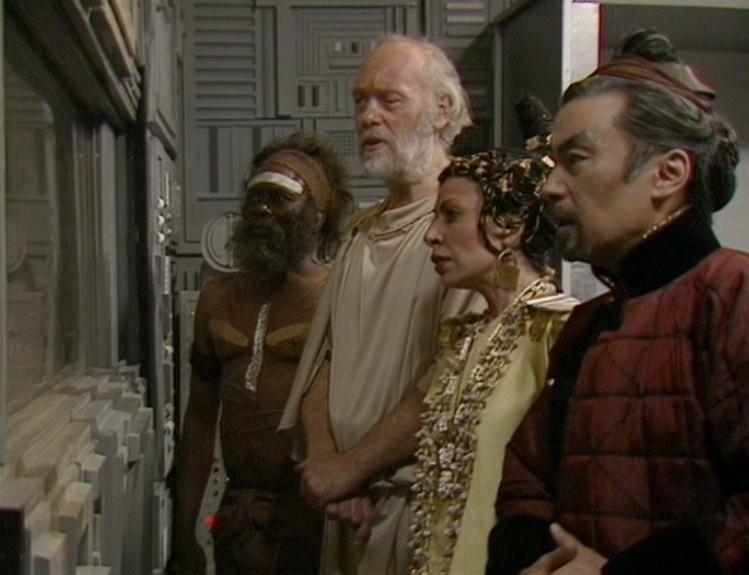
5) The four ethnic types and their coterie....what purpose do they really serve?  I don’t think the script ever gives a true rationale as to why Monarch has been gathering these people up with each subsequent trip to Earth, and save for some expository dumpage from Philip Locke’s Bigon, they pretty much do nothing but provide some, ummm, local color and stretch out the paper thin plot so that it’ll somehow fit into four episodes.

6) And speaking of stretching the plot...how much of the serial’s running time is made up of those ‘recreations’?  It seems like a third of the story’s running time is spent watching the repetitive performances.  And I still don’t understand why the final explosion where all four presentations just go off at the same time.  If that whole aspect of the story wasn’t an argument for the ultimate switching to a three-episode serial structure Nathan Turner used at the end of his tenure, I don’t know what is.

I'd look like this, too, if I was stuck in this serial.
7) So, ummm....the only reason The Doctor susses out Monarch’s real nature, which leads to his vanquishing of the froggy villian, is because his thoughts on time travel are stupid?

Words. Fail. Me.

8) I honestly don’t know who’s worse--Adric with his gullible super-earnestness, falling in with Monarch....because that's Adric's move at this point, or the overtly hysterical Tegan.  I personally waver towards Tegan, simply because of the way her screaming and stomping about not only goes thoroughly over the top, but it actually drags Davison’s performance down at moments (the exchange cited above is ludicrous in the way Davison’s voice actually cracks at an inopportune time).  Even at this early stage, you can see how the ‘Kindergarten TARDIS’ concept simply wasn’t going to work.
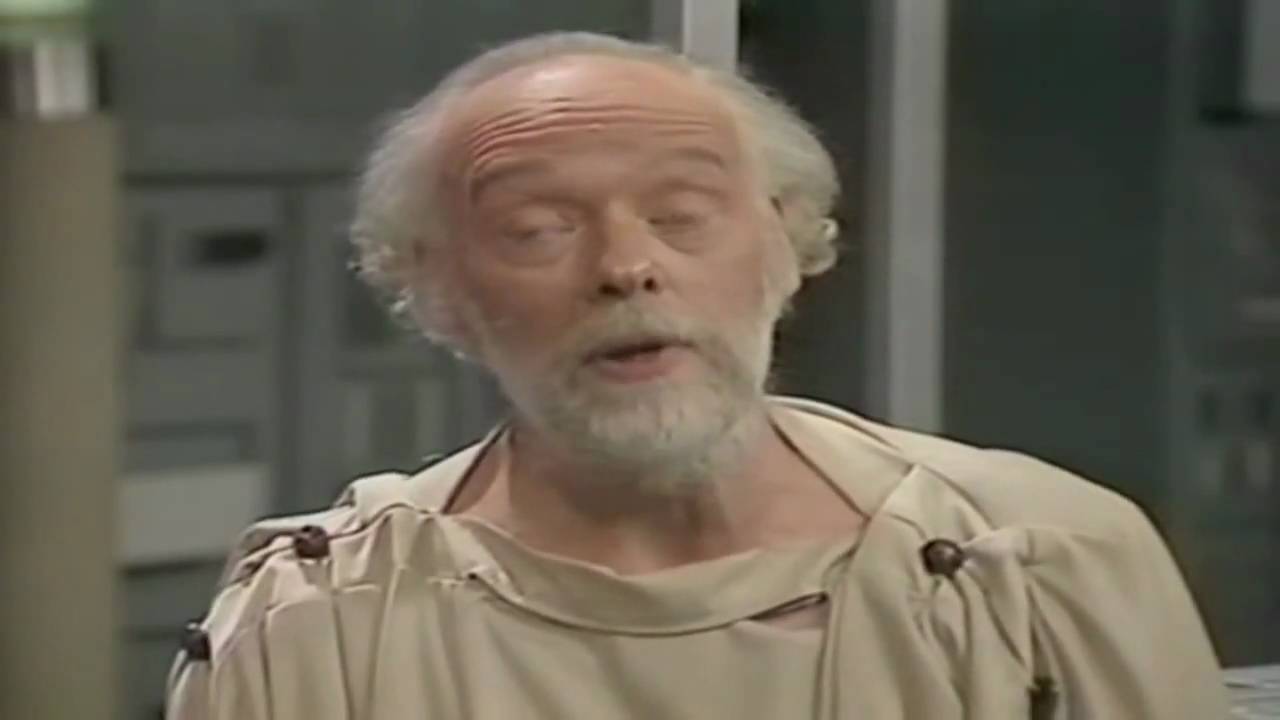
GEORGE CARLIN???

9) Okay, I’ll give the serial this much--I rather liked some of the tech on display.  For some reason, I really responded to the simplicity of the oxygen helmet, which has a quaint retro look to them.

10) I think we can safely put the cliffhanger of Episode One in amongst the Lamest Cliffhanger Of All Time.  Having an alien frog show up as a severe looking woman in the dress Tegan sketched out, and having Tegan be creeped out by it is not fascinating viewing.

Overall...Ugh.  Just...ugh.  It’s not the worst Davison serial.  It’s not the worst Davison serial this season.  But it’s still rotten and stinking of cheese.

Saturday, August 3, 2013

Ten Statements About....DOCTOR WHO STORY ONE HUNDRED AND SEVENTEEN: CASTROVALVA (1982)

Doctor In A Box!
“That's the trouble with regeneration: you never quite know what you're going to get.”

1) And here we formally begin the Peter Davison era with this final leg of the introduction of the Master--and it’s indicative of the Davison era in how it feels like two separate stories welded together, seems to be truly stretched out and features some moments where the TARDIS Crew seems...ineffectual.  And yet there are large swatches of the serial that works and works well.

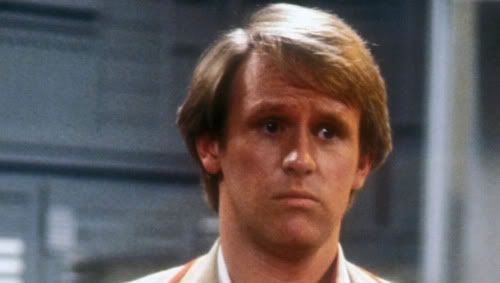
2) This is, of course, Davison’s first full serial as the Doctor and let’s give him credit--he gives it his all, especially during the first half’s failing regeneration.  I appreciate how Davison works hard to give all the shout-outs to previous Doctors some weight even when it’s obvious they were shoehorned in as a game of Husker-Du.  He’s going to struggle throughout his three years to find out what his Doctor is like (something that’s not entirely his fault), but even here there are glimmers of what could make him unique.

3) Maybe it’s because Adric is more or less credibly out of the picture (although he’s in the picture in another sense), but this serial actually, you know, gives Nyssa a lot to do.  Even though Davison assigns to Tegan the role of ‘Administrator,’ Nyssa pretty much is in control of things.  She’s the one who keeps the team together, she’s the one who figures things out, and she’s the one that’s key in doing lots of the science-y stuff.  Granted, after this she falls asleep for a serial, and...well, not all that much after that.  As someone who (like Davison) felt Nyssa was the best of the three companions, it’s a little heartening.

4) Look, I get that the Nathan Turner conception of the Master is that he’s always in disguise manipulating things from behind the scenes...but Ye Gods, how come no one figures out which one of the Castrovalvas is him?  Putting powder in your hair and stooping over does not make an effective disguise.
"You're not fooling me, Anthony.  You look like an old
queen."

5) Of the two parts, I vastly prefer the first part, where our companion corps have to work out how to stop falling into (what will become) the sun.  There’s a definite sense of urgency and pace that seems to dissipate once they reach Castrovalva.  That being said, I do very much appreciate how Bidmead is able to make the first half significant to the second, setting up factors that will dominate once everyone gets to the titular area.

6) Watching it now, I’m sort of puzzled by all that’s made of how sinister Derek Waring’s Shardovan is in the third and part of the fourth chapter.  It’s almost as if they want him to be a red herring, but they try too hard, from dressing him in black unlike the other Castrovalvans, having him look on in an enigmatic way, at one point interposing himself between the escaping crew and pretty much glaring, etc.  If the intent was to throw us off the scent of the Master, it fails because it’s trying too hard....

7) But then, this might be why the serial seems so disjointed throughout; in trying to establish how different the first Doctor he has complete stewardship of is, Nathan Turner seems to overcompensate...which is weird, given how so much of Nathan Turner’s last Baker season was built on simply good stories and not on the deck-chair-changing exercises.  But then, last season was story edited by this story’s writer, Christopher H. Bidmead, while this season (and so many others after it) was edited by...grumblemutter...Eric Saward.

You will learn much of my dislike of Mr. Eric Saward and his dumb-ass Buster Brown haircut in the coming months.

8) I do like the design of Castrovalva, which--like the serial--was inspired by Bidmead’s interest in M.C. Escher.  I like the way he furthermore extrapolates on Escher’s design asesthetic to create a trap for The Doctor.  However, the effectiveness of 1982 special effects does blunt the impact of the trap being sprung at the end of the third chapter.
There are some who would say being trapped in an abstract
web was the best use of Matthew Waterhouse's time...

9) I have to be honest--I’m still a little hazy as to the nature of the Castrovalvans.  If we accept what the Master says about them as gospel (and I see no reason why we shouldn’t, given that The Doctor and Nyssa pretty much confirm the fact), then the Castrovalvans’ ultimate fate doesn’t quite make sense.  It makes for cool visuals, but...no sense.

10)  Even this early in the Ainley Master’s career, the man is beginning to degrade into the cackling goofball that he becomes toward the end of the classic era.  There’s some moments in particular, like when he’s gloating about creating traps within traps, where he seems to get too pantomime-y and disrupts what Nathan Turner is trying to do with his quieter, more human Doctor.

Overall...even though it has its shaky moments, this is still a good serial, and a decent ending to the ‘Return of The Master’ trilogy.

But enjoy this good story while you can, because a lot of what follows....ugh.

Wednesday, July 10, 2013

Ten Statements About....DOCTOR WHO STORY ONE HUNDRED AND SIXTEEN: LOGOPOLIS (1980)

Now that he's established, this Master gets to
being truly, seriously scary....
“Logopolis is not the universe."
“But it is. Logopolis is the keystone. If you destroy Logopolis, you unravel the whole causal nexus.”

1) There is no doubt, right from the first part of this serial, that Janet Fielding’s Tegan Jovanka is going dominate the companion screen time....and given the abrasiveness and bossiness of the character (it’s not for nothing that at one point during her tenure she’s referred to as ‘a mouth on legs’), this does not bode well for the tenure of incoming Doctor Peter Davision.

2) And the fact that Nathan Turner has fallen in love with Tegan results in his impulse add of Sarah Sutton’s Nyssa becoming inconsequential.  Nyssa just appears out of nowhere in the second part of the story, and seems to be there solely so The Master can have someone to use that weird arm-controlling device in part three.  Admittedly, there is an attempt to bind her together thematically with the other companions when her planet is destroyed (a moment where Sutton shines), but the fact that she’s there Just Because is glaring.

3) Christopher H. Bidmead’s script is typical in its hard science concepts, especially when it comes to Logopolis itself.  The moment the TARDIS lands on this planet and we start to unravel the mystery and purpose behind it, the serial never lets up.  And Bidmead trusts us enough as an audience to grasp these principles without talking down or stopping everything to explain what’s going on.  That allows for the story to flow evenly and allow us to concentrate on the characters and what’s happening to them.
"Free at last, free at last!"

4) This is the first full serial that reveals Anthony Ainley’s Master to the world, and man is he pretty damn scary!  Even though he’s saddled with that odd outfit with the black frock coat and ornate silver collar that made me refer to it as ‘the gay pirate’ uniform, Ainley creates a very malevolent and--more importantly--opportunistic figure who thinks nothing of taking advantage of a serious situation he caused by accident to blackmail the entire universe.

5) I have to wonder why Bidmead allows the whole sequence concerning the nesting Tardisi, as it really doesn’t pay off much save for watching Tegan wander around and around the Tardis looking for an exit.  This is something we’ll see a number of times throughout the Peter Davison series, where there seems to be two separate and unconnected acts that run through the serial.

6) The Watcher...I am of two minds about this aspect of the story.  It’s certainly a fairly shaky justification for a regeneration, and the Watcher is an even shakier device for it to happen.  That being said, I give both Bidmead and Nathan-Turner credit for trying to make the whole regeneration epic.  It doesn’t work (the Davison-to-Colin-Baker regeneration works a whole lot better, primarily because the moment is treated as more intimate), but at least it’s there.

7) Maybe it’s because he’s finally getting his pass out of the series, but Tom Baker is surprisingly subdued and effective in the serial.  There’s a sense of him being aware of his own impending doom (the way he keeps trying to pass off Adric and, later, the girls, off on others seems to emphasize this) and trying hard to keep it together.  Plus he shows absolute contempt for the Master.  There’s that moment at the end of episode where the Master offers his hand to cement an alliance; Baker looks away before shaking his enemy’s hand that speaks volumes about his distaste for the deal.
"Mark my words...one of you is going to have to go..."

8) John Fraser’s performance as The Monitor is rather intriguing.  There’s a certain sense of, well, modest immodesty to his actions, and the way he rarely speaks in anything other than  conversational tones makes the few moments when he does lose his self-control all the more effective...especially the moment where we learn the true secret of Logopolis.

9) Maybe it’s because the series had been under the influence of Baker for several years, or maybe it’s because of the inexperience of two of the main actors involved in the serial--namely Matthew Waterhouse and Janet Fielding--there’s a level of pantomiminess that serves to make the flow of the serial out of kilter.  The broadness of the reactions in Fielding’s case are particularly jarring.

10) I appreciate the use of the Pharos Project; it dovetails nicely with Bidmead’s mathematics theme, I assume it allowed the budget to stretch so that this serial looks a little cooler than it could have...but I think that the final part is a little too full of everybody running around the grounds, all hunched over in the hopes of not being seen.  This, coupled with the whole ‘nesting Tardisii’ things give the serial a sense of being overinflated.

Overall...Yes, it’s flawed.  Yes, it could be more tightly plotted.  Yes, it suffers from companion-itis.  But it’s got a wonderful nugget of a premise that is very hard science fiction with some excellent performances by Baker and Ainley.  This is absolutely essential viewing.