Showing posts with label Peter Jeffreys. Show all posts

Sunday, November 18, 2012

Ten Statements About....DOCTOR WHO STORY ONE HUNDRED AND ONE: THE ANDROIDS OF TARA (1978)

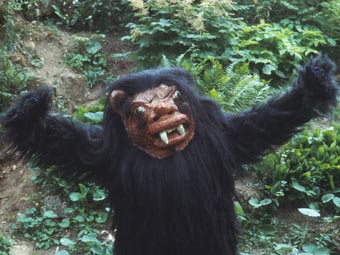
When I Googled images for 'Androids Of Tara', this is the
first thing that came up...Sigh...
"You can't trust androids, you know."
"That's funny, you know. That's what some androids say about people."


1) I think it's indicative of the Graham Williams era that one of its greatest serials is one which pretty much slavishly follows The Prisoner of Zenda, only with science fiction trappings like androids interposed within it. Hell, when one of your major actors seems to have been cast solely because of his resemblance to Ronald Coleman is uncanny and The Doctor tells another character that their plan has been done before...well, they're not even bothering to hide it.

2) But one of the reasons this story works so well is the way writer David Fisher finds a way to make the android tech critical to the story. There are certain ways that the plot would not work in this iteration without the presence of androids. And because we accept the use of android tech, the other weird tech aspects--like the electronic crossbows and swords--make a lot more sense

3) A large portion of why this serial is so much fun lies in the performance of Peter Jeffreys as Count Grendel. Especially given the pastiche nature of this episode, there was a need for a larger than life villain, and Jeffreys takes the opportunity to breathe life into a charming cad like the Count. And more importantly, Grendel is smart. He's never made to look the fool by the Doctor--something that will become a problem as we get deeper into Williams' reign--and bases his strategies on logic and a love of cunning. He's so fun that when he's allowed to escape, you almost wish they found a way to bring the Count back.

4) I find it really refreshing that Fischer gets rid of the whole Key To Time aspect of the story within the first ten minutes so he can then dive into the silliness and craziness of the actual tale. Yes, there are moment when the Key fragment becomes the focus of the scene, but usually it's there only to tell us more about the character who's bringing it up, as in the moment where we learn just how intelligent Lois Baxter's Madame Lamia really is.
"I am going to ask you to take your hand off my ass politely..."

5) I think I've mentioned how much I enjoyed it whenever Tom Baker took up a sword and got all Erroll Flynn, right? Well, this is manna for me, as Baker gets to ride a horse, and engages in a climatic sword fight with Jeffreys that is really cool.

6) Since I mentioned her before, I rather liked the way Lois Baxter found a way to infuse Madame Lamia with more nuance than she really needed. One gets the sense that Lamia is clever, maybe even more clever than Grendel, but allows herself to be used due to a combination of Tara's caste system and her own feelings for the Count. It's a pity that she's written out about halfway through the tale, because some of her interactions with the Count and Romana are pretty cool.

7) This is arguably the last time we'll see the Mary Tamm version of Romana being, well, a useful and willful counterpoint to the Baker Doctor. She's the one who sticks to the mission of finding the Key fragment, after all. But there's this tendency to the 'wailing frail' archetype, as she gets kidnapped not once, but twice, and struggles to ride a horse that's a sign of things to come. Hell, when we finally meet her in her dual role as The Princess Strella, we're rather struck by how much more proactive she's in.
"The pellet with the poison is in the vessel with
the pestle--the Hell you say!"

8) God, that freaking pig-midget monster thing. Thankfully, unlike the Shrivenzale of the first Key To Time story,it's only used once and glimpsed very briefly...but it still is an embarassment that points out the chintziness of the show's production at this time.

9) I do wonder if the story wouldn't have been more effective if the serial at the very least moved away from the very Zenda-esque trappings we see here. Because the costuming and sets are all reminiscent of that Ronald Coleman classic, we're constantly reminded of the source material. It's made even more peculiar given the rather fetching outfit Romana produces as 'what all the fashionable Tarans are wearing this year,' which looks nothing like the very Edwardian fashions we see on display here.

10) Even though Williams is very much enamored of K-9--hell, the little monster originated under his reign--it's interesting how they're already finding way to write it out for key scenes. While we do get a lot of K-9 making things easy for Baker, the climax literally dumps him in a boat in the middle of the moat...and it's just an echo of things to come once John Nathan-Turner takes over.

Overall...one of the better stories in the Graham Williams era in spite of its slavishly following the playbook of a classic film.

Wednesday, March 21, 2012

Ten Statements About....THE ABOMINABLE DOCTOR PHIBES (1971)

He says more with body language and a look than some horror
actors can say with everything in their arsenal.
"Nine killed you. Nine shall die. Nine eternities in doom."

1) You want proof that Vincent Price is a true actor and not the hammy caricature most people think he is? In this movie, Price manages to emote in subtle and meaningful ways while being robbed of both his face and, for the bulk of the story's ninety-eight minute run, his voice. It's truly one of his greatest performances.

2) And even though it wasn't written by Robert Fuest (although Fuest did do a slight rewrite to tone down the supposedly grotesquely violent nature of James Whiton and William Goldstein's original script), this film is his baby. There's a look and feel of the movie that can be seen as a direct connection between it and the television series where Fuest made his bones, The Avengers.

3) ...so much so, that you can almost see the bad Doctor and his assistant, Vulnavia, as the evil mirror universe version of Steed and Peel. Each has their own stylistic stamp that makes them instantly recognizable, each shows an appreciation of finer things, and most importantly, each goes to some wild extremes in carrying out their purpose in life.

Perfection in woman-as-villian....thy name is Virginia North.
....sigh....
4) Virginia North may not be the most beautiful woman in the world--an argument could certainly be made that Vallie Kemp, who replaced her in the sequel, is a much more attractive gal--but she is without a doubt overpoweringly sexy in her role as Vulnavia. She's got a certain Grecian beauty, which coupled with her body language, makes her the perfect female assistant for any up-and-coming criminal madman. Hell, she manages to commit the usually unforgivable sin of breaking the fourth wall without distracting the audience from the story as a whole.

If I ever become an evil mastermind, I want Virginia North as my assistant.

5) My best friend Derrick pointed this out to me--the true hero of this film isn't Joseph Cotton's Vesalius, but Peter Jeffreys' excellent Inspector Trout. Trout is an exceptionally clever character--smart and capable of real cool deductions, but hampered almost entirely by people around him who look upon him as a simple blue-collar noob. It's his collaboration with Vesalius that drives the film's plot forward, and you definitely get the sense that if it wasn't for the classism of the people around him, he may very well have stopped Phibes.

6) You know something else I love about this film? I love how this could almost be looked upon as a musical. There are a number of cool sequences which are just Phibes playing with his clockwork band, or Vulnavia taking a break from cleaning up to listen to some music, or (my favorite) a victim having his neck crushed to powder by a gimmicked frog mask while Paul Frees sings 'Darktown Strutters Ball'. Hell, even the destruction of the mansion puts Vulnavia's swinging an axe every which way to jaunty jazz.

7) And while we're on the subject of Vulnavia, this film features one of the few times I can accept a 'Just Go With It' moment. We have literally no idea who she is, why she doesn't speak, and why she is so devoted to Phibes. But because so much else is explained so elegantly, and there's enough time between Phibes' supposed death and his ramapge, that we can accept her presence without knowing her backstory.

8) One of the true, small joys of this film is how even the smallest character is given little grace notes that lifts them up from being just a cardboard place setter of a character. Of the smaller parts, I'm rather partial to Aubrey Woods' fussy, prissy Goldsmith, but even someone like John Franklyn's Graveyard Attendant gets a pinch of flavoring. Hell, we even get a sense of Victoria (my beloved Caroline Munro) as a character even though she's primarily seen only in a series of snapshots.
Yep...I've stared at photos of Caroline Muro for hours as well...

9) Even though they don't get into it, I like how there's a definite resonance between Phibes and Vesalius--I have to assume that, like Phibes, Vesalius is widowed, and to an extent his son assists him in cracking the case (pointing him toward the music seller) the same way Vulnavia assists Phibes. Vesalius is a great opponent because he is Phibes, ummm, light mirror that reflects and informs our fiend's madness.

10) And the greatest thing about this film? Unlike similar movies of this type, where we're asked to sympathize with the villain, then turn around and root against him for the climax, Phibes gets away with it. He triumphs, giving our heroes the slip by using the Tenth Plague of The Pharoahs on himself...a trick he always planned.

Overall...I love this movie. It's one of my favorite films, period, and can be seen as one of the bridges between the 'classic' horror movies to the slasher films of the 70's and beyond. A great showcase for Price and Fuest, it is absolutely essential viewing for anyone interested in this period of scare flicks.