Showing posts with label Wendy Padbury. Show all posts

Wednesday, July 24, 2013

Ten Statements About....THE BLOOD ON SATAN’S CLAW (1971)

Ladies and gentleman...the Hot Face Of Evil!
"You must have patience, even while people die. Only thus can the whole evil be destroyed. You must let it grow."

1) The thing I find the most fascinating about this picture is how it’s dominated by Patrick Wymark’s Judge and Linda Hayden’s Angel Blake--and yet both actors only appear sporadically, especially Wymark.  It’s to the credit of these two actors that they manage to cast a shadow over the story even when they’re nowhere to be seen.

2) The film also greatly benefits from being shot on location using mostly natural lighting.  There is a definite sense of veracity to this small town, which makes the strange and disturbing things that happen all the more creepy.

3) God is Linda Hayden gorgeous.  And while I still think she is while she’s wearing that ridiculous sheet and the black crepe-ish eyebrows in the third act, her Angel Blake is a tutorial in how to be seductively evil.  There are moments when director Piers Haggard just focuses ever-so-briefly on Angel, and the way she’s staring, or the way her lips just curls gently into a smile, speaks volumes about the darkness in her heart.
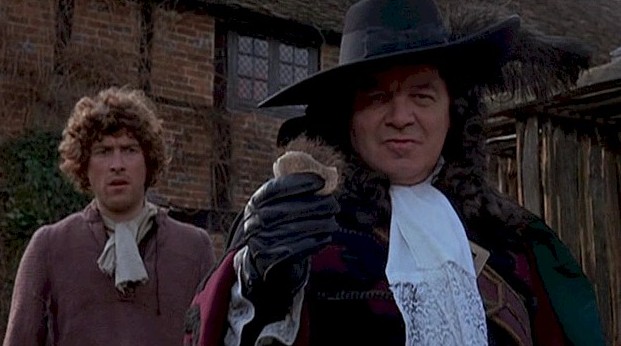
"Verily, this cookie has gone bad..."

4) Apparently, this script was written as three shorter films set in three different time periods before Haggard insisted on them being integrated into one story...and you know, that integration works to heighten the sense of this small rural town in Jacobean England falling into utter chaos.

5) One of the reasons I love films from this period of British cinema is how they’re populated by these amazing character actors that bring life even to their briefest scenes.  I was particularly taken with Howard Goorney’s unnamed Doctor and Anthony Ainley’s naturalist Reverend Fallowfield, who bring a little nuance to their every moment on screen.

6) Perhaps the thing that I find so disturbing about the events in the film is how it’s almost entirely caused by a group of kids who seem to think they’re playing.  And to make things even worse, Haggard adds these two old people in amongst the kids, laughing and smiling in encouragement that adds a whole layer of unsettlement to the proceedings.

7) According to Haggard, the centerpiece of this film--the ritual (incestuous, necrophiliac) rape and murder of Wendy Padbury’s Cathy, was improvised on the day.  If that’s the case, it’s a magnificent piece of on-the-spot filmmaking. It’s truly scary for the way Haggard seems to play with our expectations, leading us to imagine all sorts of fates for Cathy...until we see what Angel has in store for the hapless young girl and we realize it’s much, much worse.

8) The greatest unsung hero in making this film so great is composer Mark Wilkinson, whose weird, woodwinds-intensive score that tweets and twitters like the crows that serve as one of the movie’s motifs.  The way it seems to insinuate itself quietly, commenting on the events as they grow more and more out of control, contributes to the overall sense of unease in the story.
"Collect All My Parts And I Will Be....A MONSTA!!!"

9) Okay...that freakin’ paper mache’ devil.  What the.....?  In a film that so skillfully creates mood and atmosphere and maintains such a creepy feel, the goofy looking demon hoping around just kills a lot of said atmosphere.

10) And while we’re on the subject, while I don’t think it has the buzz-kill aspect of paper mache’ devil, I find it amusing that The Judge warns people he will use unimaginable methods to kill the evil, and ‘unimaginable methods’ apparently equals a big honking sword, two mean dogs, and that deaf mute guy who got thrown off the roof in The Spy Who Loved Me.

Overall...a really amazing little horror film that manages to create a disturbing atmosphere throughout.  One of the great jewels in the crown of Tigon’s career, and a shame that it’s not available on DVD or Blu-Ray in the United States.

Friday, March 2, 2012

Ten Statements About....DOCTOR WHO STORY FORTY-FIVE: THE MIND ROBBER (1968)

"Ahhhh, there's an actor who isn't my pal Frazier...."
"When somebody writes about an incident after it happens, that is history. But when the writing comes first, that's fiction. If we had fallen into the Master's trap, we would have become fiction."

1) I know this was a scripted serial--hell, they talk at length with writer Peter Ling in the documentary accompanying the story on the DVD--but one of the things I like about this tale is how the whole thing feels on some level improvised. Granted, part of that is because the producers had to add an extra episode (the first) onto it with literally no budget, but even when we're deep in the scripted portion, that feeling of organicness remains.

2) Another thing I liked? For the bulk of the first three episodes, the Troughton Doctor is off-balance. He literally doesn't know how to manipulate this situation to his own advantage, and seems extremely lost and panicky at times. And I like seeing Troughton dithering and knowing it's not The Doctor putting on an act.

3) It's so strange hearing this version of The Doctor talking about a villain called The Master. I know Emrys Jones' character isn't that Master (calm down, Michael!), but still.....

4) Even though there is some tiny lip service made to an alien race using this Land of Fiction outside of the space/time continuum, this is arguably the closest the classic series ever gets to pure fantasy...and once again, we get some really clever ways of working around a budget. The way the production staff conveys the idea of Jamie standing on top of a forest made of adages, for example, is quite clever.
"You don't think it doesn't take hours of effort and work to
make my hair look like a Stooge's?"

5) ...and speaking of Jamie, this is the serial where Frazier Hines' illness prompts him to be replaced for an episode by Hamish Wilson. And while Mr. Wilson's work is good, his presence really emphasizes how great Hines was as a companion. The chemistry Hines has with both The Doctor and Zoe is just outstading.

6) Zoe...Wendy Padbury is a definite improvement over Deborah Watling. Unlike the screaming machine that Victoria became, Zoe seems to have a real place in the crew. I particularly like the way The Doctor will treat her like a peer when it came to piloting the Tardis.

And that cliffhanger to episode one....ummmmmm, yeah. Good way to point out that Padbury is not a young girl while making us fans uncomfortable. If you've ever seen this, you know what I mean.

7) Given that this serial apparently had almost no budget whatsoever to work with, I was rather impressed with how some of the crazier mythological beasts came off. The unicorn that serves as the cliffhanger for Episode Two is really cool and convincing, and the way the crew works out the minotaur utilizing shadows, sound effects, and a very, very, very brief shot of a minotaur head works...but then you get that really bizarre, almost impressionistic version of the Medusa with the stop-motion snakes that's just shoddy. No amount of Zoe screaming that this gorgon is real convinced me at all.
"Girl....you'll be a woman....soon."
(And all over England, adolescent boys suddenly realize
they....are MEN!)

8) I rather like some of the featured fictional characters, particularly Christine Pirie's Rapunzel. The way she seems so casually resigned to having people climb up her hair is hilarious.

9) I have to give Emrys Jones credit--he makes the constant switching from a befuddled lil' writer to the spokesvoice for the strange alien race that's intending to drag humanity into the World of Fiction so they can inhabit Earth work. The way director David Maloney leads us to believe the Master is a very sinister figure only to have him be this gentle, sad man is pretty well done.

10) As creative as this serial is, and given how much is thrown onto the screen, the shorter episode lengths (they last from eighteen to twenty-one minutes in length, as opposed to the standard twenty-four) is noticable. Instead of making the serial seem more faster paced, it makes the narrative flow come off as fractured and disjointed. The final episode in particular edges toward the nonsensical.

Overall...another one of the classic series' forays into surrealism, this one is head and shoulders above the previous attempt at something unique, the Hartnell serial The Web Planet, and is probably the best example until we hit the McCoy serial Ghost Light at the end of the classic run. A curiosity, but one worth watching if you're interested in seeing just how out there some production staffs were willing to go.